
If you need help, learn more about our Arbitration.
You’re in the middle of a dispute.
Maybe a contractor walked off the job halfway through. Maybe a business partner broke an agreement. Maybe an employer treated you unfairly.
You’re frustrated, you want justice - and then someone asks:
“Do you want to arbitrate, mediate, or go to court?”
If you don’t already know the difference, that question can feel like a second problem layered on top of the first.
Choose the wrong path, and your case could drag on for years, cost far more than it has to, or even end with a result you’re stuck with - no appeal, no second chances.
These aren’t just labels - they’re strategies. Each one changes who’s in control, how much you can say, what evidence is used, and whether you walk away satisfied or frustrated.
This guide isn’t just definitions - it’s about making sure you choose the process that serves you best when the stakes feel personal and the clock is ticking.
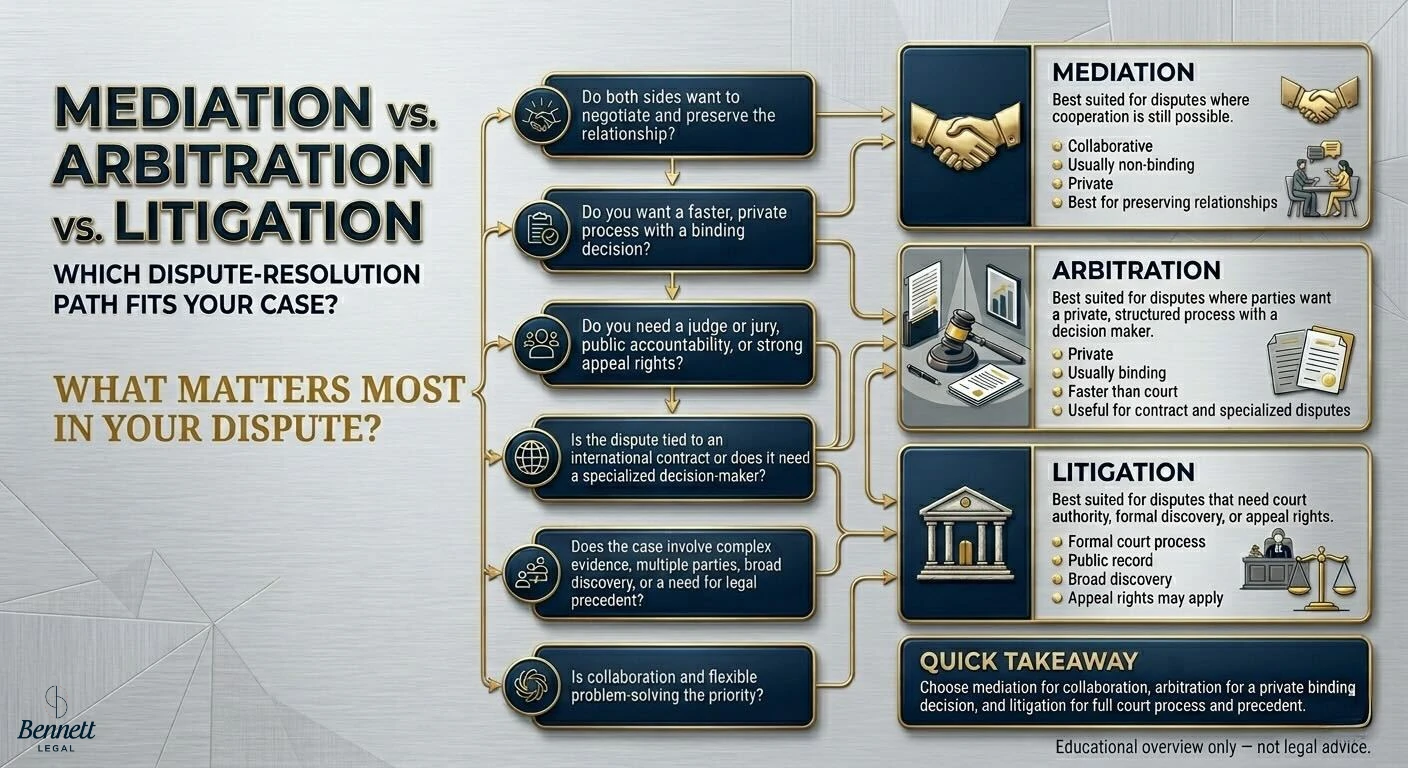
Definitions: Arbitration, Mediation, Litigation
Arbitration
Arbitration is a private dispute resolution process where a neutral third party - the arbitrator - hears evidence from both sides and issues a decision, known as an award. That decision can be binding or non‑binding, depending on what’s agreed in advance, but most commercial arbitration is binding and enforceable like a court judgment. Learn more about how to prepare for a deposition.

It typically follows a more flexible procedure than litigation, and hearings are conducted outside of the courtroom.
Example: Two businesses in a supplier–retailer dispute choose arbitration to save time and keep sensitive financial details out of public court records.
Pros:
- Faster resolution compared to court in many cases.
- Confidential - proceedings are not public record.
- Greater flexibility in scheduling and structuring the process.
- Arbitrators can be chosen for specialized knowledge in the dispute’s subject matter.
Cons:
- Limited right to appeal in binding arbitration.
- May still be expensive in complex cases.
- Risk of arbitrator bias if selection process isn’t balanced.
- Decision control rests entirely with the arbitrator, not the parties.
Mediation
Mediation is a voluntary process where a neutral mediator helps the parties negotiate a mutually acceptable resolution. Unlike an arbitrator or judge, the mediator doesn’t make decisions or impose solutions - control stays with the parties. Mediation is designed to encourage communication, preserve relationships, and allow creative solutions that a court or arbitrator might not be able to order.
Example: Neighbors in a property boundary disagreement use mediation to agree on a new fence line, avoiding court entirely.
Pros:
- Parties retain complete control over the outcome.
- Often faster and less expensive than arbitration or litigation.
- Helps preserve ongoing business or personal relationships.
- Flexible - solutions can go beyond legal remedies.
Cons:
- No guaranteed resolution; depends on cooperation.
- Outcome is not automatically enforceable - must be formalized into an agreement.
- Ineffective if one party is unwilling to negotiate in good faith.
Litigation
Litigation is the formal process of resolving disputes through the court system, overseen by a judge and, in some cases, a jury. It follows strict rules of evidence and procedure, and decisions are binding, enforceable, and appealable. Litigation creates public record and, in many cases, legal precedent that shapes future cases.

Example: An employee pursuing a workplace discrimination claim files in court to seek a public judgment and establish precedent for similar cases.
Pros:
- Binding, enforceable results with full appeal rights.
- Access to the court’s power to compel evidence and witness testimony.
- Ability to create public precedent for broader legal impact.
- Strong enforcement mechanisms once judgment is entered.
Cons:
- Often the longest and most expensive path to resolution.
- Public process - filings and outcomes are on record.
- Can permanently damage relationships due to the adversarial nature.
- Rigid procedural rules limit creativity in solutions.
Free consultation
Facing forced arbitration?
Know your rights. Bennett Legal can help you navigate the process.
Core Differences at a Glance - Arbitration vs Mediation vs Litigation
| Factor | Arbitration | Mediation | Litigation |
|---|---|---|---|
| Decision Maker | Neutral arbitrator decides the case. | Neutral mediator facilitates discussions; parties decide. | Judge (and sometimes jury) renders a binding verdict. |
| Binding vs Non‑Binding | Usually binding; can be non‑binding if agreed. | Always non‑binding unless agreement formalized. | Always binding once judgment entered. |
| Formality Level | More flexible than court, but structured. | Informal and collaborative. | Highly formal with strict rules of procedure. |
| Cost & Time Frame | Often faster and cheaper than court; cost varies. | Typically lowest cost and shortest timeline. | Usually most expensive and lengthy. |
| Appeal Rights | Very limited in binding arbitration. | Not applicable - no imposed decision to appeal. | Full appeal rights within the judicial system. |
| Confidentiality | Private proceedings; not public record. | Entirely private unless parties disclose. | Public filings and outcomes. |
| Cooperation Required | Low - arbitrator can rule even if one party disengages. | High - success depends on both sides participating. | Low - court compels participation through procedures. |
| Enforcement | Binding awards enforceable in court; non‑binding requires agreement. | Mediated agreements enforceable once formalized. | Judgments enforceable under court authority. |
Example Scenarios: Which Process Fits Best - and Why
Scenario 1: Supplier Fails to Deliver, Business Deadlines at Risk
Your supplier missed critical delivery dates, putting your customer commitments - and revenue - on the line. You need a fast, enforceable resolution before the damage spreads.
Best Fit: Arbitration
Arbitration gives you a binding decision faster than litigation and allows you to bring in an arbitrator with commercial expertise. The award can be enforced quickly in court, compelling the supplier to act or compensate you. Litigation could take too long, and mediation may fail if the supplier denies liability.
Scenario 2: Partnership Disagreement But You Want to Stay in Business Together
You and your business partner disagree on profit distribution, but neither wants to dissolve the partnership. You want a solution that keeps the relationship intact.
Best Fit: Mediation
Mediation keeps decision-making in your hands, encourages open dialogue, and allows creative arrangements a court or arbitrator might not consider - such as future profit resets or alternative revenue allocation. Arbitration or litigation risks deepening the conflict and permanently damaging the partnership. Learn more about types of arbitration and when to use each.
Scenario 3: Workplace Discrimination Claim Where Public Accountability Matters
You believe your employer discriminated against you and want a ruling that’s enforceable and on public record. You also want this to set precedent for others in the same situation.
Best Fit: Litigation
Litigation offers binding judgments, full appeal rights, and creates public precedent that can help others. Arbitration would keep the matter private, limiting wider impact, and mediation relies too heavily on employer willingness to change without legal pressure.
Scenario 4: Neighbor Dispute Over Property Line
You and your neighbor disagree on the boundary fence placement. Both want the issue resolved but prefer not to spend months in court.
Best Fit: Mediation
A mediator can guide you to a mutually acceptable compromise (e.g., adjusted fence line with shared costs) without imposing an outcome. Arbitration might resolve it faster than court but risks damaging neighborly relations if one side loses.
Scenario 5: International Contract Breach
Your overseas client failed to deliver goods under contract. You need a neutral forum to resolve it and ensure enforceability across borders.
Best Fit: Arbitration
International arbitration avoids home-court advantage for either party, allows for expert arbitrators in cross-border trade, and awards are enforceable internationally under treaties like the New York Convention. Litigation could be slow and complicated with jurisdictional issues, and mediation risks producing an unenforceable agreement.
Scenario 6: Complex Construction Defect Dispute
Multiple contractors and suppliers are involved in a building defect case. The issues are technical, high-stakes, and there’s risk of future claims.
Best Fit: Litigation (or Specialist Arbitration)
Litigation provides the court’s subpoena power to compel evidence from multiple parties and robust appeal rights for complex findings. Specialist arbitration could work if all parties agree, as arbitrators with construction expertise can untangle technical details faster - but litigation remains safer if appeal is important.
Key Takeaways:
- Real disputes aren’t one-size-fits-all.
- The correct path depends on what matters most - speed, relationship preservation, enforceability, public precedent, or technical expertise.
- Matching the scenario to the right process is where Bennett Legal ensures clients don’t just resolve their dispute - they resolve it the right way.
Common Misconceptions About Arbitration, Mediation, and Litigation
Dispute resolution is often misunderstood.
People hear certain “truths” about arbitration, mediation, or litigation from friends, colleagues, or online - but many of these are either oversimplified or outright wrong.
Here are some common misconceptions and the realities behind them:
1: Arbitration is always cheaper than going to court
Truth: Arbitration can save money compared to drawn-out litigation, but in complex disputes, arbitrator fees and administrative costs can rival or exceed court expenses. The difference comes down to case complexity, hearing length, and the number of arbitrators.
2: Mediation guarantees a resolution
Truth: Mediation works only if both parties are willing to negotiate in good faith. The mediator facilitates discussion but cannot force agreement. If either side refuses to compromise, mediation may end without a deal.
3: Litigation is the only way to “get justice”
Truth: While litigation can provide enforceable judgments and legal precedent, arbitration can also deliver binding, enforceable results - often faster and more privately. Mediation can also produce fair outcomes when collaboration is possible.
4: Arbitration and mediation are basically the same thing
Truth: In arbitration, a neutral makes a decision. In mediation, a neutral helps parties make their own decision. Confusing the two can lead to choosing the wrong process for your goals.
5: Court rulings are always appealable
Truth: While litigation allows appeals within the rules of the judicial system, arbitration - if binding - severely limits appeal rights, and mediation outcomes aren’t court decisions at all.
6: Private means secret
Truth: Arbitration and mediation are private in that they aren’t held in public courtrooms, but records can still be disclosed if a party chooses, and enforcement in court may make certain details public.
7: The fastest process is always the best
Truth: Speed matters, but so do enforceability, fairness, ability to appeal, and preserving relationships. Choosing purely based on speed can backfire if the process doesn’t match your needs.
Bottom line: Misunderstanding how each process truly works is one of the most common - and most costly - mistakes in dispute resolution. Knowing the realities before choosing is not just smart, it’s essential for protecting your interests.
Choosing the Right Path - With Bennett Legal By Your Side

Choosing wrong can mean wasted months, unnecessary costs, or an unenforceable outcome. Choosing right can mean you close your dispute efficiently, protect your rights, and walk away with an outcome you understand and accept.
At Bennett Legal, we help clients:
- Analyze goals and priorities - speed, privacy, precedent, relationships - to match them with the right process.
- Decode contracts that dictate dispute resolution so there are no surprises down the road.
- Negotiate favorable terms in arbitration clauses or mediation agreements before problems arise.
- Advocate strategically in any forum: arbitration, mediation, or courtroom litigation.
- Protect and enforce your rights if the other party refuses to comply.
Disputes are stressful enough without making the wrong procedural choice.
We guide you from the moment you ask “Which process should I choose?” - ensuring your case is heard in the forum that gives you the best chance at a fair, timely, and enforceable resolution.
Because in dispute resolution, how you start often decides how you finish.
Frequently Asked Questions
Q1: What is the main difference between mediation and arbitration?
In arbitration, a neutral arbitrator hears evidence and makes a decision that can be binding or non-binding. In mediation, a neutral mediator helps the parties negotiate and reach their own agreement - the mediator does not decide the case. Arbitration is more formal and closer to a mini-trial, while mediation is collaborative and discussion-based.
Q2: Is arbitration legally binding?
Most arbitration is binding, meaning the arbitrator’s decision (award) can be confirmed by a court and enforced as a judgment. However, arbitration can be non-binding if the parties agree in advance, allowing either side to reject the decision and pursue other remedies.
Q3: Which is faster - arbitration, mediation, or litigation?
Mediation is generally the fastest option because it can be completed in a matter of hours or days if both sides cooperate. Arbitration typically resolves disputes in months, while litigation can take many months or years due to court schedules and appeal rights.
Q4: Can I appeal an arbitration decision?
In binding arbitration, appeal rights are extremely limited and only allowed in cases of fraud, bias, or significant procedural errors. In non-binding arbitration, you can reject the decision entirely and continue to court.
Q5: Does mediation require a lawyer?
While you’re not required to have a lawyer during mediation, having legal guidance can help you understand your rights, evaluate offers, and ensure any agreement reached is enforceable. Bennett Legal often assists clients in mediation for better outcomes.
Q6: Which process is best for keeping disputes private?
Both arbitration and mediation are private, meaning they aren’t held in public courtrooms and records aren’t automatically public. Litigation, on the other hand, creates public filings and verdicts.
Q7: What if the other party refuses to participate?
In arbitration and litigation, the process can continue with or without one party’s active participation - decisions can still be issued and enforced. In mediation, cooperation is required, so if the other party refuses, the mediation will end without resolution.
Q8: How do I know which process is right for my dispute?
It depends on your priorities - speed, enforceability, privacy, relationship preservation, or public precedent. Bennett Legal can assess your case details and match you with the process that provides the most strategic advantage.
Related Reading
Free consultation
Facing forced arbitration?
Know your rights. Bennett Legal can help you navigate the process.