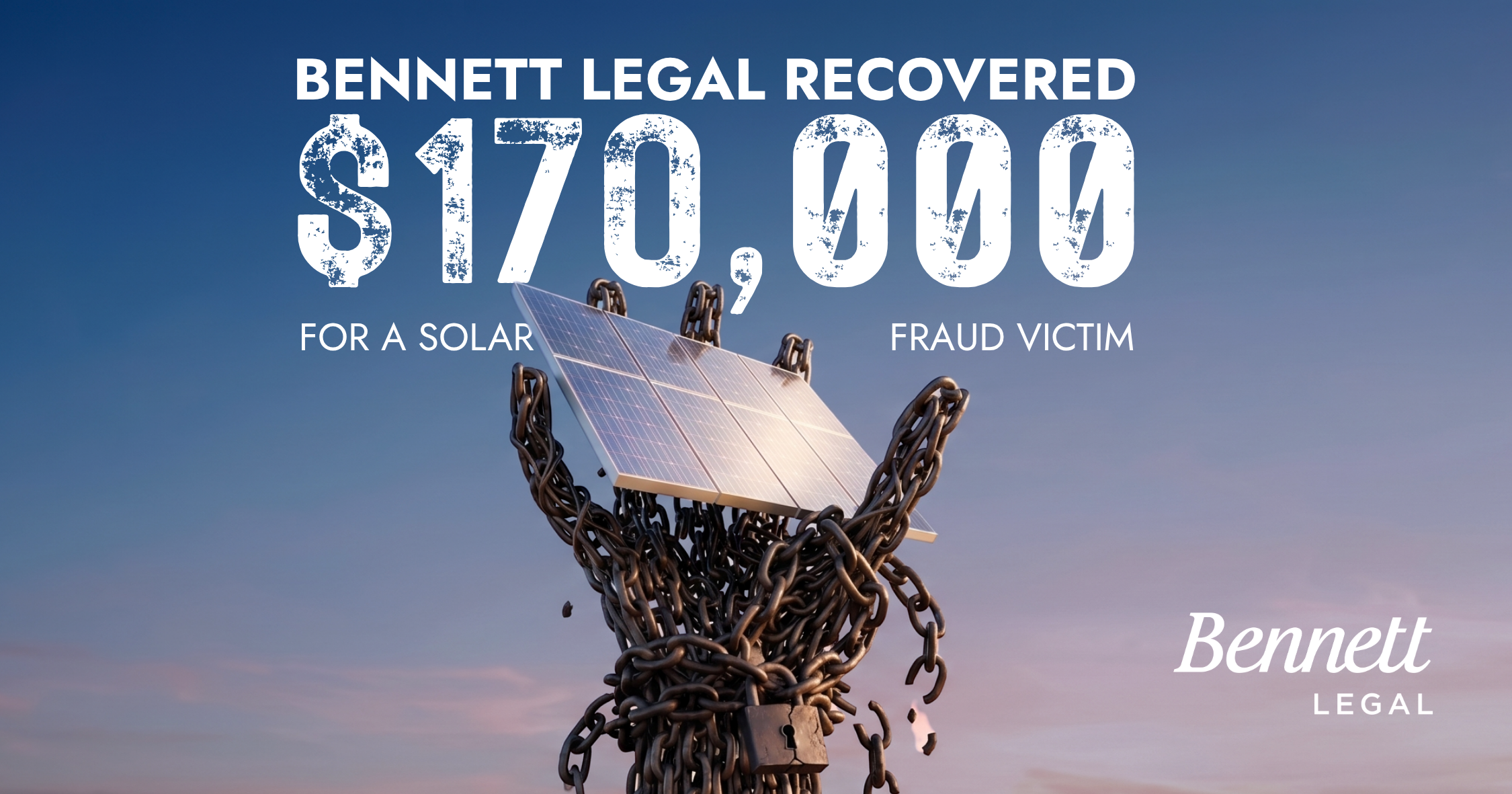
Every solar fraud case has a story behind it. This one started with a salesman at the door of a woman in her eighties — and ended with Sunlight Financial cancelling a $113,000 loan, removing a lien from her home, and writing a check.
Yesterday, an arbitrator ruled that Sunlight Financial has no confidentiality rights over this settlement. So we are going to tell you exactly what happened.
Free consultation
Solar panel contract problems?
We help homeowners fight back against solar fraud. Free consultation.
She Thought It Was a Government Program
The salesman came to her door speaking quickly and confidently. Our client is an 84-year-old retiree living alone on $1,300 a month in Social Security in Texas. Spanish is her first language. She had spent a lifetime paying her bills on time, taking care of her home, and trusting people who presented themselves as legitimate.
He told her she qualified for a special program. Solar panels for homeowners in Texas — a government initiative. No more electricity bills. A credit she was entitled to.
He asked about her utility costs, her living situation, her home. He used every answer to move her closer to a signature.
Then he handed her his phone and told her to sign with her finger.
No printed contract. No written terms. No copy left behind. No explanation in Spanish of what she was actually agreeing to.
When she signed, she was completely unaware she had agreed to anything beyond a no-cost government benefit. She had no idea she had just taken on a 25-year solar loan for nearly $113,000. These are classic warning signs of solar panel fraud — a signed device, no paper copy, no disclosure of terms.
The Panels Went Up. The Power Never Came On.
Before the installation crew even arrived, Sunlight Financial and Cross River Bank had already filed a UCC lien on her home for the full loan amount.
A crew came and mounted panels to her roof. They left an electrical control box. They said someone would return to activate the system.
No one came back.
The panels were never connected to the grid. The system never produced a single watt of electricity. Her utility bills stayed exactly the same as before. And then the first solar finance bill arrived: $268 a month, with an escalating schedule that would climb to $375 a month within 18 months.
On a Social Security income of $1,300.
When she reached out to family, she was excited. She thought this deal would save her money. She believed the lies.
The Toll
Her family started digging. The solar installation company had already gone bankrupt. The 25-year loan with Cross River Bank was being serviced by Sunlight Financial, a company that had no intention of making anything right. The government program the salesman described? Entirely fabricated.
They called Sunlight Financial. They wrote letters. They explained the situation — an elderly woman on fixed income, a system that never worked, a contract signed under false pretenses. Sunlight Financial responded with silence. Then deflection. Then more silence.
Meanwhile, the lien sat on her home — the home she had spent a lifetime paying off and had planned to protect for her future care. The stress of it was relentless. She stopped sleeping through the night. She developed anxiety and stomach problems. The health challenges she was already carrying became harder to manage under the weight of it.
But what frightened her most was the lien. Her plan — the one she had held onto for years — was to use her home's equity to fund nursing care if she ever needed it. That home, paid off over a lifetime of work, was her safety net. The lien Sunlight Financial placed on it before the panels were ever activated put that entire plan at risk.
She had no fallback if she lost it.
That is not a side effect of this case. That is the case.
Has this happened to you or someone in your family? If you have a Sunlight Financial or GoodLeap solar loan — or any solar loan for a system that was misrepresented or never worked — Bennett Legal offers free case reviews. Contact us today.
Bennett Legal Entered the Fight
The family realized Sunlight Financial was never going to do the right thing voluntarily. That is when they contacted Bennett Legal.
We filed for arbitration and issued discovery demands targeting Sunlight Financial's internal records — their complaint logs, their underwriting policies, their communications about this loan. We wanted to know exactly what they knew, when they knew it, and why they let it proceed.
The same company that had ignored this family for months — that let calls go unanswered and letters go unacknowledged — suddenly wanted to talk. Suddenly wanted mediation. Suddenly wanted this to go away.
That shift did not come from patience. It came from pressure.
What We Won
The settlement delivered everything this family had been fighting for:
- A $113,000 solar loan cancelled in full
- The UCC lien removed from her home
- Credit repair underway
- $100,000 in cash paid by Sunlight Financial
After attorney's fees and costs, she takes home more than $58,000 in her pocket. The total financial impact to her life: over $170,000.
If you are trying to get out of a solar loan or wondering whether your situation qualifies for these same remedies, the answer starts with a free case review.
The Arbitrator Ruled Against Sunlight's NDA Attempt
Before we could share any of this publicly, Sunlight Financial tried to stop us. They pushed for a confidentiality agreement that would have prevented Bennett Legal from disclosing what happened — the loan cancellation, the cash recovery, all of it.
We refused.
The arbitrator agreed with us. The ruling yesterday confirmed that Sunlight Financial holds no confidentiality rights that would prevent us from disclosing this settlement.
This matters. When companies like Sunlight Financial push for NDAs on settlement outcomes, it is not to protect anyone's privacy. It is to prevent other victims from knowing what is possible. They do not want you to know that full loan cancellation — with lien removal and cash recovery on top — is achievable.
Now you know.
What This Case Proves
For two years, Bennett Legal has been building solar fraud cases against Sunlight Financial, Cross River Bank, and their network of solar installers. This settlement proves we can deliver four remedies that many people assumed were out of reach:
- Cancel the solar loan entirely — not a reduction, not a forbearance, a full cancellation.
- Remove the UCC lien from your home — Sunlight Financial and other solar lenders routinely file UCC liens without adequate disclosure. That lien can block a home sale or refinance. We got it removed.
- Repair your credit — Solar panel fraud destroys credit when lenders report missed payments on loans homeowners never meaningfully agreed to. Credit repair is part of the settlement.
- Recover cash for fraud, mental anguish, and punitive damages — The cash payment addresses the harm done. It is about being made whole.
Not one of those four. All four.
What Is Sunlight Financial?
Sunlight Financial is a solar loan financing company that partners with installation companies across the United States to fund customer purchases. Rather than installing panels themselves, Sunlight provides the financing that allows installers to close deals — often at the kitchen table, using high-pressure tactics and promises that are never kept.
Sunlight engineers a "dealer fee" into these transactions that has been the subject of multiple lawsuits by State Attorneys General around the country for several years. The dealer fee — between 20% and 40% of the loan principal — is hidden in their contracts. The homeowner unwittingly pays interest on it for 25 years.
When installers fail to perform, Sunlight Financial still expects to be paid. Homeowners are left with debt tied to panels that do not function, a lien they do not understand, and a solar company that has disappeared.
Sunlight Financial's banking partner in many of these transactions is Cross River Bank, a fintech-focused bank that provides the capital behind the loans. Both entities have been named in consumer fraud and arbitration claims.
If you have a Sunlight Financial or Cross River Bank solar loan, our team has been building cases against them for two years. We know their contracts, their internal records, and their arbitration playbook. Tell us about your situation.
What Is GoodLeap?
GoodLeap is another solar financing lender we are actively investigating. Like Sunlight Financial, GoodLeap funded solar installations through a national network of installers — and homeowners who financed through GoodLeap have reported many of the same patterns: loans they did not agree to, systems that were never installed or never performed, and liens filed on their homes without clear disclosure.
If your solar contract was financed through GoodLeap, the same legal framework that produced this Sunlight Financial result applies to your situation. We want to hear from you.
GoodLeap borrower? Read what we know about GoodLeap complaints and what your options are.
The Pattern Behind Solar Financing Fraud
This case is part of a larger pattern. Lenders like Sunlight Financial and GoodLeap built their businesses on volume — funding as many installations as possible through dealer networks. The faster the deals closed, the faster they got paid.
That structure created powerful incentives for installers to cut corners, misrepresent terms, and disappear. The people left behind are often elderly, often on fixed incomes, often navigating a contract they signed in a language that was not fully explained to them. They are left with a debt they cannot escape, a lien on a home they spent a lifetime protecting, and panels on their roof that have never worked.
The weight of that has a cost. Physical. Emotional. Financial. This settlement tried to account for all of it.
"This was a predatory deal, designed to exploit elderly individuals under false promises." — Client's son-in-law, speaking about what Sunlight Financial did to the family
State Attorney General Actions {#state-attorney-general-actions}
Bennett Legal is not alone in identifying this pattern. Attorneys General across the country have taken formal action against the same solar financing companies implicated in cases like this one.
Minnesota (March 2024): Attorney General Keith Ellison sued GoodLeap, Sunlight Financial, Solar Mosaic, and Dividend Solar Finance for concealing hidden dealer fees from more than 5,000 Minnesota homeowners — totaling more than $35 million in undisclosed charges. The complaint documented that these lenders contractually prohibited solar installers from disclosing the dealer fee to customers.
New York (2026): Attorney General Letitia James sued a solar company and its lending partners for cheating New Yorkers out of hundreds of millions of dollars through deceptive sales practices and fraudulent financing arrangements.
Virginia (January 2026): Attorney General Jason Miyares sued solar company founders and their lenders for misrepresenting savings and hiding loan fees. More than 4,000 Virginia households took out over $200 million in solar loans under false pretenses, with nearly 500 complaints sharing the same themes: systems that failed and savings that never materialized.
Texas (April 2026): Attorney General Ken Paxton launched a major enforcement initiative and issued Civil Investigative Demands to multiple residential solar companies — including Freedom Forever, Sunrun, and others — for alleged violations of the Deceptive Trade Practices-Consumer Protection Act. The investigation targets misrepresentations about energy savings, system performance, and contract terms.
Regulators at every level are reaching the same conclusion: the residential solar financing industry has a systemic fraud problem. If you have been affected, you are not alone — and the law is on your side.
Why Arbitration — and Why It Worked Here
Solar loan contracts almost universally require disputes to go through private arbitration rather than court. Many homeowners assume this means the lender wins automatically. It does not.
Bennett Legal has been litigating solar fraud cases through JAMS arbitration — the forum specified in most Sunlight Financial and GoodLeap contracts — and building the institutional knowledge to win. The arbitration process, when done right, can produce results faster than litigation with outcomes that are binding on the lender.
The confidentiality ruling in this case is itself significant. The arbitrator found that Sunlight Financial holds no confidentiality rights that would prevent us from disclosing this settlement. That means we can tell you what we won. And we intend to.
What You Should Do If You Have a Sunlight Financial or GoodLeap Contract
The statute of limitations on consumer fraud claims is not unlimited. If you — or a parent, grandparent, or someone you love — has a Sunlight Financial or GoodLeap solar loan, the time to act is now.
- Find the contract. Know whether the lender is Sunlight Financial, GoodLeap, Cross River Bank, or another solar financing company.
- Document what was promised versus what was delivered. Savings estimates, installation timelines, whether the system ever actually worked — all of it matters.
- Do not make payments on a loan you believe was fraudulently obtained without speaking to an attorney first.
- Contact Bennett Legal. We will review your case at no cost to you. If we take your case, you pay nothing unless we win.
We have been doing this work for over two years. We know these lenders. We know the tactics they use against people who trusted them. And we know how to win.
When we asked our client whether she would ever have signed that contract had she known what it actually was, her answer was immediate.
"Absolutely not."
Let this settlement be the proof.
Free Case Review
If you have a Sunlight Financial or GoodLeap solar loan — or any solar loan for a system that was misrepresented, never activated, or sold through deceptive tactics — Bennett Legal will review your case at no cost.
We have spent two years building the evidence playbooks, arbitration strategies, and institutional knowledge to win these cases. This settlement is proof of what is possible.
Contact Bennett Legal — Free Consultation
Past results do not guarantee similar outcomes. Every case is unique.
Free consultation
Solar panel contract problems?
We help homeowners fight back against solar fraud. Free consultation.