Start by identifying what you signed and when. This guide compares exit routes; it does not assume every agreement can be canceled.
$170,000+ recovery
Against Sunlight Financial · Solar fraud arbitration
- $113,000 loan cancelled
- UCC lien removed
- Credit repaired
- $58,000 cash to client
Past results do not guarantee a similar outcome. Every case is different.
| Your situation | Documents to locate | Where to start |
|---|---|---|
| You recently signed, or the system is not installed yet | Dated agreement and cancellation notice | Cancelling before installation: check the timing rules before a deadline passes. |
| The panels are already installed | Contract, loan papers and utility records | Your options after installation. |
| You dispute agreeing to a loan | Loan application, signature records and lender correspondence | Challenging a solar loan you did not authorize. |
| You lease the panels or buy their electricity | Lease or power purchase agreement, payment schedule and transfer terms | Compare leases, PPAs and financed purchases. |
| A salesperson promised cancellation at any time | Written promises, messages and the contract's cancellation terms | Evaluate an anytime-cancellation promise. |
| The installed system does not perform | Production records, warranty and repair requests | Review a denied solar warranty alongside the contract's notice and remedy provisions. |
If you need help, learn more about our Solar Panel Financing Fraud.
“I signed a 25-year solar lease… but my bill isn’t lower, my roof warranty is in question, and now I just want out. Am I stuck forever?”
You are not alone. Thousands of homeowners each year feel trapped in long-term solar contracts - often for 15, 20, or even 25 years. These agreements can make financial sense at first, but life changes, hidden clauses, or poor system performance can flip that equation.
The problem is that solar contracts aren’t as easy to cancel as other services. They are legally binding, often tied to financing or property liens, and walking away without following the right path can result in early termination fees, lawsuits, or severe credit damage.
The good news? In many situations, there are legal and contractual ways to exit - but you need to know which path applies to your contract, your state, and your circumstances.
So, Can You Get Out?
Sometimes. The available route depends on your agreement and the facts. Options range from buyouts and transfers to performance disputes and, in cases of fraud or misrepresentation, full contract cancellation.
But here’s the critical point - your exit path depends on the exact type of contract you signed (lease, PPA, or purchase agreement), as well as your state’s consumer protection laws. Learn more about the difference between solar leases and loans.
Walking away without a plan can make the situation worse. You could end up owing more than if you had stayed put and negotiated or challenged the agreement. Learn more about solar companies selling your contract without permission.
Can You Cancel a Solar Contract Before Installation?
Your options before installation depend on when you signed, not on when the crew is scheduled. Here is how to cancel a solar panel contract before installation, in order:
- Count business days from the date you signed. For a covered residential solar agreement signed in Texas on or after September 1, 2025, you can cancel without penalty or further obligation by written notice on or before the fifth business day after you signed (Texas Occupations Code § 1806.156). A later installation date does not extend that deadline. Other covered home sales may carry the federal three-business-day right explained under Know Your Legal Rights.
- Send written notice to the address in the agreement, and keep proof. The agreement must state the last day to cancel and a mailing or email address for the notice. Say plainly that you are cancelling, and include your name, the property address, the date you signed and any contract or account number. Email gives you a timestamp; mail with tracking gives you a delivery record. If the address is missing, written notice by any reasonable method within the same five business days is allowed.
- Make sure the loan is cancelled too. If the installer arranged your financing through a lender it is affiliated with or referred you to, the agreement must require that lender to cancel the loan when you cancel under § 1806.156 (§ 1806.155(c)). Send the lender a copy of your notice and ask for written confirmation that the loan is cancelled.
- If the window has closed, read the agreement before refusing installation. Look for a clause allowing cancellation before installation, any fee it charges, and deadlines for permits, utility approval or the installation itself. Texas requires covered agreements to say that the retailer or electrical contractor will obtain the permits and utility interconnection approval (§ 1806.155(a)(3)). A missed deadline may raise a breach-of-contract question, and a false sales statement may support a misrepresentation claim, but neither is an automatic right to cancel. Meanwhile, do not pay in full, or tell a lender the job is complete, until the work is finished and has passed local inspections. TDLR's residential solar consumer brochure gives the same advice about payment.
Once the system is installed and the loan has funded, the exit routes in the rest of this guide apply instead.
Can You Cancel a Solar Contract After Installation?
Usually not just by asking. The Texas five-business-day right runs from the day you signed, so it has normally passed by the time the panels go up (§ 1806.156). After installation, a solar contract can still end in other ways:
- A buyout or a transfer that the agreement allows. See the 5 common ways to exit below.
- A negotiated termination, most often when the system underperforms or the company is facing claims.
- A breach-of-contract or warranty claim, when the company did not deliver what the contract promised.
- A legal claim over the sale itself, when you were told things that were not true. In Texas that can include the Deceptive Trade Practices Act, which generally has a two-year deadline (Business & Commerce Code § 17.565). For some financed systems, the FTC Holder Rule lets claims against the seller be raised against the company that holds the loan.
If the system was installed but your utility never approved it to run, that is not an automatic cancellation either. It is evidence: get the utility's records and write down what the installer told you. Then have the contract and loan reviewed before you stop paying.
Free consultation
Which of these sounds like your contract?
Take the free 2-minute review to see where you stand. No obligation.
Problems That Warrant a Contract Review
Not every homeowner looking to terminate a solar agreement is being “difficult” or acting out of buyer’s remorse. There are valid, legally arguable circumstances in which ending or restructuring a solar contract makes sense.
1. Financial Burden Exceeds Benefits
Your monthly payment or escalating lease rate is higher than your actual utility bill savings. Check whether your agreement increases payments each year and compare its actual schedule with your bills; a savings shortfall alone does not establish a right to cancel.
- This is especially common when utility rates stay flat or fall, making projected savings unrealistic.
- A review of your original production guarantee versus your actual output is often the first step in proving the mismatch.
2. Moving or Selling Your Home
Long-term solar leases and PPAs (Power Purchase Agreements) present a unique challenge in real estate transactions: many buyers don’t want to assume the contract.
- If your sales contract requires the buyer to take over, any reluctance can tank the sale price or drive away buyers entirely.
- Some lenders are also cautious about underwriting homes with encumbered solar leases - especially if a UCC-1 lien is filed against the property. The filing and underlying security agreement need to be checked; a filing concerning equipment is not automatically a mortgage on the home.
3. Poor System Performance
If your system is producing significantly less energy than promised - and you have documentation - it may qualify as a breach of contract or a trigger for performance-based cancellation.
- Low output can stem from faulty installation, shading issues the installer failed to disclose, or unmaintained equipment.
- In some cases, manufacturers and installers point fingers at each other, leaving the homeowner stuck.

4. Misrepresentation or Fraud During the Sales Process
Some homeowners were told outright falsehoods:
-
That the system would be “free” after incentives.
-
That the panels would eliminate 100% of their bill.
-
That they could walk away “anytime” without penalty.
If you can prove these statements were made in a way that influenced your decision, you may have grounds for cancellation under state deceptive trade practice laws. -
That a dealer fee was included in the financed price without a clear explanation. The CFPB solar-financing report describes hidden markups that can make the financed price substantially higher than the cash price. Compare both prices before drawing a conclusion about your own agreement.
5. Warranty and Service Failures
If the company is ignoring repairs, maintenance requests, or warranty claims, that’s often a breach of contract - especially if the failure affects system output and your ability to realize the promised savings.
More Serious Cases Where You Need to Exit ASAP
Some situations are so high-risk that trying to “ride it out” can cost you thousands - or even lead to foreclosure on certain solar lien-based programs like PACE financing. If you see these warning signs, it’s time to act fast:
1. Escalating Payments You Can’t Afford
If your payment increases each year and you’re already stretched thin, you could eventually default - and defaulting gives the solar lender or lessor leverage to take aggressive collection action.
2. Contract Clauses That Penalize Home Sale
Some leases and PPAs contain fine print saying you must fully pay out the contract if the next homeowner doesn’t assume it. This can leave you owing tens of thousands right before a move.
3. Unfulfilled Installation Promises
If promised features - like battery storage, net metering enrollment, or promised utility rebates - never happened, you may be paying for something less than what you agreed upon.
4. Provider’s Financial Instability
If your solar company is closing locations, laying off staff, or has a wave of BBB complaints, you risk being left without required service support. In some states, if the provider dissolves, you may still legally owe payments to the leasing company or financier.
5. Active or Pending Litigation Against Company
If your provider is facing lawsuits for fraud or breach, you may be able to join a group claim or use their misconduct as leverage to exit your own agreement.
60-Second Check
Question 1 of 5
Is your solar payment higher than what you're actually saving on your utility bill?
⚖️ Recent Case Result: $170,000+ Recovery Against Sunlight Financial
In a recent Bennett Legal case, Sunlight Financial agreed to cancel our client's $113,000 solar loan, remove the UCC lien from her home, repair her credit, and pay her $58,000 in cash — a total financial recovery of over $170,000.
If you financed through Sunlight Financial, GoodLeap, or another lender and believe you were misled, you may have more options than you think. Talk to a Bennett Legal solar attorney — free consultation.
Read the documented Sunlight Financial settlement or watch the case explanation. This individual result does not predict the outcome of another matter.
💡 The bottom line: Waiting too long only narrows your exit options. If you recognize multiple red flags, consult a solar contract lawyer now before penalties escalate or opportunities for a smooth exit vanish.
5 Common Ways to Exit a Solar Contract
Every contract is different, but here are general strategies homeowners pursue when getting out:

Buyout from the Lessor or Lender
Many leases and PPAs have a buyout clause after a certain number of years - sometimes sooner if negotiated.
The buyout price can be high early on but may make sense to avoid years of escalating payments.
Transfer to a Home Buyer
If you’re selling, a willing buyer can assume the contract. This works best when the panels are well-performing and payments are low - but it can be a sticking point in negotiations.
Negotiate Early Termination
Some companies will agree to a negotiated solar contract termination if the system underperformed or the relationship is no longer workable - especially if faced with potential legal claims.
Performance-Based Exit
If your contract includes a production guarantee and the system consistently misses targets, you can use this as leverage for cancellation or major concessions.
Legal Challenge for Fraud or Misrepresentation
In cases where the sales process involved false promises or hidden terms, an attorney can evaluate claims under the applicable state consumer-protection law and whether cancellation or another remedy is available.
Know Your Legal Rights & Protections
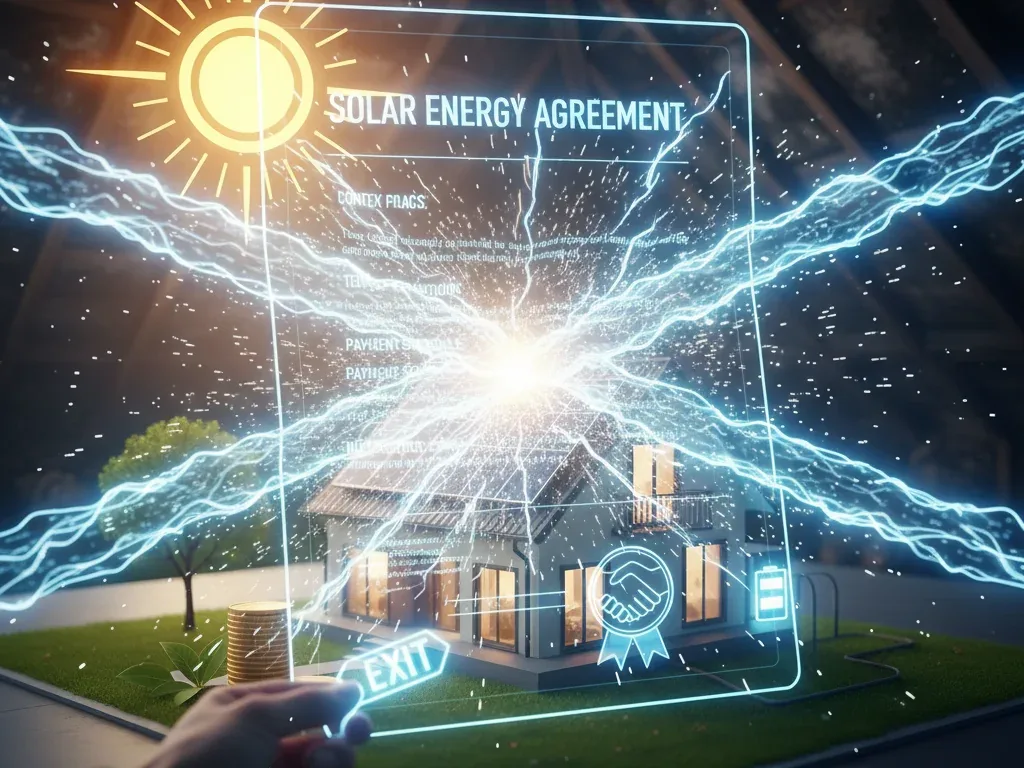
Federal cooling-off rights apply to certain sales
The FTC's consumer guidance explains a three-business-day cancellation right for certain home and temporary-location sales. It excludes some transactions, including sales completed entirely online, by mail or by telephone. Under the federal rule, Saturday counts as a business day; Sundays and federal holidays do not. Check coverage, the notice instructions and the deadline rather than assuming every solar agreement has this right.
Texas solar contract cancellation law (SB 1036)
Texas Occupations Code §§ 1806.005 and 1806.156 provide the scope and cancellation rules for covered purchases and leases. The chapter excludes systems sold or leased before September 1, 2025 and contains other exclusions. For covered agreements, written cancellation is due by the fifth business day after execution. This Texas definition excludes Saturdays, Sundays and legal holidays, unlike the federal count.
The agreement must give the cancellation deadline and mailing or email address. If the required address is missing, § 1806.156(d) permits written notice by a reasonable method within that same period. It does not create an unlimited cancellation window. Section 1806.155(c) also addresses an accompanying loan from an affiliated or referred lender. Review the sale and financing documents together.
After a cancellation window, identify the particular claim or contract remedy
A complaint about savings, installation or service is not itself a cancellation notice or a ruling that the debt is invalid. Review the agreement's performance promises, warranty, notice requirements, repair opportunities and dispute procedure. Remedies depend on the transaction, applicable state law and supporting evidence.
The FTC Holder Rule preserves certain seller-related claims and defenses against holders of covered consumer credit contracts. It is not automatic loan forgiveness and should not be assumed to cover every loan, lease or PPA. Preserve the credit contract and obtain advice about coverage and available remedies before changing payments or signing a release.
For concerns about dealer fees and financing presentations, the CFPB's 2024 solar-financing report supplies background. That report describes industry risks; it does not determine whether a particular company violated the law in your case.
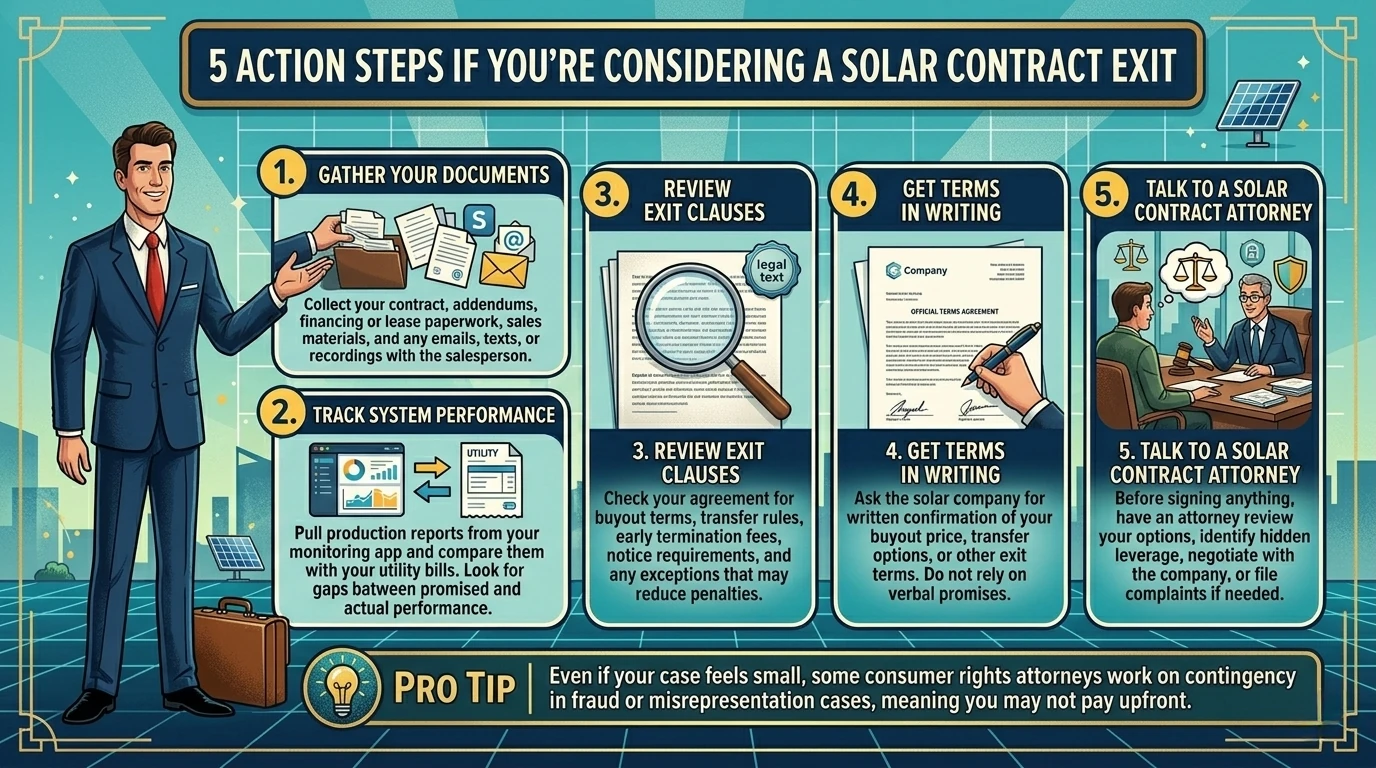
5 Action Steps if You’re Considering an Exit
Feeling trapped is overwhelming, but taking clear, organized steps can turn a messy, frustrating situation into one where you’re actively moving toward a solution. Here’s how to start:
Step 1: Gather All Relevant Documentation
Collect every piece of paperwork from the sales process to today, including:
- The signed contract and all addendums
- Financing or lease agreements
- Copies of marketing materials or sales presentations
- Emails, text messages, or recordings with the salesperson
These documents are often the best proof of what was promised versus what was delivered. Sales brochures with exaggerated savings claims or emails promising “no penalties for early exit” can be game-changers in a legal review.
Step 2: Document System Performance
If poor performance or underproduction is one of your issues, back it up with evidence.
- Pull monthly or annual production reports from your monitoring app or inverter portal.
- Compare this data to your utility bills before and after installation.
Compare any shortfall with the actual production guarantee, its exclusions and its remedy provisions. These records can help an attorney assess whether the company failed to meet a contractual obligation.
Step 3: Review Your Agreement for Exit Clauses
Read through your solar contract terms, looking specifically for:
- Buyout clauses: when they kick in, how they’re calculated
- Transfer terms: what happens if you sell your home
- Early termination provisions: fees, penalties, or notice requirements
Many homeowners are surprised to find buyout options built in - but they’re buried deep in the document. Others find clauses that can void penalties if specific events happen, such as moving to a non-suitable property.
Step 4: Get Written Terms from the Company
Before making any decision:
- Contact your solar company or lessor and request written confirmation of your buyout price, transfer terms, or any exit options
- Avoid relying on verbal promises - if they’re not in writing, they’re unlikely to be honored
Step 5: Consult a Solar Contract Attorney Before Signing Anything
Getting legal advice early can save you thousands. A solar contract attorney can:
- Spot hidden clauses that strengthen your exit case
- Help you frame your request so you don’t accidentally waive rights
- Negotiate directly with the company - often leading to better terms than you could get alone
- File formal complaints with state and federal agencies if needed
💡 Pro Tip: Ask about attorney fees and case expenses before hiring a lawyer. Review the proposed fee agreement before deciding whether to move forward.
You Are Not Stuck Forever
Signing a 15- or 25-year solar contract doesn’t mean you’ve lost control of your home or your future. If your bills are rising, your panels are underperforming, or you were misled into signing terms you never understood, you still have options. A document review can help distinguish a negotiated exit from a legal claim and explain the risks of each.
At Bennett Legal, we help families escape bad solar deals every day. We know the clauses that companies don’t want you to see, the state protections they hope you don’t use, and the legal strategies that turn “no way out” into a clear path forward.
Here is how we take action for clients:
- We uncover hidden exit clauses. Buyouts, transfer terms, and cancellation rights that can be leveraged to your advantage.
- We challenge fraud and misrepresentation. If you were promised “free solar” or “cancel anytime” and that wasn’t true, we hold companies accountable under consumer protection laws. Learn more about what happens when your solar company goes bankrupt.
- We fight abusive penalties. Escalating fees and unfair early termination clauses can often be negotiated, reduced, or struck down.
- We protect your credit and your home. From UCC lien removal to contract disputes, we evaluate the filing, payment and credit-reporting issues that may accompany the dispute.
You do not have to stay chained to a contract that drains your wallet and your peace of mind. Bennett Legal is ready to review your agreement, explain your rights, and fight for the clean break you deserve.
📞 Call Bennett Legal today at 972-972-4969 for a free consultation. The sooner you act, the more options we can put on the table - and the faster you can take back control of your home and your future.
About this guide
Charles Bennett’s attorney profile provides the background for the author identified on this page. The linked statutes and agency publications explain general rules and risks; applying them to an individual agreement requires review of the documents and facts. The Sunlight Financial case account describes one result, not a promise of relief in other matters.
Related Reading
Free consultation
Which of these sounds like your contract?
Take the free 2-minute review to see where you stand. No obligation.