$2.5M
Amazon Case Recovery
Secured substantial recovery for client injured in Amazon-related incident. Bennett Legal fought against corporate defense teams to ensure fair compensation for our client's injuries and damages.
2024
Arbitration attorneys in Dallas. We guide you through the arbitration process, protecting your rights and interests every step of the way.
Somewhere in the fine print of a contract you signed, there's a clause that says you gave up your right to sue. Most people don't find that clause until they need it — and by then, the other side already knows exactly how it reads.
We recently took a case all the way to a $2.5 million arbitration award against Amazon — proof that an arbitration clause doesn't mean the deck is stacked against you, if the case is built right.
If you're facing a dispute that's headed to arbitration, call (972) 972-4969 or fill out our free case evaluation form today. The rules are different from a courtroom — you need someone who knows them before your first filing.

Representative results
$2.5M
Secured substantial recovery for client injured in Amazon-related incident. Bennett Legal fought against corporate defense teams to ensure fair compensation for our client's injuries and damages.
2024
Past results do not guarantee a similar outcome. Every case is different.
Get Your Free Case ReviewAn arbitration clause can feel like the other side already won before you even filed — no jury, limited discovery, and rules most people have never had to learn. Here's what we bring to that fight:
• We've proven arbitration can still deliver accountability: a $2.5 million award against Amazon after a multi-year case — built the same way we build every arbitration we take on.
• We know the rules cold: arbitration isn't a smaller version of a courtroom trial, and treating it like one is how cases get lost. We build our strategy around the forum's actual rules from day one.
• We make the most of limited discovery: when you don't get a full courtroom-style discovery process, every request has to count — we know how to get the evidence that matters.
• We tell you the truth about your case from day one: including what it's worth and what it will take to get there.

Alternative Dispute Resolution (ADR) refers to methods used to resolve conflicts and legal disputes outside the courtroom. These methods provide parties with alternatives to the traditional litigation process, which can be time-consuming, expensive, and emotionally draining. ADR methods, such as arbitration, offer a more streamlined and cost-effective way to resolve disputes.
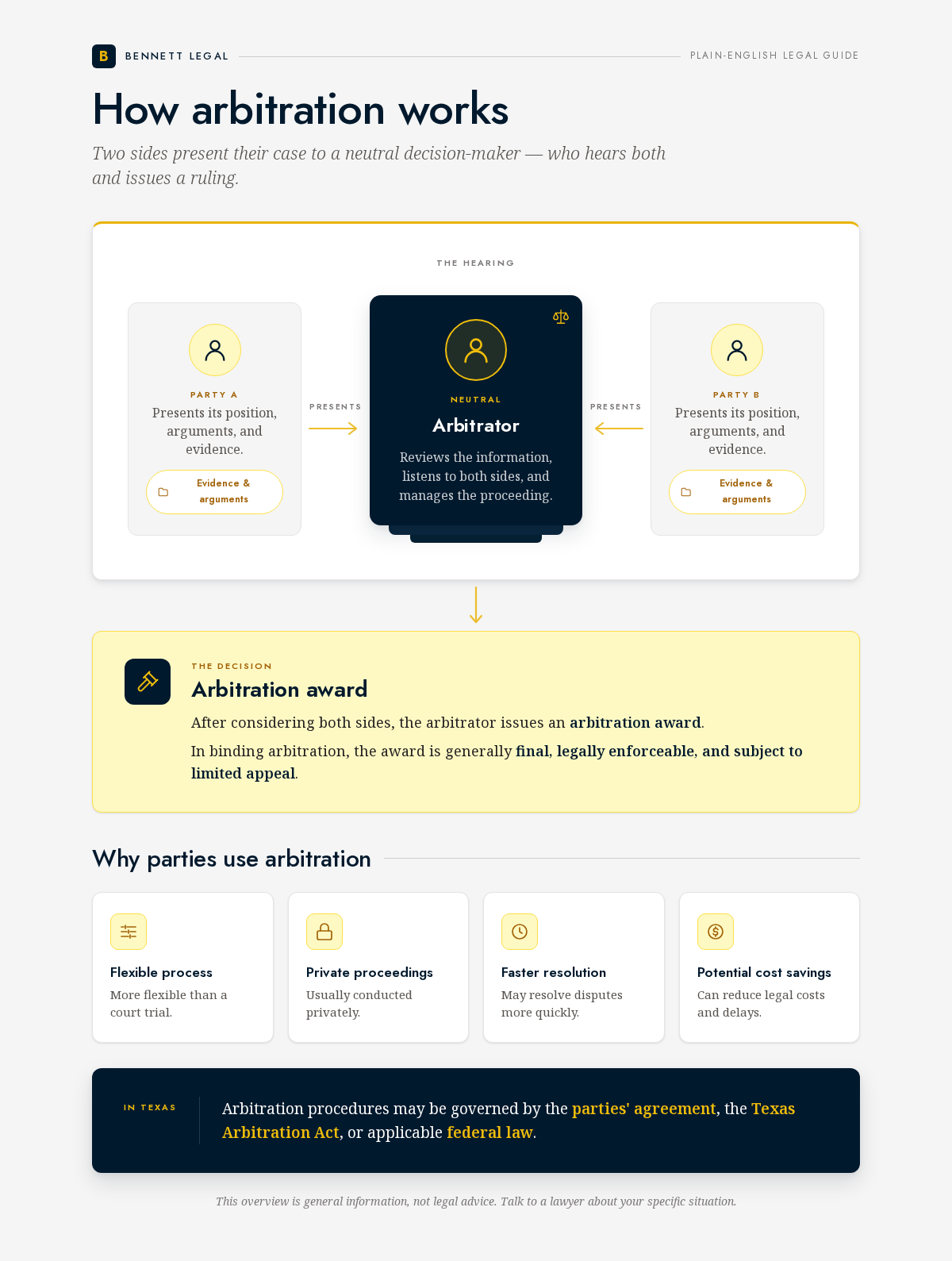
Arbitration is a form of ADR where parties involved in a dispute present their case to a neutral third party, known as an arbitrator.
In Dallas and throughout Texas, the Texas Arbitration Act, a part of the Texas Civil Practice and Remedies Code governs arbitration procedures that our attorneys navigate daily.
The arbitrator listens to both sides and reviews the evidence presented before making a final decision, known as an arbitration award. This award is legally binding and enforceable.
The arbitration process typically begins with the arbitrator's selection, who is often chosen based on their experience in the subject matter of the dispute. Once selected, the arbitrator acts as a judge and oversees the proceedings. Parties may present their case through written submissions and oral arguments, similar to a courtroom trial.
Arbitration provides parties with a more flexible and efficient process compared to litigation. It allows for confidentiality, allowing sensitive information to remain private. Additionally, arbitration can often be completed more quickly than a court trial, resulting in faster resolution and cost savings.
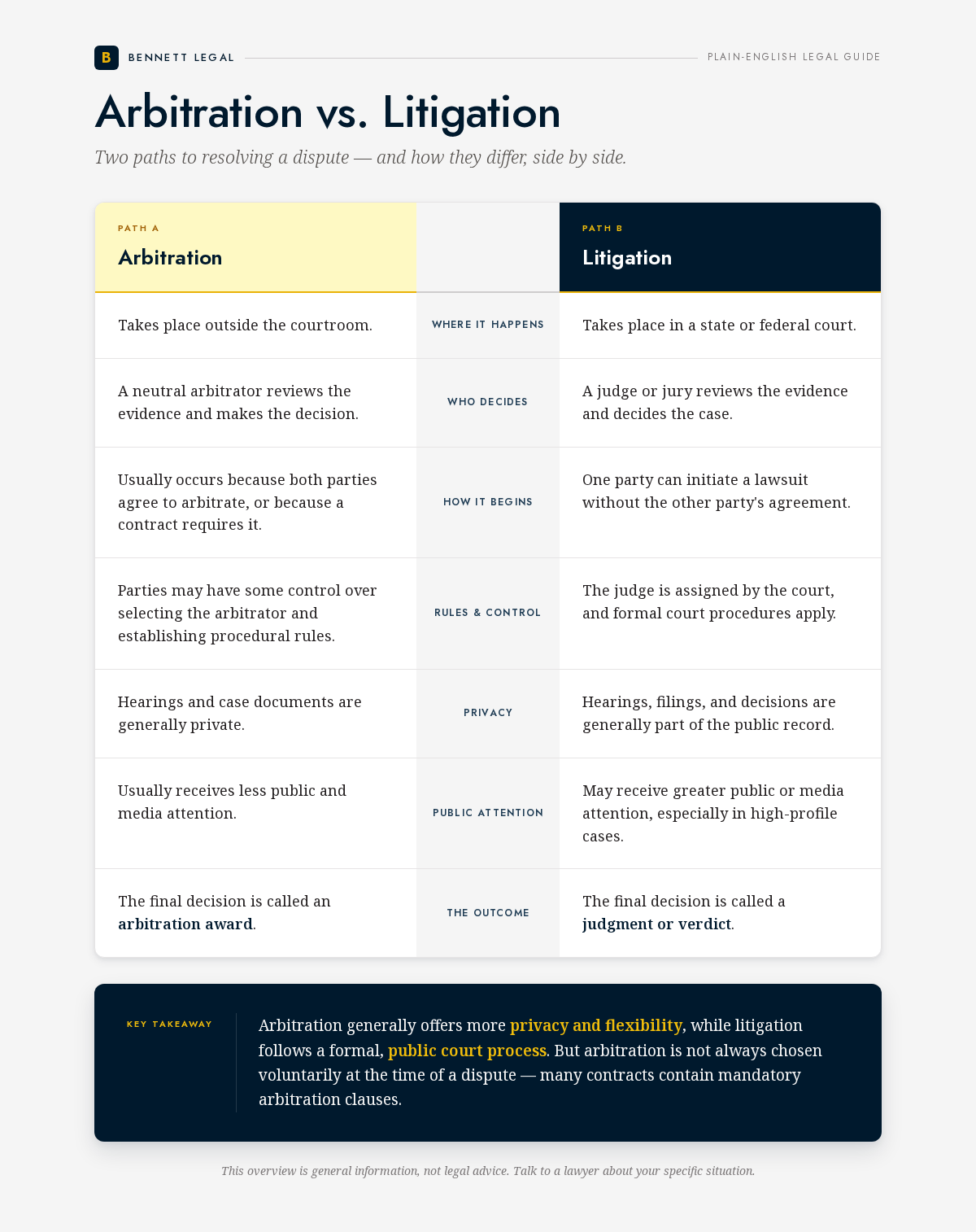
Arbitration differs from litigation in several key ways. While litigation involves taking a dispute to court and having a judge or jury decide, arbitration occurs outside the formal courtroom setting. Instead of a judge or jury, an arbitrator reviews the evidence and decides.
One significant difference is that arbitration is a consensual process, meaning both parties must agree to participate. Litigation, on the other hand, can be initiated unilaterally by one party, which can lead to adversarial proceedings. Arbitration allows parties more control over the process, since they can select the arbitrator and agree on the arbitration rules. However, there are times when arbitration is mandated ahead of time by the contract. This contract governs the relationship between the two parties.
Another difference is that arbitration provides a more private and confidential setting compared to litigation. Court proceedings are generally open to the public, while arbitration hearings can be conducted in a more discrete manner. This confidentiality can be particularly appealing in sensitive and high-profile cases.
In a court case, the public will know the decision and many of the filings in the case. Even if the arbitration result is public, it will generally take place in private and with less media coverage.
For a full side-by-side comparison of your options, see our mediation vs. arbitration vs. litigation guide.
An arbitration proceeding is much like any other type of litigated case, albeit using more streamlined procedures. You will still end up with a ruling in your case, affecting your rights and potential obligations.
You may get there more quickly and efficiently than litigation, albeit with a somewhat less robust ability to gather evidence. The parties may still be required to submit filings to the arbitrator. They can still engage in discovery, although they will not get the same amount of discovery than they would if preparing for trial.
Different forms of arbitration can resolve disputes, depending on the specific circumstances.
These include:
Binding Arbitration: In binding arbitration, the decision made by the arbitrator is final and legally enforceable. The parties are required to abide by the arbitrator's decision. Most types of arbitration are binding, and that is exactly why some parties have an interest in using this type of procedure. Further, the losing party may not even have appeal rights (everything depends on the rules of the forum in which the case is arbitrated).
Non-binding Arbitration: Non-binding arbitration allows parties to test the strength of their case before going to court. The decision made by the arbitrator is not legally binding, but it can help parties evaluate their positions and potentially facilitate settlement negotiations. This type of arbitration is usually used as outcome prediction. There is even a chance that the judge in a particular case may give their own opinion as to the merits of each party's positions. This is to potentially push them to negotiate a settlement agreement before the case were to head to trial.
Court-Annexed Arbitration: Some courts offer court-annexed arbitration as a means to encourage parties to reach a resolution without a full trial. Court-annexed arbitration is often used in civil cases and can help relieve caseload congestion in the court system.
International Arbitration: International arbitration is used to resolve disputes that involve parties from different countries. It is often governed by international treaties and agreements and follows specific rules and procedures tailored to cross-border disputes.
The choice of arbitration method depends on the preferences and needs of the parties involved. An experienced arbitration lawyer can guide you through these options and help determine the most suitable approach for your case. At Bennett Law, we have extensive experience in these types of arbitration, vigorously representing our clients to deliver results.
Arbitration offers several advantages over traditional litigation, making it an attractive option for resolving legal disputes. Some of the key benefits include:
Efficiency: The arbitration process is typically faster than litigation, allowing parties to reach a resolution more quickly. This can save time, money, and resources.
Cost-Effectiveness: Arbitration can be more cost-effective compared to litigation. The streamlined process, shorter timelines, and limited discovery proceedings can help minimize legal fees and expenses.
Limitation on Discovery: One or both parties may have an interest in keeping the scope of discovery limited because of the time and expense involved in the matter. While there is often some discovery allowed in arbitration, the scope may be limited.
Experience: Parties have the opportunity to select an arbitrator with experience in the subject matter of the dispute. This ensures that the decision-maker has a deep understanding of the issues involved. Generally, you can select an arbitrator from a list provided by the governing arbitration body.
Flexibility and Control: Unlike litigation, arbitration allows parties to have more control over the process. They can choose the arbitrator, agree on the arbitration rules, and determine the timeline for resolution.
Confidentiality: Arbitration hearings are often confidential, protecting the privacy of the parties involved. This can be particularly important in cases where sensitive information or trade secrets are involved.
Enforceability: Arbitration awards are generally easier to enforce compared to court judgments. The New York Convention on the Recognition and Enforcement of Foreign Arbitral Awards provides a framework for enforcing arbitration awards in over 160 countries.
However, there are times that litigation may be in your best interests. You may want a more robust type of discovery that you would not have in arbitration. You may also prefer having a jury decide your case because there is a chance that they can order a higher amount of punitive damages (it is possible to receive punitive damages in arbitration, but an arbitrator may be less likely to order them, and the amount can be less). Your arbitration attorney may advise you that there is a better chance of winning your case in front of a jury, especially when you are able to receive more discovery than you would in an arbitrated proceeding.
By choosing arbitration over litigation, parties can benefit from these advantages and have a more efficient and tailored dispute resolution process. However, the exact determination depends on the facts and circumstances of your situation.
If you’ve heard conflicting information about arbitration, our guide busting common arbitration myths separates fact from fiction.
Whether you can be compelled to arbitrate your case depends on various factors, including the nature of the dispute and the agreements between the parties involved. In some cases, parties may have entered into a contract that includes an arbitration clause, which requires them to resolve disputes through arbitration.
If there is a clause in an agreement requiring arbitration, chances are that it will be enforced. Time and again, courts have been called upon in matters involving the enforceability of arbitration clauses. Usually, they reach the result that there is valid public policy which favors arbitration, and courts will uphold the clause. Even if you want to go to court, you will not be able to if you have agreed to arbitration in advance of any dispute.
If there is no contractual agreement to arbitrate, it may still be possible to voluntarily agree to arbitration after a dispute arises. Both parties must agree to participate in the arbitration process for it to proceed. However, determining the enforceability of arbitration agreements can be complex, and it is advisable to consult with an arbitration attorney to assess your specific circumstances.
Before you sign anything, review our list of red flags in unfair arbitration clauses.

An arbitration lawyer can provide invaluable guidance and support throughout the arbitration process. They can help you in the following ways:

An arbitration lawyer can evaluate the strengths and weaknesses of your case and provide an objective assessment of the likelihood of success.
They can assist with gathering evidence, preparing written submissions, and presenting your case effectively to the arbitrator.
An arbitration lawyer can help you identify and select an arbitrator who has the appropriate experience and experience for your specific dispute.
They can help develop a strategic approach to your case, considering the specific goals and interests you wish to achieve.
An arbitration lawyer can help negotiate settlement agreements and explore options for resolution before and during the arbitration process.
During the arbitration hearings, an arbitration lawyer can advocate on your behalf, presenting your arguments and evidence in a persuasive manner.
Having an experienced arbitration attorney by your side can significantly enhance your chances of achieving a favorable outcome in your case.
Arbitration costs typically include filing fees, administrative fees, and the arbitrator's compensation, which is often split between the parties or, in some consumer and employment cases, covered largely by the company. Costs vary depending on the arbitration provider (such as JAMS or the AAA) and the complexity of the dispute. See a full cost breakdown, or contact Bennett Legal for a free review of your specific agreement.
Most arbitrations resolve in months rather than the years litigation can take, though timing depends on the arbitrator's schedule, case complexity, and how much discovery is needed. Straightforward disputes can conclude in as little as 3-6 months, while complex cases may take a year or longer. Learn what affects arbitration timelines.
In litigation, a judge or jury hears your case in open court, and either party can start the process unilaterally. In arbitration, a neutral arbitrator you help select decides the outcome in a private, confidential setting, typically faster than a courtroom trial — but with more limited discovery than you'd get preparing for trial. Which path applies to your dispute usually comes down to whether your contract contains an arbitration clause.
Mediation is a non-binding process where a neutral mediator helps both sides negotiate a voluntary settlement, and either party can walk away without an agreement. Arbitration results in a binding decision that both sides are legally required to follow. Compare mediation, arbitration, and litigation or talk to our team about which process fits your dispute.
If you signed a contract with a valid arbitration clause, Texas and federal courts will generally enforce it and require your dispute to go through arbitration instead of a lawsuit. There are limited exceptions where a clause may be unenforceable — such as when it's unconscionable or was procured through fraud. Read more about forced arbitration clauses, or contact Bennett Legal to review your agreement.
Binding arbitration awards have very limited appeal rights — courts will only overturn an award in narrow circumstances, such as arbitrator fraud, misconduct, or exceeding their authority. That's why building the strongest possible case the first time matters. Bennett Legal prepares every arbitration as if there's no second chance, because in most cases, there isn't.
Strong arbitration cases rely on contracts, communications, financial records, and witness testimony that clearly establish what happened and who's responsible. Because discovery is more limited in arbitration than in court litigation, gathering and preserving this evidence early is critical. See what evidence matters most.
We've proven arbitration clauses don't have to mean the deck is stacked against you — a $2.5 million award against Amazon says so. Let us show you what that could mean for your case.
Call now for a free consultation: (972) 972-4969, or complete our online form — the sooner we start, the more options you have.
Related legal guides
adr arbitration
Get a strategic overview of the 20 critical preparation steps and see how Bennett Legal's experts can secure your best possible outcome.
Read guideadr arbitration
Arbitration is buried in your contract. Learn critical clause that locks you into a costly, private process-& what to negotiate before you sign.
Read guideadr arbitration
What is Forced Arbitration? Is It Fair? When should you sign one and when not to? Find out with our expert legal guide!
Read guideExplore other areas where Bennett Legal can evaluate your options and next steps.
Told solar panels were "free" or "government-funded"? Our solar fraud lawyers review solar loans, contracts and UCC fili...
Legal representation for people injured in motor vehicle accidents. We fight for maximum compensation for your injuries ...
Compassionate wrongful death and catastrophic injury attorneys. We stand with families, securing justice and financial s...
Stay informed with legal insights and updates from the Bennett Legal team.








Complete the form and our team will contact you.
Complete this form and we'll reach out to discuss your case.
This is a draft on this device. Bennett Legal has not received this inquiry. Select Submit Inquiry on the final step to send it.

Trusted when stakes are high
$32M
Negligent security verdict
$2.5M
Amazon arbitration award
$2.2M
Traumatic brain injury settlement