If you need help, learn more about our Arbitration.
“It’s just standard language - everyone signs it.”
That’s what you’re told when you see an arbitration clause buried deep in a contract. A new job offer. A service agreement. A home renovation contract. The sales rep smiles, the manager assures you it’s nothing to worry about, and they hand you the pen.
But here’s the problem: arbitration can be fair… or it can be stacked entirely against you before a dispute even arises.
The difference comes down to the fine print - and some clauses are deliberately written to tilt the playing field in favor of the company or service provider holding the pen.
At Bennett Legal, we’ve watched too many people sign away critical rights without realizing it:
- Giving up where their dispute is heard.
- Paying excessive fees just to file.
- Waiving legal remedies they didn’t even know they had.
- Facing an arbitrator hand‑picked by the opposing side.
And when a conflict finally hits?
They discover the “neutral process” is anything but - and fixing the terms after you’ve signed is nearly impossible.
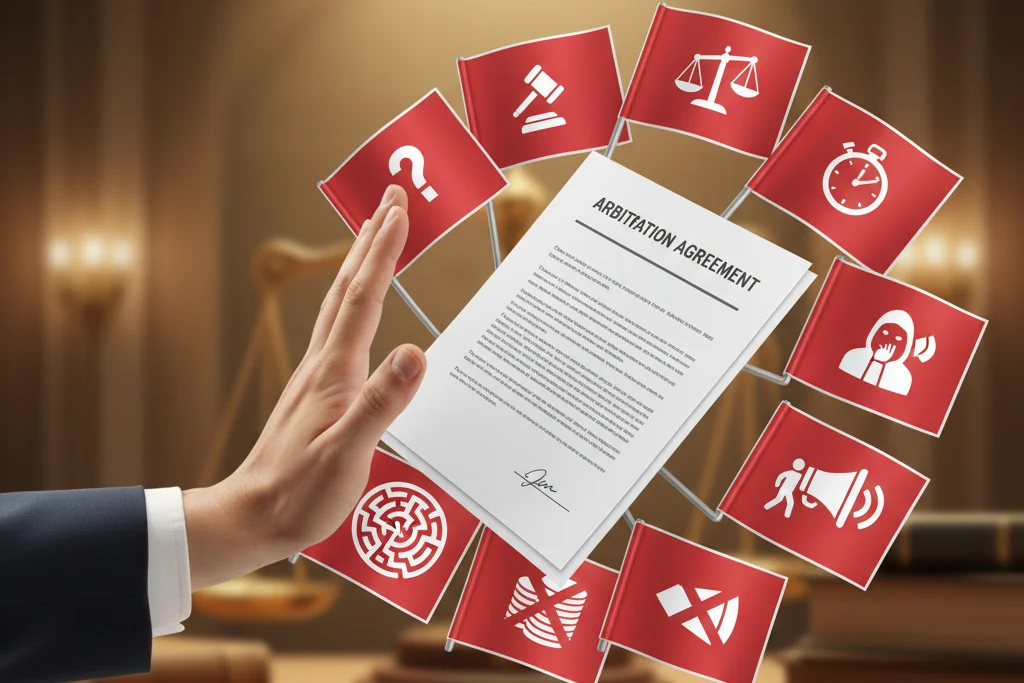
This guide is your contract defense toolkit. We’ll walk you through 9 specific red flags that signal trouble in an arbitration clause. If you recognize even one of these in your agreement, stop. Read on. And don’t sign until you’ve made the terms fair for both sides.
9 Red Flags Arbitration Terms Are Unfair & How to Push Back
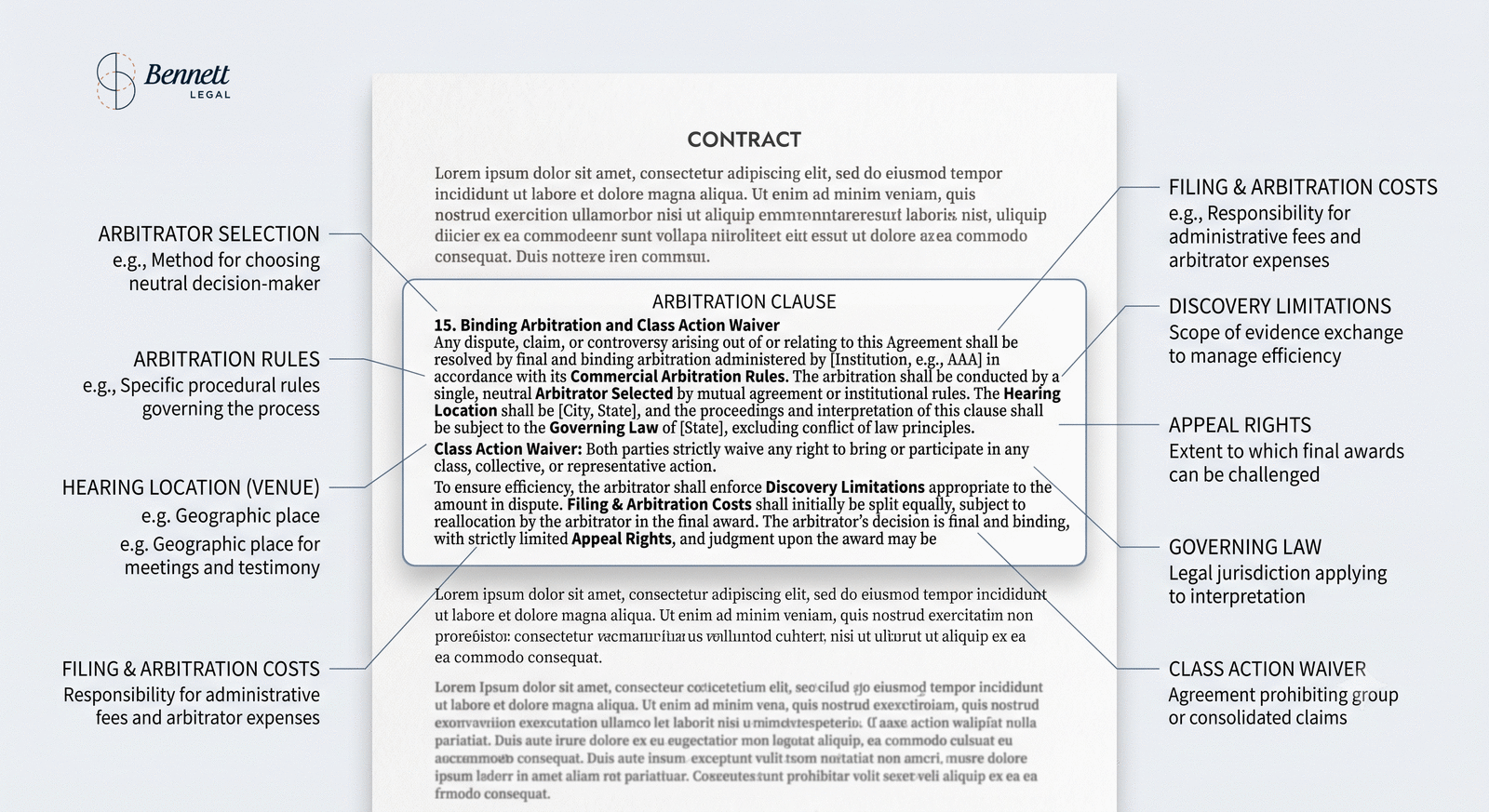 Infographic showing the anatomy of an arbitration clause with labeled sections explaining arbitrator selection, costs, venue, discovery limitations, governing law, and class action waivers.
Arbitration can be a fair, efficient way to resolve disputes - in theory.
In practice, however, arbitration clauses in consumer, employment, and service contracts are too often designed to stack the deck in favor of the party who drafted them.
If you know where to look, you can spot unreasonable arbitration terms before you’re bound by them. Here are nine red flags, explained in depth, along with practical scripting for pushing back.
| Red Flag | Core Risk | Quick Push Back Tip |
| 1. “Sign Right Now” Pressure | Limits time to review and negotiate, increasing risk of agreeing to unfair terms. | Insist on 48–72 hours to review; document your request. |
| 2. All the Power on Their Side | One party controls arbitrator, venue, and rules - undermining neutrality. | Demand mutual selection from a neutral body like AAA/JAMS. |
| 3. Extremely Distant Venue | Makes pursuing claims costly and inconvenient; discourages participation. | Request local venue or virtual hearings. |
| 4. “You Pay Most of the Costs” | High fees deter filing, especially in low-value disputes. | Propose cost-sharing with caps or hardship waivers. |
| 5. Severe Discovery Limits | Restricts evidence access, weakening case preparation. | Tie discovery rights to established arbitration rules. |
| 6. Waivers of Certain Rights or Damages | Removes statutory remedies or damages you could win in court. | Ensure remedies match what law allows; remove broad waivers. |
| 7. Mandatory [Binding Arbitration](/binding-non-binding-arbitration-differences/) with No Exceptions | Final decision with no appeal; mistakes can’t be corrected. | Seek limited appeal rights for high-value or complex cases. |
| 8. No Carve-Outs for Certain Claim Types | Forces all disputes into arbitration, even urgent or low-value ones. | Add carve-outs for small claims and emergency relief. |
| 9. One-Way Clauses | Only you must arbitrate; other party can still sue. | Require mutual arbitration obligations for both sides. |
1. “Sign Right Now” Pressure
 Person being rushed to sign a contract on the spot, illustrating high-pressure tactics used to prevent review of an arbitration clause before signing.
“Sign right now” pressure is one of the most telling early indicators that a contract may contain terms – including arbitration clauses – that are unfavorable to you. The essence of this tactic is speed: the other party is deliberately trying to shorten your time horizon for decision-making, leaving you with insufficient opportunity to review, question, or negotiate the details.
When presented with any agreement, most people naturally want to avoid confrontation and maintain goodwill with the other party. This tendency is heightened when urgency is manufactured – for example, by suggesting there’s a limited-time opportunity or that delays will cause logistical complications.
This places you in a mental state that values preserving the relationship or locking in the deal over thoroughly protecting your own interests.
Hidden Consequences:
- You effectively waive your right to scrutinize terms.
- You lose the single strongest bargaining moment: before consent.
- You risk agreeing to rules that are intentionally disadvantageous.
- Clauses may be in dense, small-print sections that are easy to miss.
- Without time to research arbitration rules or costs, most people default to trusting the other party.
Push Back Script: “I appreciate the opportunity and I want to make sure we both move forward on solid footing. I’ll need a short period to review the full agreement carefully, so I can confirm the arbitration and dispute terms align with fair standards. This ensures neither of us faces misunderstandings later.”
Pro Tips:
- State clearly and confidently that you require a reasonable period (commonly 48–72 hours) to read and assess the agreement in full, including dispute resolution provisions.
- If they truly need your commitment for scheduling purposes, ask to sign a Letter of Intent or service confirmation without the arbitration clause, and finalize terms after a review.
- Always make the request for time in writing (email or dated note). This creates a record and may help later if coerced consent is challenged.
2. All the Power on Their Side
An arbitration agreement should provide a balanced framework that gives both parties equal influence over key elements of the process, such as choosing the arbitrator, deciding the venue, and setting procedural rules. When an agreement grants one party exclusive control over these factors, it blatantly undermines neutrality and fairness.
This is a structural imbalance, not just a technical detail. The party holding sole authority can shape the dispute process to its advantage - selecting individuals or institutions that routinely side with them, designing timelines that work in their favor, or imposing procedural restrictions that weaken your case from the outset.
From a negotiation standpoint, handing over all procedural power removes the checks and balances needed to ensure unbiased dispute resolution. Arbitration becomes less about justice, and more about managing outcomes.
Hidden Consequences:
- Risk of repeat-player bias where arbitrators rely on ongoing business with the controlling party and may lean toward their interests.
- Potential implementation of custom rules that limit remedies, shorten hearings, or restrict witnesses to disadvantage your position.
- Venue selection manipulation, increasing your costs, inconvenience, and logistical barriers to presenting a strong case.
- Loss of collaborative decision-making that fosters trust and fairness in resolving disputes.
- Reduction in transparency, as the controlling party can dictate how much information is shared, how it is processed, and how the decisions are documented.
Push Back Script: “We should mutually agree on the arbitrator and rules by selecting them from a recognized, neutral organization such as the American Arbitration Association or JAMS. That way, we both have confidence in the process and its fairness.”
Pro Tips:
- Insist on mutual selection of the arbitrator or a system where each side nominates candidates and a neutral third party makes the final appointment.
- Request that procedural rules be drawn from established arbitration bodies (AAA, JAMS, or similar) rather than bespoke or in-house rules.
- Document any refusal to allow shared control - it may help to demonstrate procedural unconscionability later.
- If neutrality in selection is denied, consider walking away or seeking legal review before committing. An unbalanced arbitration clause often signals broader contractual unfairness.
3. Extremely Distant Venue
When an agreement stipulates a venue that is far from your location, it creates immediate logistical and financial barriers to pursuing a dispute. This is not merely an inconvenience - it is a calculated tactic that can discourage parties from filing claims or fully presenting their case.
From a fairness perspective, venue clauses should aim for geographic neutrality. When they do not, it raises questions about whether the process is being engineered to reduce the likelihood of challenges and to suppress legitimate claims.
Arbitration works best when both parties can participate without undue burden. A distant venue skews this balance, as the controlling party often chooses a location that is most convenient for them or strategically detrimental to you. This can make your engagement in the process costly, time-consuming, and harder to coordinate.
Hidden Consequences:
- Increased travel costs for transportation, lodging, and meals, which may exceed the potential recovery from the claim.
- Greater difficulty in bringing key witnesses, particularly if they cannot afford to travel or adjust their schedules.
- Significant loss of time due to travel days, impacting work, family responsibilities, and overall availability.
- Increased stress and fatigue from travel, which can impair performance during hearings.
- Potential for venue-related jurisdictional advantages that favor the other party through local rules, laws, or arbitrator familiarity.
Push Back Script: “For fairness and accessibility, the arbitration venue should be set within my state, or we should agree to conduct proceedings virtually. This ensures both parties can participate equally without unnecessary cost or hardship.”
Pro Tips:
- Suggest virtual or hybrid arbitration proceedings, which are now common and recognized by major arbitration organizations.
- If in-person hearings are necessary, propose selecting a mutually convenient location midway between both parties.
- Ensure any venue clause specifies flexibility, allowing a change in location by mutual agreement if circumstances change.
- Document any refusal to consider a more neutral venue, as it can highlight an imbalance for later legal review.
4. “You Pay Most of the Costs”
Arbitration can be significantly more expensive than filing a case in court, and an agreement that shifts most or all of these costs onto one party - typically the less-resourced party - can be a powerful deterrent to pursuing a claim.
Arbitration expenses may include arbitrator fees, administrative costs charged by the arbitration organization, travel, lodging, professional representation, preparation of exhibits, and expert witness fees. When you are responsible for covering most or all of these, the financial risk can outweigh the potential benefit of winning your case.
This cost allocation method is not accidental; it is often engineered to minimize the likelihood of challenges, especially in lower-value disputes. From a fairness standpoint, the costs of arbitration should be shared equitably or borne by the party with greater resources, particularly when that party insists on arbitration instead of litigation. Otherwise, the clause becomes a barrier to justice rather than an avenue for resolution.
Hidden Consequences:
- Significant upfront fees may prevent you from initiating a case at all.
- Risk of owing not only your costs but also the other party’s expenses if you lose (known as “fee-shifting” clauses).
- Reduced resources for legal representation, lowering your effectiveness in presenting your case.
- Psychological deterrence - fear of potential debt may cause you to settle unfavorably or abandon valid claims.
- Creation of an uneven playing field where the more financially robust party can pursue aggressive claims unhindered.
Push Back Script: “Given the disparity in resources, it’s fair that the party requiring arbitration should cover the majority of administrative and arbitrator fees so both sides can participate equally.”
Pro Tips:
- Request equal cost-sharing for base arbitration fees, with higher costs capped for each party.
- In lower-value disputes, propose that the filing party or the party requiring arbitration bear all costs beyond the filing fee.
- Ask for inclusion of a hard cap on individual party contributions to prevent runaway expenses.
- Seek an agreement that the arbitrator can waive or reassign fees based on financial hardship.
5. Severe Discovery Limits
Discovery - the process of exchanging documents, information, and witness testimony - is a cornerstone of fair dispute resolution. In arbitration, however, discovery rights can be sharply curtailed. When an agreement imposes severe limits on discovery, it reduces transparency, restricts access to evidence, and shifts control over critical information to the other party.
Discovery clauses that impose blanket restrictions, prohibit certain categories of evidence, or limit witness testimony substantially undermine your ability to present a comprehensive and accurate case. Restrictive discovery is particularly hazardous when the opposing party holds the majority of pertinent information, such as internal reports, communications, or contracts.
In a balanced arbitration process, discovery should be proportional to the claims at issue and should ensure both parties can substantiate their positions. Severe limits reflect an attempt to control narrative flow and prevent certain facts from coming to light.
Hidden Consequences:
- Inability to access vital documents that substantiate your claims.
- Limited witness availability prevents full exploration of disputed facts.
- Greater likelihood of being blindsided by evidence presented by the other party without prior access for review.
- Reduction in your ability to challenge the other party’s narrative effectively.
- Misalignment with general principles of procedural fairness recognized by respected arbitration bodies.
Push Back Script: “Discovery should allow reasonable access to key documents and witness testimony from both sides. This ensures neither party can restrict information necessary to a fair resolution.”
Pro Tips:
- Reference the discovery standards of established arbitration organizations (e.g., AAA or JAMS) when negotiating clause revisions.
- Request specific minimums: document exchange, limited depositions, and interrogatories if relevant.
- Include language allowing the arbitrator discretion to order additional discovery if one party holds critical information.
- Document any resistance to fair discovery - this may become important if the clause’s enforceability is challenged later.
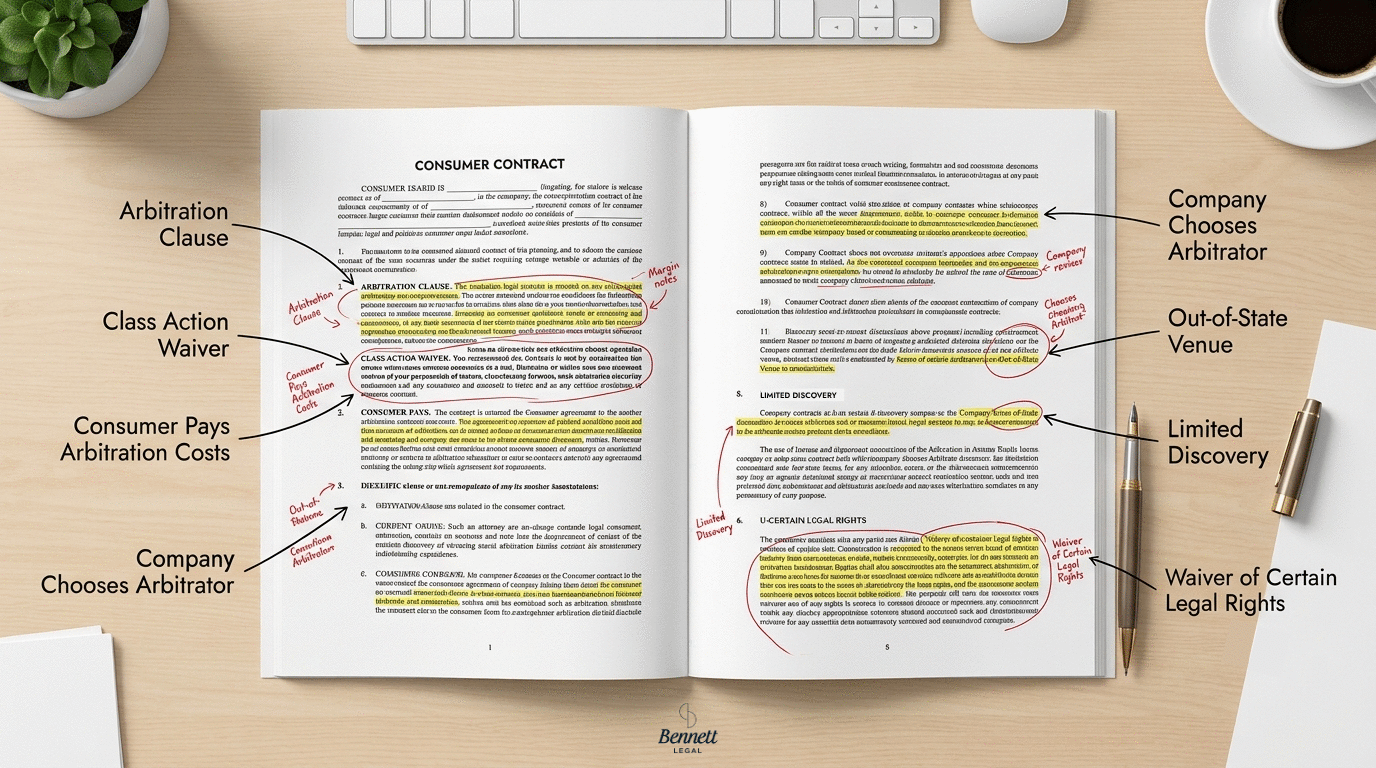 Legal contract with highlighted arbitration clauses and attorney-style annotations identifying unfair contract terms, including arbitration costs, class action waiver, and venue requirements.
6. Waivers of Certain Rights or Damages
Some arbitration clauses go beyond specifying procedure and venue - they actively strip away specific legal rights or remedies you might otherwise have under state or federal law. These waivers can include prohibitions on punitive damages, injunctions, statutory remedies, attorney’s fees recovery, or even certain categories of claims entirely.
While arbitration itself changes the forum for resolving disputes, these waivers change the substance of what you can achieve if you prevail. This can profoundly undermine the core purpose of pursuing a claim: protecting yourself from harm or obtaining fair compensation.
The inclusion of such waivers is rarely neutral. They are often designed to insulate the drafting party from significant legal consequences, limit their financial exposure, or prevent you from taking action that could disrupt their business operations - even if you have a valid case.
Hidden Consequences:
- Reduction in possible compensation, sometimes making the dispute not worth pursuing.
- Loss of injunctive relief, meaning you cannot legally stop ongoing harmful conduct.
- Elimination of certain statutory claims, reducing leverage for settlement.
- Restriction of attorney’s fee recovery, making it less feasible to obtain professional legal representation.
- Preclusion from pursuing claims that have public interest implications, reducing broader accountability for wrongful acts.
Push Back Script: “Remedies should reflect what is available under applicable law. Removing statutory rights or damages limits the fairness of the process and undermines the purpose of dispute resolution.”
Pro Tips:
- Identify and insist on removal of any clause that waives statutory or court-available remedies unless required by law.
- Request that remedies be aligned with applicable jurisdictional standards, rather than custom limitations.
- Ensure any injunctive relief clause allows urgent measures where ongoing harm is present.
- Have a legal professional review all remedy-related language; some waivers may be unenforceable in certain states.
7. Mandatory Binding Arbitration with No Exceptions
Mandatory binding arbitration means that whatever decision the arbitrator reaches is final and enforceable with no right to appeal or judicial review except in very narrow circumstances, such as cases of fraud or evident partiality. While this can expedite resolution, it can also lock in costly or unjust outcomes with no recourse.
Binding arbitration with no exceptions removes the safety net of appellate oversight. This structure assumes the arbitrator will always reach a fair and legally sound conclusion - an assumption that does not match reality. Mistakes can happen, bias can occur, and procedural errors may influence outcomes, but in a strictly binding framework, these issues cannot be corrected.
If your dispute involves complex facts, high stakes, or evolving legal standards, the absence of appeal mechanisms is particularly risky. You lose the opportunity to build a record in court or create precedents that can benefit similarly situated individuals.
Hidden Consequences:
- Irreversible decisions even when substantial errors are made.
- Increased vulnerability to arbitrator bias or misunderstanding of the case.
- Loss of opportunity for judicial precedent or clarification of ambiguous legal issues.
- Potential long-term financial harm if a large award against you cannot be challenged.
- Deterrence from pursuing legitimate claims for fear of permanent adverse rulings.
Push Back Script: “For disputes of significant value or complexity, arbitration should be non-binding unless both parties agree after the hearing, or there should be a limited right to appeal to ensure accuracy.”
Pro Tips:
- Propose tiered arbitration: start with non-binding arbitration for certain disputes, binding only by mutual consent.
- Request a clause allowing appeal to a second arbitrator, panel, or court for cases above a specified monetary threshold.
- Include carve-outs for disputes involving unsettled law or significant public interest, where appellate review may be appropriate.
- Understand the narrow legal grounds for vacating an arbitration award - these can be extremely difficult to meet.
8. No Carve-Outs for Certain Claim Types
Not all disputes are best suited for arbitration. Some are inherently more appropriate for certain courts or legal processes, whether due to urgency, simplicity, or statutory allocation. A fair arbitration agreement often contains carve-outs - specific types of claims that can bypass arbitration and be resolved through an alternative forum.
When a clause mandates arbitration for all disputes without exceptions, it forces even inappropriate cases into a process that may be slower, more expensive, or procedurally ill-suited. This can be especially damaging in time-sensitive matters or small-value disputes where arbitration costs outweigh the potential recovery.
Removing the flexibility to pursue certain claims in court unnecessarily restricts your available tools for protecting your rights. This rigidity is often intended to shield the drafting party from rapid or public challenges, rather than to promote efficiency.
Hidden Consequences:
- Urgent matters, such as those requiring injunctions or restraining orders, are delayed by arbitration timelines.
- Small-value disputes become financially impractical to pursue in arbitration.
- Certain statutory claims that benefit from specialized court handling lose those advantages.
- Inability to apply expedited court processes that could resolve disputes more swiftly.
- Mandatory arbitration for all matters undermines proportionality in dispute resolution.
Push Back Script: “Small claims and urgent matters should remain eligible for court proceedings. This ensures proportionality and preserves the ability to act quickly where circumstances demand.”
Pro Tips:
- Request carve-outs for small claims court, urgent injunctions, and statutory claims designated for specific tribunals.
- Specify monetary thresholds below which disputes default to small claims processes.
- Ensure carve-outs allow court access for time-sensitive relief where immediate action is required.
- Use language from established arbitration organizations to frame carve-out proposals in neutral terms.
9. One-Way Clauses
A one-way arbitration clause requires only one party - usually you - to resolve disputes through arbitration, while allowing the other party to take matters to court. This imbalanced approach removes mutuality, granting the drafting party greater strategic flexibility while limiting yours.
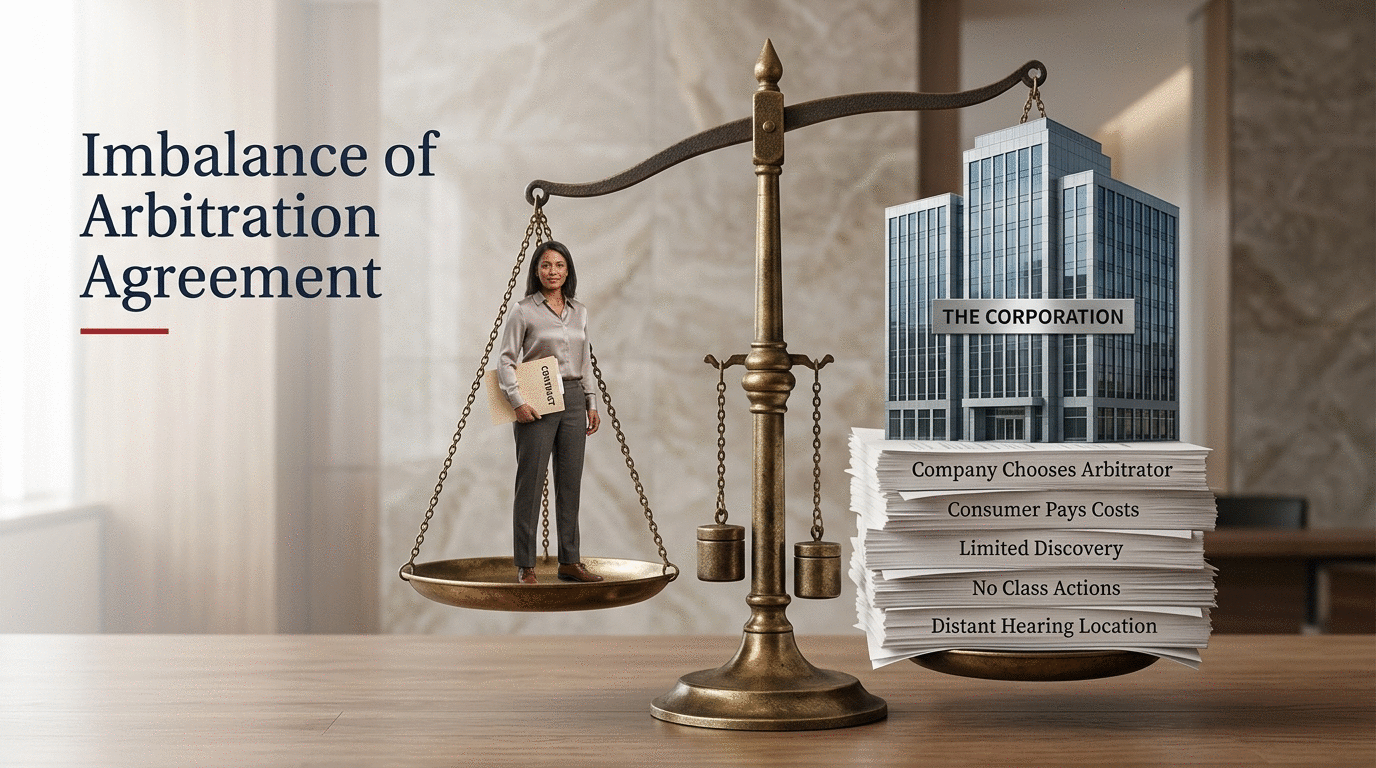 Illustration of a justice scale tipped in favor of a corporation because of one-sided arbitration contract terms, symbolizing an imbalance between consumers and companies.
Mutual obligation is a cornerstone of fair dispute resolution agreements. When one side has multiple forum options and the other has only arbitration, the result is a system designed to maximize one party’s leverage. In practice, this can mean they use court for claims beneficial to them (such as quick debt recovery) while forcing you into arbitration for claims more favorable to you in litigation.
From a fairness perspective, one-way clauses strip the process of equality. They often suggest that arbitration is not universally advantageous - otherwise, the drafting party would bind itself to the same requirement.
Hidden Consequences:
- The other party retains tactical choice of forum, using it to their advantage.
- You lose access to potentially faster or more favorable court processes for certain claims.
- Asymmetry in options can lead to unbalanced settlement negotiations heavily skewed toward the other party.
- The presence of a one-way clause signals broader inequities in the contractual relationship.
- Reduced incentive for the drafting party to negotiate fair arbitration terms since they can bypass them.
Push Back Script: “For fairness and balance, both parties should agree to the same dispute resolution process. Mutuality ensures confidence and trust in the outcome.”
Pro Tips:
- Insist on mutuality - any arbitration obligation should apply equally to both sides for comparable claims.
- If mutuality is refused, explore whether alternative terms can offset the asymmetry, such as cost-shifting in your favor.
- Document the one-way nature clearly; in some jurisdictions, this can support an argument for unconscionability.
- Question why the other party is unwilling to bind themselves - the answer often reveals their expectation of advantage.
When Arbitration Stops Being Fair - Bennett Legal Protects Your Rights
Arbitration clauses are often slipped into contracts as routine “standard terms.” But standard doesn’t always mean fair. In the wrong hands, arbitration becomes less about resolving disputes efficiently and more about controlling outcomes in favor of the drafting party.
The venue, the arbitrator, the rules, the costs - every detail in the fine print can tilt the playing field before your case even begins. And once you’ve signed, those details are binding.
At Bennett Legal, we make sure you don’t walk into arbitration unaware or unprepared. Our legal team works with you to:
- Spot hidden disadvantages - from one-sided venue rules to biased selection processes - before they can harm your position.
- Decode the legal language so you understand exactly how an arbitration clause would apply to your unique case.
- Negotiate fairer terms that protect your rights and create mutual obligations between you and the other party.
- Defend you in arbitration with the same strategic depth and evidence-driven approach we use in court.
- Challenge unfair awards in situations where arbitrators exceed their authority, show bias, or disregard fundamental fairness.
We know arbitration isn’t always the enemy - but unbalanced arbitration is. Whether your dispute is with a contractor, an employer, a service provider, or a corporate entity, our mission is the same: to level the playing field and safeguard your right to a fair resolution.
Because your rights should be protected by the contract you sign - not signed away by fine print.
Free consultation
Facing forced arbitration?
Know your rights. Bennett Legal can help you navigate the process.
Related Reading
Free consultation
Facing forced arbitration?
Know your rights. Bennett Legal can help you navigate the process.