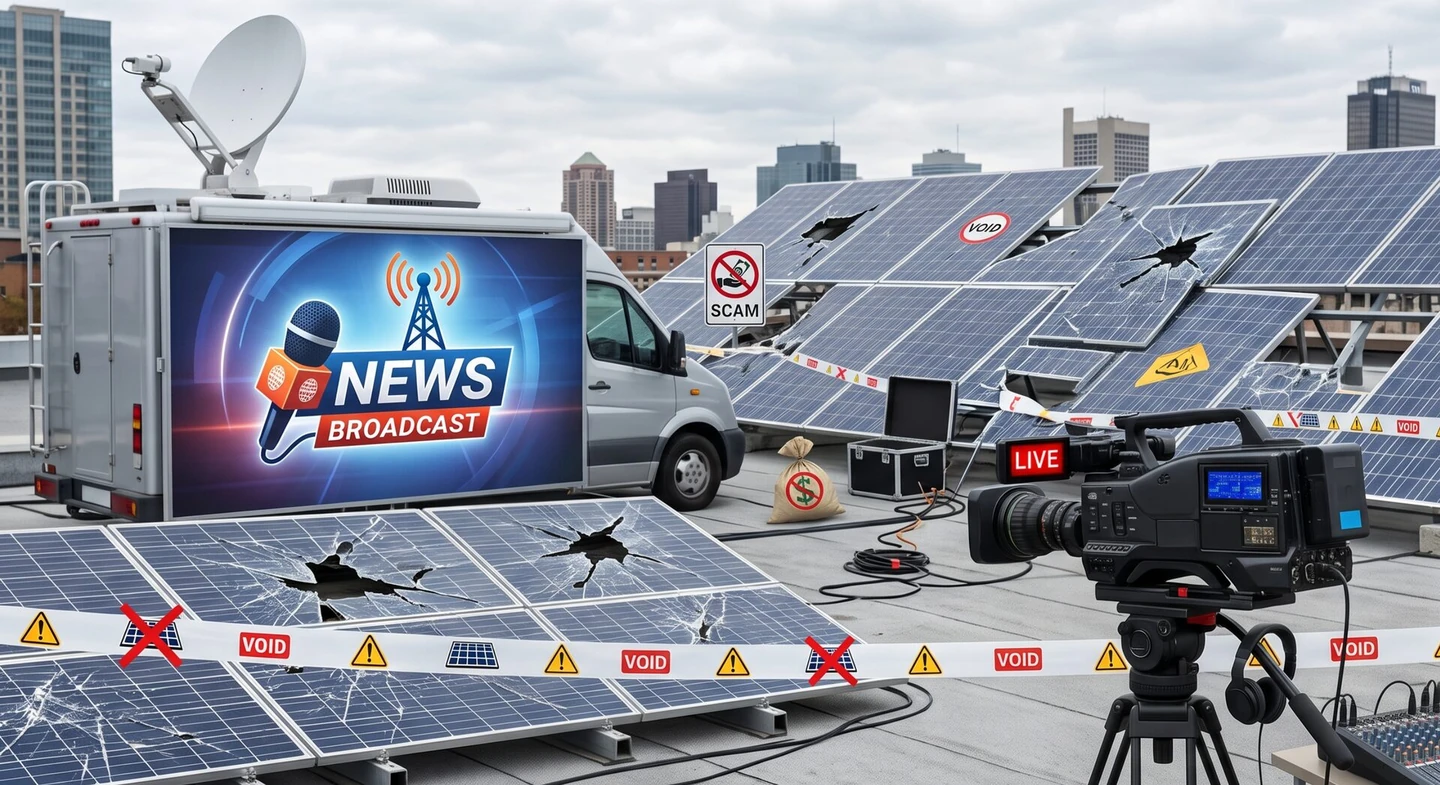
A new CBS News Texas investigation (watch the full report) highlights a growing problem for solar customers: homeowners are being left with broken solar panels and faulty systems while their monthly loan payments keep arriving on schedule.
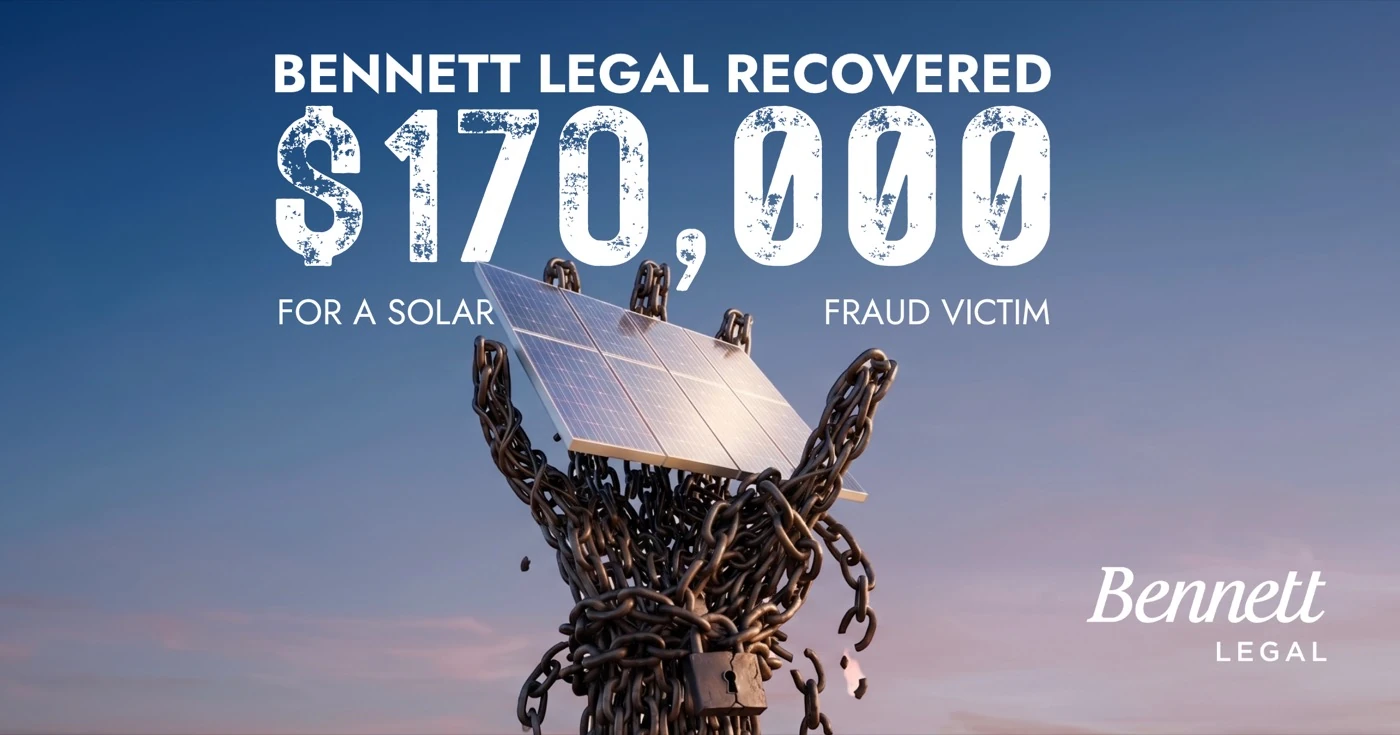
$170,000+ recovery
Against Sunlight Financial · Solar fraud arbitration
- $113,000 loan cancelled
- UCC lien removed
- Credit repaired
- $58,000 cash to client
Past results do not guarantee a similar outcome. Every case is different.
The report centers on Christina Jimenez, a Fort Worth homeowner whose panels started failing last year. When she tried to reach the company that sold and installed her system, TriSmart Solar, fourteen emails and dozens of phone calls went nowhere. Meanwhile, GoodLeap, the lender behind her $67,000 solar loan, kept billing her every month. Her mother, in Odessa, is dealing with the same problem after her panels — sold by Lumio, which filed for bankruptcy in 2024 — stopped working with no one to call for a repair.
Free consultation
Solar Company Gone? Panels Not Working?
Bennett Legal can review your solar contract, financing documents, and warranty paperwork to help you understand your options. Free consultation.
"I found out on Reddit they'd closed TriSmart." — Christina Jimenez, to CBS News Texas
The Real Problem Isn't Bankruptcy — It's Abandonment
Solar company bankruptcies aren't rare anymore. CBS reports that roughly 100 solar businesses nationwide have closed in recent years, including major names like Freedom Forever, Sunnova, and Solar Mosaic, as a shrinking federal tax credit and a wave of loan defaults squeezed the industry. But for the homeowner standing in their driveway staring at a dead panel, the bankruptcy filing itself isn't the real problem. (For the legal mechanics of what a bankruptcy filing does and doesn't erase, see our guide on what happens to your panels, contract, and warranty when a solar company goes bankrupt.)
For homeowners, the problem is not just bankruptcy. The problem is abandonment. A company can close its doors, stop answering the phone, and disappear from its own website's leadership page — while the loan tied to its product keeps running exactly as if nothing happened. That gap between "the seller is gone" and "the bill is not" is where most of the real financial harm shows up.
What Is an "Orphaned Solar System"?
CBS's report uses a term worth borrowing: the orphaned solar system. An orphaned solar system is a system still sitting on a homeowner's roof, still tied to a loan or financing agreement, but no longer supported by the company that sold it, installed it, or promised to maintain it.
That means no one to call for a warranty claim. No one who can tell you which manufacturer made your inverter. No one showing up to fix a panel that stopped producing power six months ago. One attorney quoted in the CBS report noted that homeowners still paying off a solar loan are typically left holding a UCC lien — a legal filing that gives the lender a recorded interest in the homeowner's property until the loan is paid off, whether or not the system actually works. We've written before about how these liens get placed and what homeowners can do about them.
"The Company Is Gone" Does Not Always Mean "Your Rights Are Gone"
It's easy to assume that once the installer disappears, so does your recourse. That's rarely true, and it's the misconception we see most often.
A single solar purchase can involve several separate legal entities: the sales company, the installer, the equipment manufacturer, the lender who financed the loan, and — increasingly common after a bankruptcy — an assignee that bought the loan or "stepped in" to service it. CBS's report describes exactly this with SunStrong, which took over servicing for customers whose panels were financed through the now-bankrupt Sunnova.
Your legal options often depend on which of those entities did what, and when. What does the original contract say about warranties and service obligations? What do the financing documents actually authorize the lender or its assignee to do? What representations were made during the sales pitch about production, savings, or maintenance? Whether the system was defective, misrepresented, or simply never serviced as promised can all matter — separately from whether the original seller still exists.
Why Are Homeowners Still Paying for Broken Solar Panels?
This is the part that catches most homeowners off guard, and it's the emotional and financial center of the CBS report.
Solar loans are typically structured as separate from the installation contract. The company that sold and installed your panels and the company that financed them are often not the same business — which means one can go bankrupt while the other keeps collecting. CBS reported that one homeowner is now paying $300 a year for a service plan just so someone will fix her panels if they fail again, while another was quoted a $700 fee just to have hers inspected, with no guarantee of a repair.
"They informed me that SunStrong had taken over Sunnova after Sunnova went bankrupt... if I don't pay these two bills that I'm behind and get caught up, that they have the right to foreclose on my house." — Terry Pullum, Seagoville homeowner, to CBS News Texas
Attorney Neal Prevost, who has spent years representing solar loan clients, put it plainly to CBS: promissory notes are assignable, and once a loan is legally assigned to a new lender or servicer, "you can't say 'I don't know you I'm not paying.'" Stopping payment on your own, without understanding the consequences, is not a safe shortcut — it can trigger credit damage, collection activity, and disputes over UCC liens or contract transfers that are harder to unwind later. Prevost also told CBS that arbitration can be a path to canceling these contracts, estimating that roughly 75% of customers who pursue it see some form of restitution, though exact outcomes vary and most settlements are confidential.
If you're weighing whether to keep paying, stop paying, or fight the contract itself, that's a decision worth making with facts in hand — not guesswork. Our guide on how to get out of a solar panel contract walks through the options in more detail.
GoodLeap and Sunlight Financial: Bennett Legal Is Taking Cases Now
If your loan is through GoodLeap — the lender CBS found was still billing Christina Jimenez on her $67,000 loan after her installer vanished — or through Sunlight Financial, one of the largest solar lenders in the country, Bennett Legal is actively taking cases right now.
These aren't fringe lenders with a handful of bad reviews. State attorneys general across the country are investigating or suing them for the same practices playing out in the CBS report:
| State | Action | Scale |
|---|---|---|
| **Minnesota** | AG sued GoodLeap, Sunlight Financial, Solar Mosaic, and Dividend Solar for hidden dealer fees added to loans without disclosure | 5,000+ homeowners · $35M+ in undisclosed charges |
| **New York** | Deceptive sales and financing allegations against solar lenders targeting homeowners | Ongoing AG investigation |
| **Virginia** | State enforcement action for deceptive practices by residential solar companies | 4,000+ households · $200M+ in solar loans · nearly 500 complaints filed |
| **Texas** | AG enforcement initiative with Civil Investigative Demands (CIDs) targeting residential solar companies | Active enforcement — and where Bennett Legal fights these cases every day |
When four states are investigating the same lenders for the same conduct, it's not bad luck — it's a business model. We're currently accepting GoodLeap and Sunlight Financial cases. Tell us what happened →
What Homeowners Should Do After Seeing This Report
If any part of this sounds familiar — your installer is unreachable, your panels aren't producing, or you're still being billed for a system that doesn't work — start building your paper trail now, before you talk to anyone at the lender.
- Save the CBS article if it reflects what happened to you — it's a useful reference point for timelines and industry context.
- Download your solar contract and financing agreement in full, including any addenda or disclosures.
- Save every bill and payment statement, especially any that changed after a company bankruptcy or loan transfer.
- Screenshot your monitoring app showing production problems or an "out of business" status for your installer.
- Photograph broken, disconnected, or non-producing panels with visible dates.
- Write down the dates of every call, email, and service request you've made, and who (if anyone) responded.
- Request a written explanation from the lender, servicer, or assignee about who owns your loan and who is responsible for service.
- Do not sign a new service plan, transfer document, or release without understanding what rights you may be giving up in exchange.
- Talk to a consumer protection attorney before assuming you have no options — most homeowners in this situation have more leverage than they think.
⚠️ Before You Act on Your Own Steps 1–7 are safe to do today, on your own. Step 8 is where homeowners get hurt — signing a transfer document, a new service plan, or a release without a lawyer reviewing it first can waive rights you don't know you have. Talk to an attorney before you sign anything or stop paying anything.
Why You Should Contact Bennett Legal
- We know these exact lenders. We're currently representing homeowners in active matters against GoodLeap and Sunlight Financial — the two lenders at the center of this report — plus other financiers named in the CBS investigation. We're not learning who these companies are for the first time on your case.
- We know how UCC liens and loan assignments work. Whether your loan was sold to a new servicer, your installer vanished, or a UCC lien is sitting on your title, we can tell you what it actually means and how to challenge it.
- We've gotten real results. $170,000+ recovered for one Texas homeowner in a single solar fraud arbitration against Sunlight Financial — loan cancelled, lien removed, credit repaired, cash in her pocket.
- Request an initial case review. Ask about attorney fees and case expenses before deciding whether to move forward.
- Deadlines are real. Many solar fraud and misrepresentation claims have limited windows to act — waiting costs you options, not just time.
Talk to a Solar Fraud Attorney Before You Decide Anything
If your solar company disappeared, your panels stopped working, or you're still being billed for a system that doesn't perform, you're not the only one — and you're not without options. Bennett Legal can review your solar contract, financing documents, and warranty paperwork to help you understand what you're actually obligated to pay, what your lender or its assignee is required to do, and whether you have a claim worth pursuing. Homeowners dealing with a solar company that lied about savings or performance should also see our related guide on what to do when a solar company misrepresents your savings.
Contact Bennett Legal for a free consultation before you sign anything, stop paying anything, or assume your rights disappeared along with your installer.
"I want reform in the solar industry so that this doesn't happen." — Christina Jimenez, to CBS News Texas
Sources: CBS News Texas, "Solar bust: Bankruptcies leave some solar customers with broken panels, faulty systems," July 7, 2026; Center for Responsible Lending, "Widespread Residential Solar Energy Adoption Threatened by Industry Sales and Financing Model"; WFSB, "I-Team: Solar bankruptcies force CT homeowners to do business with new company; AG investigating," May 4, 2026.
Free consultation
Solar Company Gone? Panels Not Working?
Bennett Legal can review your solar contract, financing documents, and warranty paperwork to help you understand your options. Free consultation.