
Hey folks, Tall Chuck here from Bennett Legal — and today I'm suiting up to take on one of the biggest villains in the solar financing world: Sunlight Financial.
$170,000+ recovery
Against Sunlight Financial · Solar fraud arbitration
- $113,000 loan cancelled
- UCC lien removed
- Credit repaired
- $58,000 cash to client
Past results do not guarantee a similar outcome. Every case is different.
This isn't a small story. This is a full-on origin arc — a company that positioned itself as the hero of clean energy financing and allegedly ended up hiding millions in fees from the very homeowners it was supposed to serve. The Minnesota Attorney General is in the fight. The bankruptcy courts have weighed in. And real homeowners — thousands of them — are still holding loan balances they may never fully understand.
Here's the complete Sunlight Financial litigation update, written in plain English. No jargon. No spin. Just the facts you need to know if you have a Sunlight Financial solar loan.
Free consultation
Solar panel contract problems?
We review Sunlight Financial solar loan disputes. Free case evaluation.
Why Sunlight Financial Is Facing Legal Scrutiny
Let me give you the origin story first. Sunlight Financial was a solar lending platform — the company that powered the financing for hundreds of thousands of residential solar installations across the country. They weren't the installer. They weren't the panel manufacturer. They were the money behind the deal, connecting homeowners to solar loans originated through banks like Cross River Bank.
For years, the solar sales machine was printing money — and Sunlight was right in the middle of it. Installers loved the easy financing. Homeowners signed on the dotted line. And fees — sometimes enormous ones — allegedly got baked into loan balances without anyone telling the borrower.
This pattern isn't unique to Sunlight. We've documented similar issues with GoodLeap complaints, where borrowers have reported hidden fees, payoff problems, and contractor failures. The difference here is scale — and the fact that a state Attorney General has stepped in.
Three things brought Sunlight Financial into legal crosshairs:
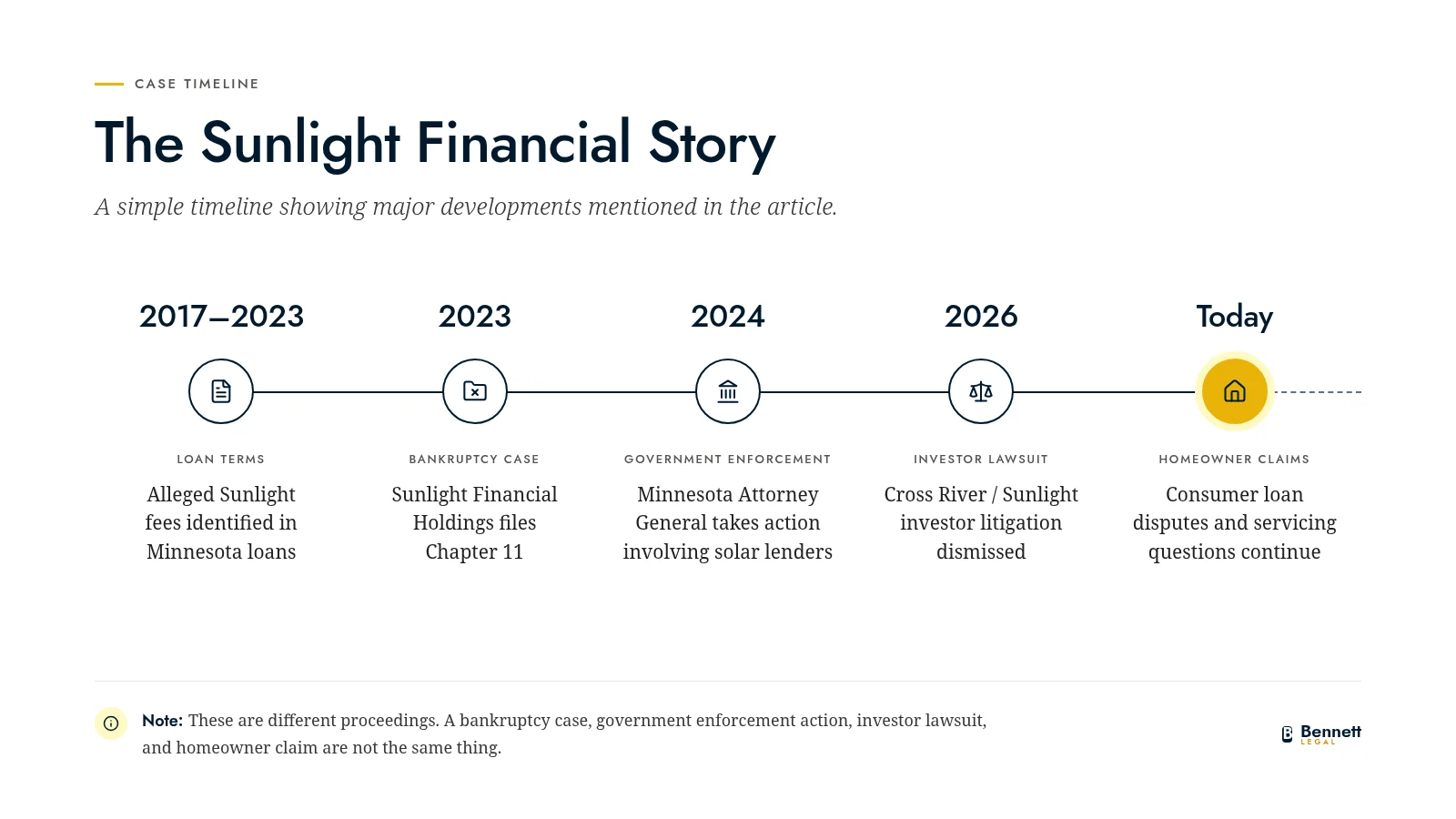
First, the Minnesota Attorney General filed a landmark enforcement lawsuit targeting Sunlight Financial and the broader solar lending ecosystem, alleging that hidden upfront fees were systematically built into loan amounts without proper disclosure.
Second, Sunlight Financial filed for Chapter 11 bankruptcy in 2023 — a significant corporate collapse that shook the solar lending industry and left thousands of borrowers uncertain about who actually holds their loan.
Third, investor litigation involving Cross River Bank and Sunlight dragged the company's financial practices into federal court, drawing even more scrutiny to how its lending model actually worked.
Here's the hard truth: you may be paying on a loan that includes thousands of dollars in hidden fees that you never agreed to — and you may not even know it.
If you have a Sunlight Financial solar loan, Bennett Legal can review your documents. Available options depend on your documents and facts. Free case evaluation.
Minnesota AG Lawsuit Against Sunlight Financial
The Minnesota Attorney General lawsuit is the centerpiece of the Sunlight Financial legal saga, and the numbers are staggering.
The AG's complaint names Sunlight Financial as part of a broader enforcement action targeting solar lenders and installers across Minnesota. The allegations: lenders and their installer partners built hidden upfront fees into the loan principal — fees that inflated what homeowners owed without ever appearing as a separate line item on any disclosure document.
The scale? The complaint targets approximately $35 million in alleged harm across nearly 5,000 Minnesota solar loans.
This isn't a minor clerical dispute. The Minnesota AG is alleging a systematic, industry-wide pattern of deceptive lending — and Sunlight Financial's loan portfolio is squarely in the middle of it.
Is Sunlight Financial being sued? Yes — as part of this Minnesota enforcement action specifically targeting how solar loan fees were disclosed (or not disclosed) to consumers.
Bennett Legal Settlement: $170,000 Recovered for a Solar Fraud Victim
While the Minnesota AG case plays out, homeowners don't have to wait for government enforcement to get relief. Bennett Legal has already secured major results for clients in similar situations.
$113,000 loan cancelled · UCC lien removed · Credit repaired · $58,000 cash to client
We recently recovered $170,000 for a solar fraud victim — the full loan was cancelled, the UCC lien was removed from the client's property, their credit was repaired, and $58,000 was delivered directly to them. Read the full Sunlight Financial settlement →
Results vary based on the facts of each case. But this outcome shows that significant relief is possible — including full loan cancellation, lien removal, credit repair, and monetary recovery. You don't have to wait for the AG's enforcement to get yours.
Sunlight Financial Hidden Fee Allegations
Now let me get specific — because this is where the Sunlight Financial litigation gets personal for real borrowers.
The Minnesota AG's complaint contains Sunlight-specific figures that should make anyone with a Sunlight loan take a long, hard look at their documents.
Here's what the complaint alleges for Sunlight Financial's Minnesota loan portfolio specifically:
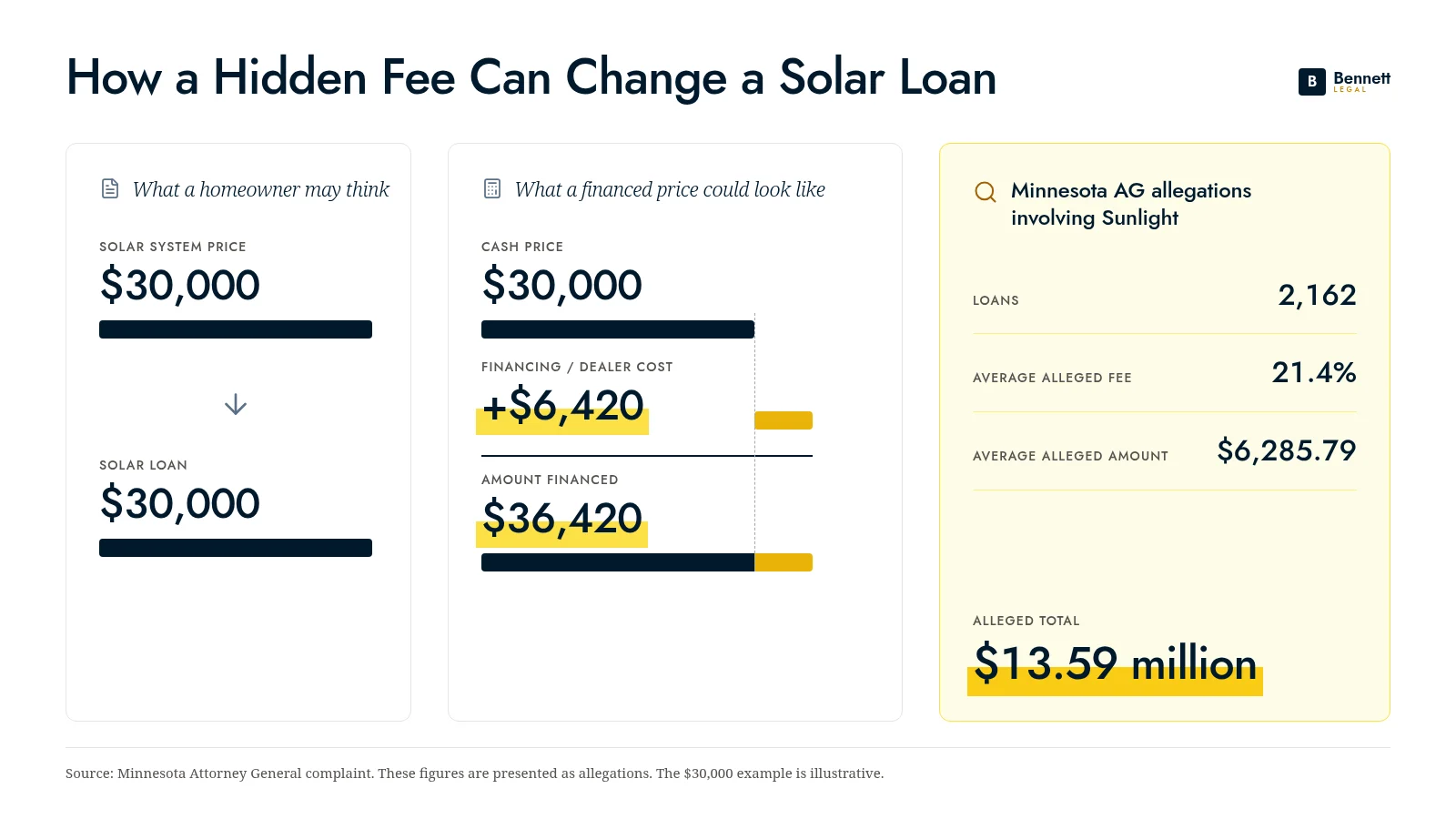
- 2,162 Minnesota Sunlight loans are at issue
- The alleged hidden upfront fee range: 2.5% to 55% of the loan amount
- The average alleged upfront fee: 21.4%
- That works out to an average of $6,285.79 per loan
- The total alleged hidden fees: $13.59 million — collected from Minnesota consumers between 2017 and 2023
Let me put that in plain English. On a $30,000 solar loan, a 21.4% hidden fee means approximately $6,400 was built into your loan balance before you made your first payment — and allegedly, you were never told about it.
Did Sunlight Financial hide fees in solar loans? According to the Minnesota Attorney General: yes, on a massive scale.
These fees go by different names in loan documents — "dealer fees," "program fees," "platform fees," "origination fees," or the accounting term "original issue discount" (OID). The allegation is that these fees were never clearly disclosed to borrowers as a separate cost of the loan, and that the annual percentage rate (APR) shown to borrowers didn't accurately reflect the true cost of the money they were borrowing.
If you have a Sunlight Financial solar loan — especially one originated between 2017 and 2023 — this is the section of this article you should print out and bring to an attorney.
We've seen the same hidden-fee pattern across multiple lenders. If your loan is through a different company, visit our Sunlight Financial practice page for a full breakdown of what to look for in your specific documents.
How Solar Tax Credits Factored Into Sunlight Loans
Here's where Sunlight's loan structure added another layer of complexity that tripped up thousands of borrowers. This isn't unique to Sunlight — it's an industry-wide issue — but Sunlight's specific loan terms made it particularly dangerous.
Many Sunlight Financial solar loans were structured around the federal solar Investment Tax Credit (ITC). Here's how the pitch typically went:
"You'll get a 30% federal tax credit when you file your taxes. Use that credit to pay down a chunk of your loan, and your monthly payment will stay low."
Sounds reasonable, right? Here's the villain twist.
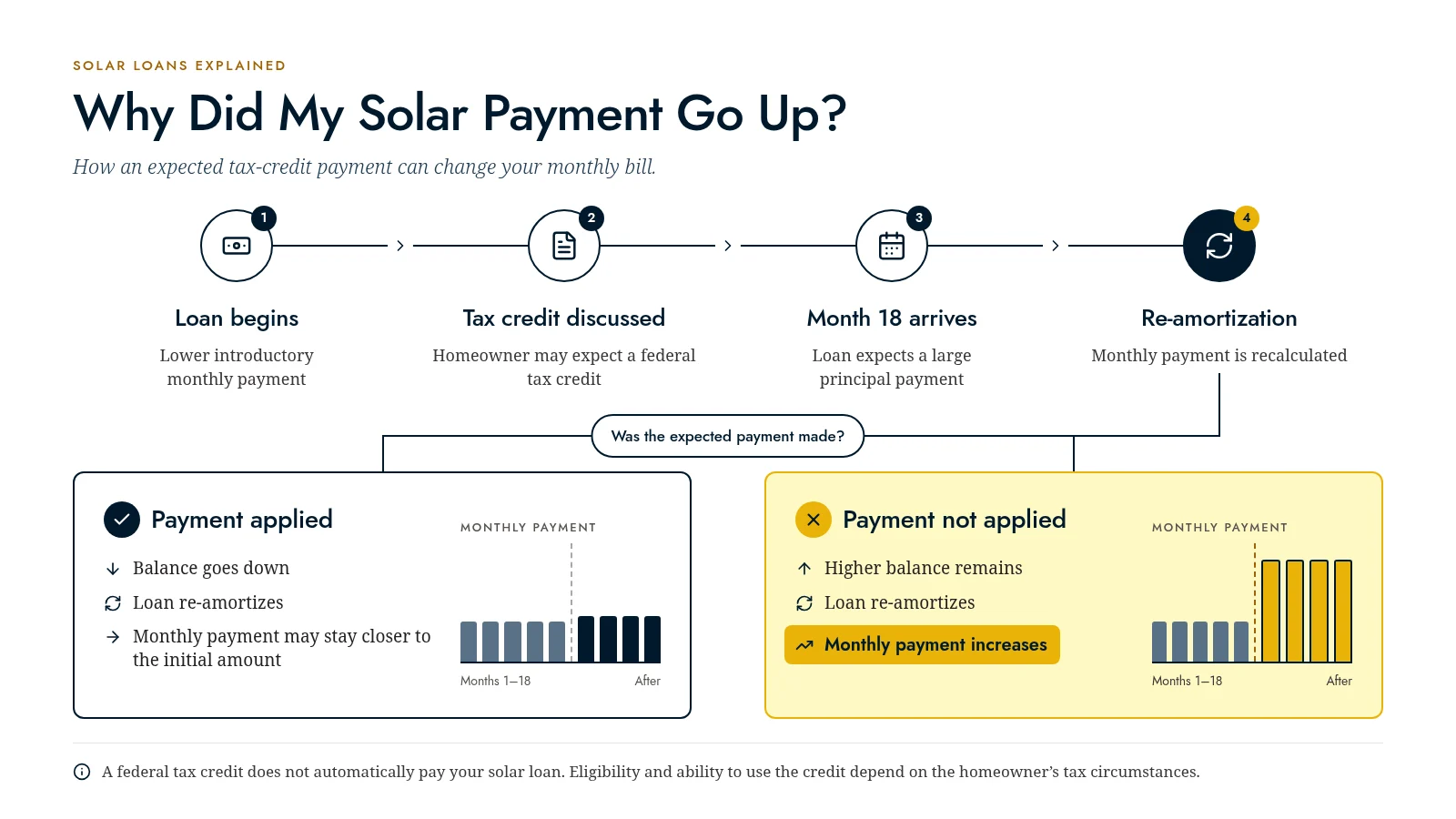
Sunlight loans were often structured with a lower initial payment for the first 18 months — a period specifically designed to coincide with when you'd theoretically receive and apply your tax credit. If you made that lump-sum payment at month 18, your loan would re-amortize at the lower balance, and your payment would stay manageable.
But here's what happened for thousands of borrowers:
- The tax credit wasn't explained accurately — they didn't qualify, or they couldn't apply it to reduce the loan
- No one told them they had to make the large payment at month 18 or face a significantly higher monthly payment
- When month 18 arrived, the loan re-amortized at the original (inflated) balance — and their payment jumped
Why did my Sunlight Financial payment increase after the tax credit period? Because the loan structure required a balloon-style payment at 18 months that many borrowers were never clearly warned about. If you didn't make it, you're now paying interest on a higher balance for the rest of the loan term.
This is a consumer protection issue. It's not a math error. It was a disclosure failure — and in many cases, it may rise to the level of deceptive lending under Texas and federal law.
Confused about your loan terms? Free case evaluation. We can review your documents and explain the questions they raise.
Sunlight Financial Bankruptcy: What Happened?
Did Sunlight Financial file for bankruptcy? Yes.
In 2023, Sunlight Financial Holdings filed for Chapter 11 bankruptcy protection. This was a significant event for anyone with a Sunlight-originated solar loan — and it created a wave of confusion among borrowers about who they owed, who to call, and whether their loan even still existed.
Here's the short version of what happened:
Sunlight Financial's business model depended on a steady flow of new solar installations and loan originations. When rising interest rates, installer failures, and increased regulatory scrutiny hit the solar industry in 2022 and 2023, Sunlight's origination volume collapsed. Without new business coming in, the company couldn't sustain its operations.
Chapter 11 isn't liquidation — it's a reorganization. Sunlight Financial's bankruptcy plan was confirmed, and the company emerged from restructuring. But the reorganization didn't erase your loan. It transferred servicing and ownership of loan portfolios, which is part of why so many borrowers found themselves suddenly dealing with Launch Servicing instead of Sunlight directly.
If you're having trouble reaching anyone about your loan, if your servicer seems to have changed, or if you've received confusing correspondence about your account — this is why. The bankruptcy reorganization reshuffled the deck on who holds and services Sunlight loans.
The bankruptcy does not eliminate your right to dispute improper fees or deceptive loan terms. Your legal claims travel with you regardless of who holds the paper.
To distinguish the installer from the lender or current servicer, compare the names on your sales agreement, financing contract and statements. The solar installer directory summarizes historical public records, while the Sunlight Financial resource page focuses on Sunlight-related financing information. Bennett Legal is not affiliated with Sunlight Financial.
Another Bennett Legal Win.
The Sunlight Financial bankruptcy changed who owns your loan — but it didn't change your right to fight back. Here's proof.
Full loan cancelled · UCC lien removed · $58,000+ cash delivered to client
In the Tellez case, Bennett Legal secured a $170,000+ total recovery against a solar lender using the same tactics alleged against Sunlight — hidden fees, misleading disclosures, and a UCC lien left on the client's property. See the full result →
The bankruptcy reorganization does not resolve questions about a particular loan. Your loan may be held by a new servicer; review the current statements and contract together. Free case evaluation.
Cross River Bank and Sunlight Financial Investor Litigation
This part of the Sunlight Financial story is important context — but I want to be clear about what it is and isn't.
Cross River Bank was one of the primary bank partners that originated solar loans through Sunlight Financial's platform. Cross River Bank vs. Sunlight Financial became the subject of investor litigation — a dispute between sophisticated financial parties about business losses and the collapse of the lending relationship.
That investor lawsuit was dismissed in 2026.
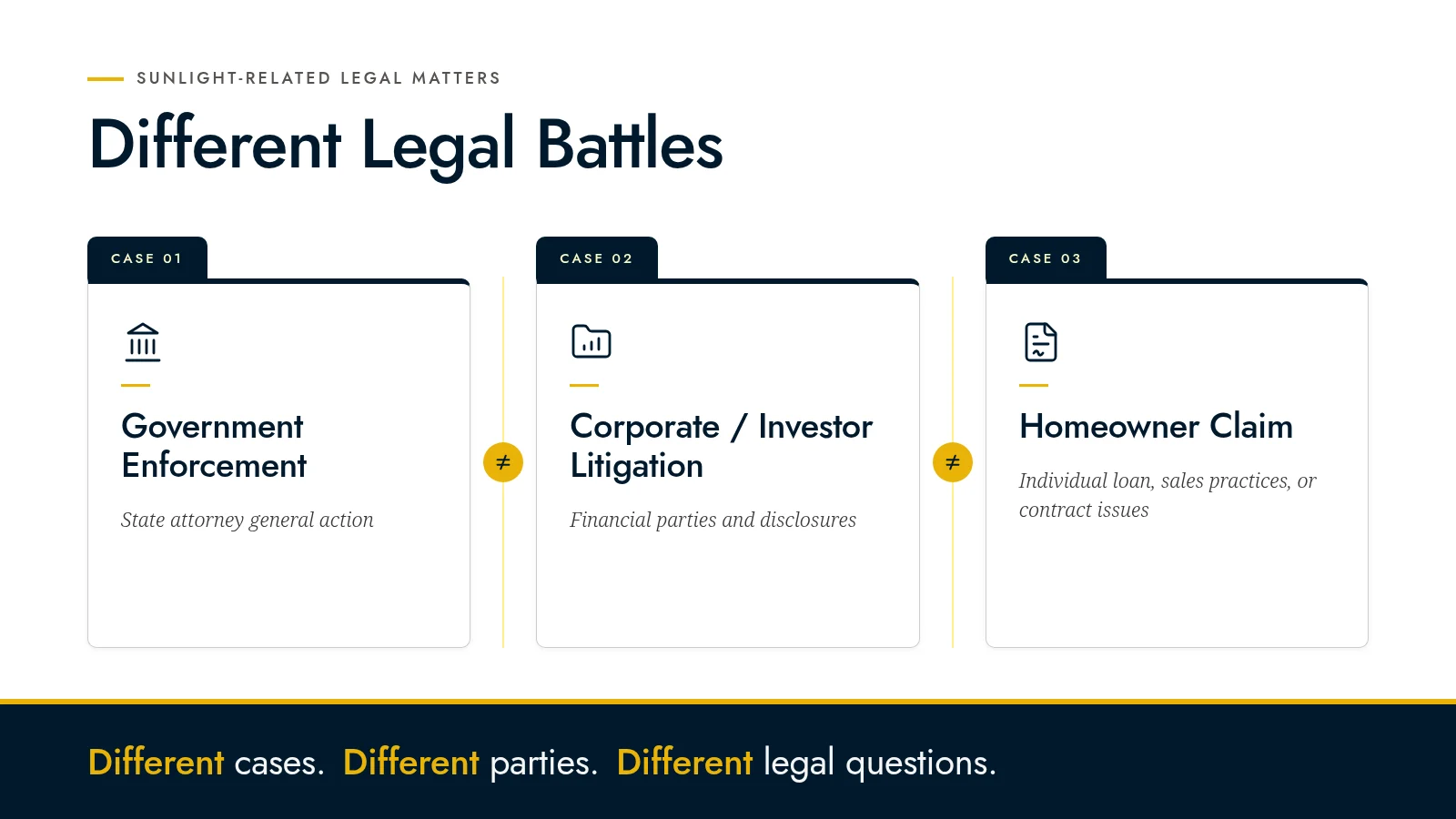
Here's what that means for you as a borrower: the Cross River Bank investor litigation is separate from consumer claims. The fact that investor litigation was dismissed doesn't mean your individual claim for undisclosed fees, deceptive tax credit disclosures, or loan servicing problems is dismissed. Those are entirely different legal theories pursued by different parties.
What the Cross River Bank-Sunlight litigation does tell us is that the business model at the heart of solar lending — where platform companies like Sunlight facilitated loans originated by partner banks — generated significant financial disputes even among the insiders who built it.
Consumer Complaints About Sunlight Financial
The Minnesota AG lawsuit and investor litigation are the formal legal battles. But the ground-level picture of consumer complaints about Sunlight Financial tells an equally important story.
Borrowers have filed complaints with the Better Business Bureau (BBB) and the Consumer Financial Protection Bureau (CFPB) in significant numbers. The themes are consistent:
Tax credit confusion. Borrowers weren't told that failing to make the 18-month lump-sum payment would cause their monthly payment to jump. Many didn't realize the lower payment was temporary until it was too late.
Installer bankruptcy. Thousands of homeowners found themselves paying on solar loans for systems installed by companies that subsequently went bankrupt — leaving incomplete installations, no warranty support, and no one to call for repairs.
Nonfunctioning solar systems. Panels that never produced the promised savings, systems that weren't properly permitted, and installations that failed shortly after completion — while the loan kept collecting payments.
Payoff problems. Borrowers trying to sell their homes reported significant difficulty obtaining accurate payoff amounts, creating complications at closing and — in some cases — title issues. We've documented the same pattern in our GoodLeap complaints article, where borrowers across different lenders report identical payoff problems.
Loan cancellation issues. Homeowners who tried to rescind loans after installation problems reported being stonewalled or given runaround responses.
Difficulty reaching servicing support. The transition through bankruptcy and servicer changes left many borrowers unable to get basic account information from Launch Servicing or other servicers who inherited their loans.
Can I dispute a Sunlight Financial solar loan? Whether a dispute is available depends on the contract, documents and facts. Free case evaluation.
What Homeowners With Sunlight Financial Solar Loans Should Check
This is where Tall Chuck gets practical. If you have a Sunlight Financial solar loan, here's your action plan.
Compare your cash price to your financed price. Pull your original sales proposal and your loan documents. The cash price the installer quoted should match (or be close to) the amount financed. If your loan balance is significantly higher than what you were quoted to pay out of pocket, you may have hidden dealer fees built into your loan.
Look for dealer fees, OID, program fees, or platform fees in your loan documents. These terms are the legal labels for what the AG is calling "hidden fees." If you find them — especially if you were never told about them in plain language — document everything.
Check whether the tax credit payment structure was explained accurately. Did anyone tell you in writing that you needed to make a specific payment at 18 months or your monthly payment would increase? Did the sales rep or installer accurately explain how the tax credit worked and what you'd need to do with it? If not, that's a disclosure failure.
Determine whether your installer completed the work. If your system was never fully installed, never received final permits, isn't producing power, or was installed by a company that has since gone bankrupt — you have a claim. The loan doesn't disappear because the installer did.
Check for UCC filings, liens, or title issues. Solar lenders often file UCC-1 financing statements. If you're trying to sell, refinance, or transfer your property, these filings can create complications. A title search will tell you what's there.
Preserve every document you have. Sales proposals, text messages, emails from the installer, loan disclosures, utility savings estimates, photos of the installation — all of it. Evidence has a way of disappearing over time, and you'll want it if you pursue a legal claim.
What happens if my solar installer went out of business but I still owe Sunlight Financial? You may still have claims against the lender directly, particularly if the lender's fees or disclosures contributed to the harm. The installer going bankrupt doesn't end your legal options.
Frequently Asked Questions
Is Sunlight Financial being sued? Yes. Sunlight Financial is named in the Minnesota Attorney General's enforcement lawsuit alleging hidden solar loan fees affecting nearly 5,000 Minnesota loans, with Sunlight-specific allegations totaling more than $13.5 million in undisclosed upfront fees from 2017–2023.
What is the Minnesota AG lawsuit against Sunlight Financial? It's an enforcement action by the Minnesota Attorney General alleging that Sunlight Financial and other solar lenders built hidden upfront fees — ranging from 2.5% to 55% of the loan amount — into solar loan balances without proper disclosure to borrowers.
Did Sunlight Financial hide fees in solar loans? According to the Minnesota AG's complaint, yes — an average of $6,285.79 per loan, across 2,162 Minnesota Sunlight loans, totaling $13.59 million in alleged undisclosed fees.
Can I dispute a Sunlight Financial solar loan? Yes. A pattern of undisclosed fees, inaccurate tax credit disclosures, or deceptive sales practices can support legal claims regardless of the bankruptcy reorganization. Talk to a solar fraud attorney.
What happens if my solar installer went out of business but I still owe Sunlight Financial? You may still have claims against the lender. The installer's bankruptcy doesn't eliminate your rights against the financing company, particularly if the lender's disclosures were defective or if the loan was made in connection with the installer's fraudulent promises.
Why did my Sunlight Financial payment increase after the tax credit period? Most likely because your loan was structured with a lower initial payment that depended on you applying a tax credit lump sum at 18 months. If that payment wasn't made — or couldn't be made — the loan re-amortized at the full balance, increasing your monthly obligation. If this wasn't clearly disclosed to you, it may be a deceptive lending claim.
Did Sunlight Financial file for bankruptcy? Yes. Sunlight Financial Holdings filed Chapter 11 in 2023, confirmed a reorganization plan, and emerged from bankruptcy. Loan servicing may have transferred to Launch Servicing or other servicers.
The Bottom Line
Sunlight Financial is at the center of a major enforcement action, a Chapter 11 restructuring, and a pattern of consumer complaints that tell a consistent story: homeowners who thought they were financing clean energy may have been paying on loans that hid thousands of dollars in fees they were never told about, with tax credit structures that were never properly explained.
At Bennett Legal, we review Sunlight Financial solar loan disputes. Ask about attorney fees and case expenses before deciding whether to move forward. If you have a Sunlight Financial solar loan and something about your balance, your payment, or your system doesn't add up, I want to hear your story.
From where I'm standing — as a trial attorney who has reviewed hundreds of solar contracts — the Sunlight Financial litigation is just getting started. And homeowners who act now, preserve their documents, and get a legal review are the ones who will be in the best position when this plays out.
Related reading:
- Sunlight Financial
- GoodLeap Complaints and Lawsuit Updates (2025–2026)
- Minnesota AG Solar Loan Lawsuit
- Sunlight Financial Settlement Results
- What to Do If a Solar Panel Company Lied About Your Savings
- How to Get Out of a Solar Loan You Didn't Agree To
- Signs You Might Be a Victim of Solar Panel Financing Fraud
- Solar Company Bankruptcy: What Happens to Your Contract and Warranty?
- Solar UCC-1 filings and consent
- Solar Panel Financing Fraud Practice Area
Free consultation
Solar panel contract problems?
We review Sunlight Financial solar loan disputes. Free case evaluation.