DISCLAIMER: Trucking accident laws — including federal motor carrier safety regulations, comparative fault rules, and statutes of limitation — vary by state. This article is general information only, not legal advice. Talk to a qualified attorney in your state as soon as possible about your specific wreck.
Hey folks, Tall Chuck here.
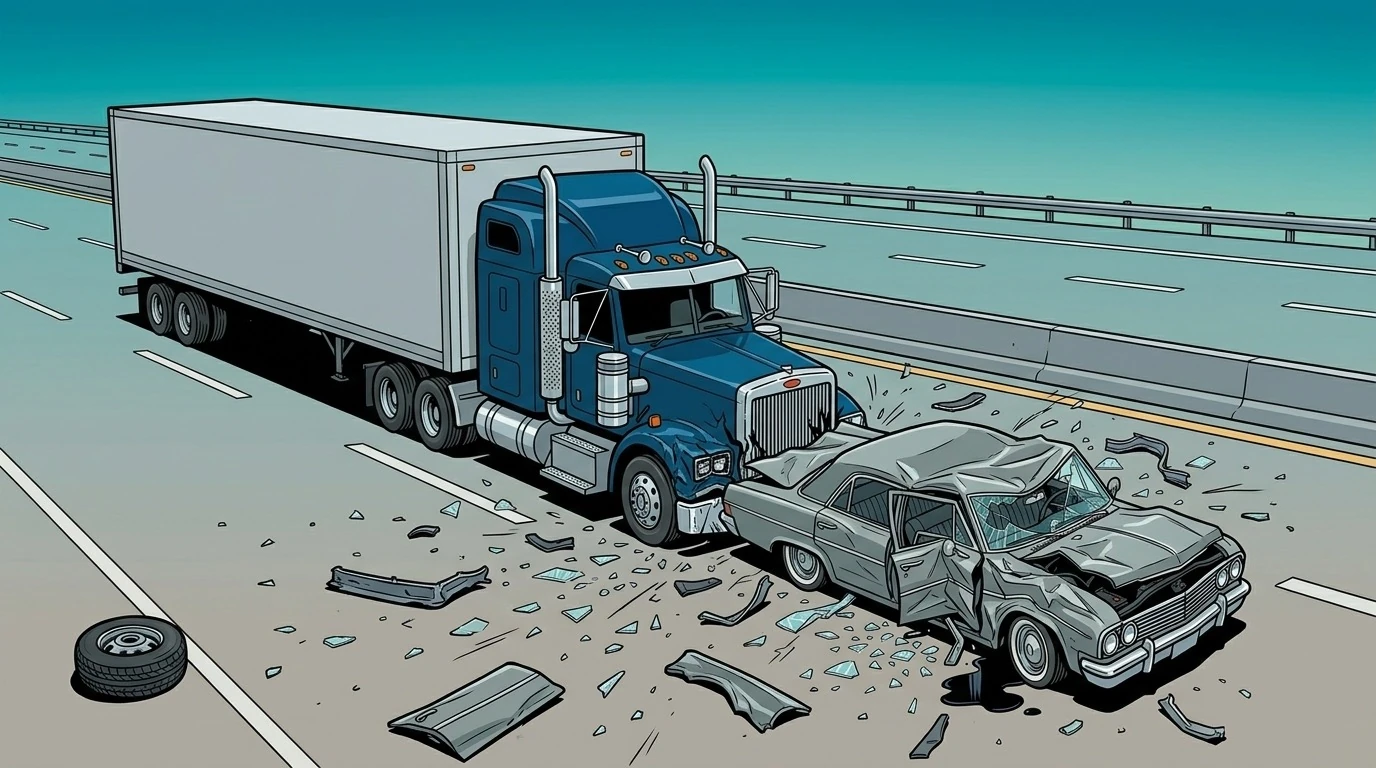
If you're reading this, chances are you or someone you love was hit by a big-rig — not just any commercial truck, but a full-blown 18-wheeler. Maybe you're staring at a crushed vehicle wondering how anyone walked away. Maybe the police report mentions "brake failure," "underride," or "jackknifing" and you have no idea what that means. Maybe the trucking company is already calling, acting real polite — which always makes me nervous.
Because here's the truth: 18-wheeler accidents aren't just "bigger truck" accidents. They're a whole different beast.
And if you don't understand those differences, you can lose the money you need to rebuild your life.
That's why having an experienced 18 wheeler accident lawyer — not just any personal injury attorney — matters more than most people realize.
Free consultation
Hurt in a truck accident?
Commercial truck cases are complex. Let an experienced attorney handle yours. Free consultation.
9 Reasons Why 18-Wheeler Accidents Are More Dangerous
Let's break this down step-by-step, the Tall Chuck way.
1. An 18-Wheeler Isn't Just "Bigger," It's Built Differently
Commercial trucks come in all shapes and sizes:
- delivery vans
- box trucks
- utility trucks
- dump trucks
- tow trucks
But an 18-wheeler — also called a semi-truck, tractor-trailer, or big-rig — is a multi-component machine with:
- a tractor
- a trailer
- air-brake systems
- multiple axles
- massive blind spots
- articulated steering
That means:
- more things can break
- more things can go wrong
- more companies can be responsible
If a box truck hits you, the case is serious.
But if an 18-wheeler hits you? The physics alone can change your life forever. And that's why an 18 wheeler accident lawyer handles these cases differently than a standard truck wreck — because the machine itself demands a different legal approach.
For a broader overview of why any commercial vehicle wreck is different from a regular car crash, see: 7 Reasons Why Truck, Rideshare, and Commercial Vehicle Wrecks Are Different
2. 18-Wheelers Have Longer Stopping Distances
Here's something most drivers don't think about:
An empty passenger car needs about 130 feet to stop.
A fully loaded 18-wheeler?
Up to 525 feet.
That's nearly two football fields.
So when folks ask why 18-wheeler crashes happen so often, especially rear-end collisions, the answer is simple:
They can't stop like regular vehicles — and bad drivers forget that.
Truckers who follow too close or speed turn their rig into a runaway missile.
3. Brake Failure Is a Big Problem — And Often Preventable
One of the biggest causes of 18-wheeler accidents commercial trucks face is brake failure.
Air-brake systems fail due to:
- skipped maintenance
- faulty hoses and valves
- overheated brakes on steep grades
- improperly loaded cargo
- worn-out brake pads
- ignored inspection requirements
Most "brake failure" crashes are not accidents — they're negligence.
And in the trucking world, brake failure is a red flag that tells me to investigate:
- the driver
- the mechanic
- the trucking company
- the maintenance contractor
- the brake manufacturer
- the cargo company
Because when an 18-wheeler's brakes fail, it's rarely one person's fault. It's usually a chain of failures up and down the company ladder.
For a deeper look at what actually causes these wrecks — backed by data and real cases — see: Commercial Truck Accident Causes
Tall Chuck says: "When somebody tells me 'the brakes just failed,' my first question is always: When was the last time those brakes were inspected? Nine times out of ten, the answer tells me everything I need to know about who's really responsible."
4. 18-Wheelers Have More Blind Spots — a Lot More
Cars have blind spots.
Trucks have blind zones.
An 18-wheeler has huge no-go areas:
- 20 feet in front
- 30 feet behind
- the entire right side
- half the left side
A box truck or work truck has blind spots too, but nothing this massive.
When unsafe lane changes happen, it's almost always the smaller vehicle that pays the price.
5. 18-Wheeler Loads Are Heavier — and More Dangerous
A typical SUV weighs around 4,000 pounds.
A fully loaded 18-wheeler?
Up to 80,000 pounds — 20 times heavier.
That weight causes:
- catastrophic injuries
- underride accidents (when a car goes under the trailer)
- jackknife crashes
- rollovers
- multi-vehicle pileups
Commercial vans and smaller trucks can cause serious damage, but nothing compares to the destruction an 18-wheeler creates when something goes wrong.
6. There Are More Rules for 18-Wheelers — and More Ways Companies Break Them
All commercial trucks have regulations, but 18-wheelers have the strictest federal rules:
- hours-of-service limits
- drug and alcohol testing
- weight restrictions
- mandatory inspections
- ELD (electronic logging) requirements
- cargo securement laws
- interstate safety compliance
And every one of these rules exists because — when an 18-wheeler fails — people die.
When we handle these cases at Bennett Legal, we look closely for:
- fatigue
- logbook violations
- overweight loads
- fake inspection stickers
- companies pressuring drivers to speed or skip rest
- prior safety violations
If the trucking company cut corners, it shows up fast.
Tall Chuck says: "Every single one of those federal regulations was written because someone got killed. When a trucking company violates them, they're not just breaking rules — they're gambling with people's lives."
Think a trucking company may have broken safety rules before your wreck? Bennett Legal digs into federal compliance records, inspection histories, and prior violations. We find what they're trying to hide. Get your free case review → bennettlegal.com/contact
7. 18-Wheeler Evidence Is Completely Different — and Disappears Faster
This is where 18-wheeler cases REALLY separate from regular commercial truck cases.
These rigs carry:
- black box / ECM data
- ELD logs
- GPS and telematics
- dash-cam or inward-facing camera footage
- cargo reports
- maintenance histories
- driver qualification files
- safety training documents
And here's the kicker: Black box and camera data can be overwritten in days.
That's why at Bennett Legal, the moment a family hires us, we send a legal Preservation/Spoliation Letter demanding the trucking company preserve:
- ELD logs
- speed data
- braking data
- dash-cam videos
- maintenance logs
- dispatch messages
If they delete anything after that letter, judges come down on them like a hammer.
Pro Tip from Tall Chuck: If your crash involved an 18-wheeler, do not let the trucking company inspect or move your vehicle before a lawyer sees it. Your car may contain impact evidence that proves speed, angles, and braking. Letting them tow it off to their yard is like letting a fox guard the henhouse.
For a deep dive on evidence that matters in any wreck, see: How to Prove Injuries After a Car Wreck: 11 Key Types of Evidence and Essential Evidence to Win a Commercial Truck Accident Case
8. 18-Wheeler Injuries Are Almost Always Catastrophic
I wish this wasn't true, but it is.
18-wheeler crashes often lead to:
- spinal cord injuries
- traumatic brain injuries
- amputations
- severe burns
- crushed limbs
- long-term disability
- wrongful death
These aren't "sore neck for two days" cases.
These are life-defining injuries.
And the settlements reflect that, because the losses — medical, financial, emotional, long-term — are massive.
This is exactly why families need an 18 wheeler accident lawyer who understands the full scope of catastrophic damages — not just current medical bills, but future care, lost earning capacity, and the long-term impact on your quality of life.
9. More Parties Usually Means More Insurance (and More Finger-Pointing)
With a normal commercial truck?
There's one company and one policy.
With an 18-wheeler?
You may be dealing with:
- the driver
- the trucking company
- the trailer owner
- the broker
- the shipper
- the maintenance contractor
- the manufacturer
- multiple insurance companies
And trust me, they all point fingers at each other. But that's good for you — because more parties often means more coverage.
One of the most powerful legal tools in these cases is vicarious liability — holding the trucking company responsible for its driver's actions. For a breakdown of how that works, see: How to Prove Vicarious Liability in Commercial Truck Accident Lawsuits
18-Wheeler Crashes vs. Other Commercial Truck Crashes at a Glance
| Factor | Other Commercial Trucks | 18-Wheelers |
|---|---|---|
| Weight | 10,000–26,000 lbs | Up to 80,000 lbs — 20x a passenger car |
| Stopping distance | Longer than cars, but manageable | Up to 525 feet — nearly two football fields |
| Blind spots | Larger than cars | Massive no-go zones on all four sides |
| Federal regulations | Some apply | Full FMCSA hours-of-service, ELD, drug testing, cargo securement, inspections |
| Evidence available | Basic — photos, police report | Black box, ELD logs, GPS, dash cams, dispatch messages — disappears in days |
| Liable parties | Usually driver + one company | Driver, trucking company, trailer owner, broker, shipper, maintenance contractor, manufacturer |
| Injury severity | Serious | Almost always catastrophic — TBI, spinal cord, amputation, wrongful death |
| Insurance coverage | One policy, lower limits | Multiple stacked policies, higher required minimums |
What to Do Right Now If You Were Hit by an 18-Wheeler
If you're reading this in the aftermath of a wreck, here's your short checklist:
- Get medical care immediately — even if you "feel fine." Adrenaline masks serious injuries like TBI, internal bleeding, and spinal damage.
- Call the police and make sure the report notes it was an 18-wheeler, tractor-trailer, or semi-truck — not just a "truck."
- Take photos of everything: the rig's DOT number, license plates, company logos, damage to all vehicles, skid marks, road conditions.
- Do not give a recorded statement to the trucking company's insurance. You can say: "I'm getting medical care and consulting an attorney."
- Do not let the trucking company tow or inspect your vehicle before your own lawyer has seen it.
- Call an 18 wheeler accident lawyer immediately. Evidence from these rigs — black box data, dash cams, ELD logs — can be overwritten or destroyed within 24–72 hours.
For a full step-by-step walkthrough of what comes next, see: From Crash Scene to Courtroom: A Car Wreck Lawyer's 6-Phase Roadmap
How Bennett Legal Takes On 18-Wheeler Cases (And Why It Matters)
Let me give you the straight version.
18-wheeler cases aren't won by arguing louder — they're won by moving faster and digging deeper than the trucking company.
At Bennett Legal, here's how we handle it:
We Lock Down the Evidence Immediately
Black box data, ELD logs, dash cams — this stuff disappears fast. We send preservation letters right away to make sure nothing gets "lost."
We Investigate Beyond the Driver
We don't stop at "driver error." We look at:
- maintenance failures
- company pressure and scheduling
- loading mistakes
- safety violations
Because in 18 wheeler accidents commercial trucks cases, the real fault is usually higher up the chain. A good 18 wheeler accident lawyer knows where to look.
We Identify Every Responsible Party
Driver. Company. Broker. Shipper. Maintenance crew. Manufacturer.
More responsibility = more coverage = a stronger case.
We Build the Case Like It's Going to Trial
We don't wait to get serious. We build pressure early so insurers know:
This isn't a quick settlement case — this is a fight.
We Keep It Simple for You
No legal jargon. No confusion. Just:
- what happened
- what it means
- and what your next move is
You're Not Crazy for Feeling Overwhelmed
18-wheeler accidents hit families hard — medically, financially, emotionally.
It's not a small problem.
It's not a simple claim.
It's not something you "just handle with insurance."
This is exactly the kind of fight Bennett Legal was built for.
We protect families.
We hold trucking companies accountable.
We turn confusion into clarity — and lowball offers into justice.
If an 18-wheeler changed your life — whether you're in Dallas, Fort Worth, or anywhere in the DFW metroplex — you don't have to face that alone.
Learn more about how we handle trucking accident cases at Bennett Legal.
READY TO STAND TALL?
You've read the breakdown. You know why 18-wheeler wrecks are a whole different beast. Now the only question is whether you face the trucking company alone — or with someone who's fought these cases hundreds of times.
Tell us about your wreck — free, no obligation, no fee unless we win your 18-wheeler case.
Bennett Legal serves families across Dallas, Fort Worth, and the entire DFW metroplex. We'll tell you exactly where you stand, what to watch out for, and whether Tall Chuck and the team can help. If we can't, we'll say so. That's a promise.
Don't wait until the trucking company destroys evidence or a deadline you didn't know about passes you by. Avoid the mistakes that weaken your case and reach out today.
bennettlegal.com/contact | Call us today
Keep standing tall, folks. Chuck's got your back.
Related Articles from Bennett Legal:
- Commercial Truck Accident Causes
- Essential Evidence to Win a Commercial Truck Accident Case
- How to Prove Vicarious Liability in Commercial Truck Accident Lawsuits
- 7 Reasons Why Truck, Rideshare, and Commercial Vehicle Wrecks Are Different
- Your First Call After a Car Wreck: Insurance Company or Lawyer?
- Dangerous Trucking Companies Are Gaming the System
Free consultation
Hurt in a truck accident?
Commercial truck cases are complex. Let an experienced attorney handle yours. Free consultation.