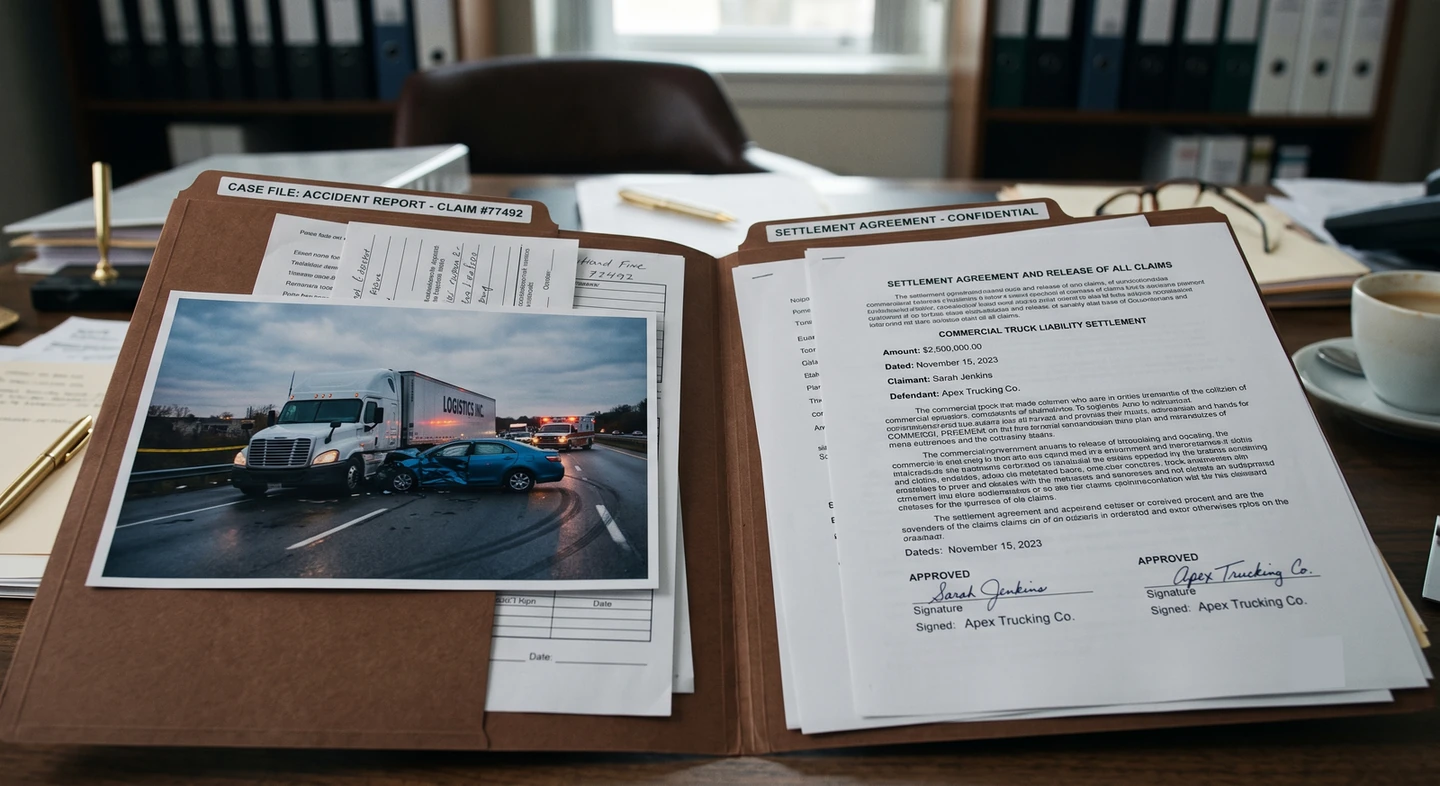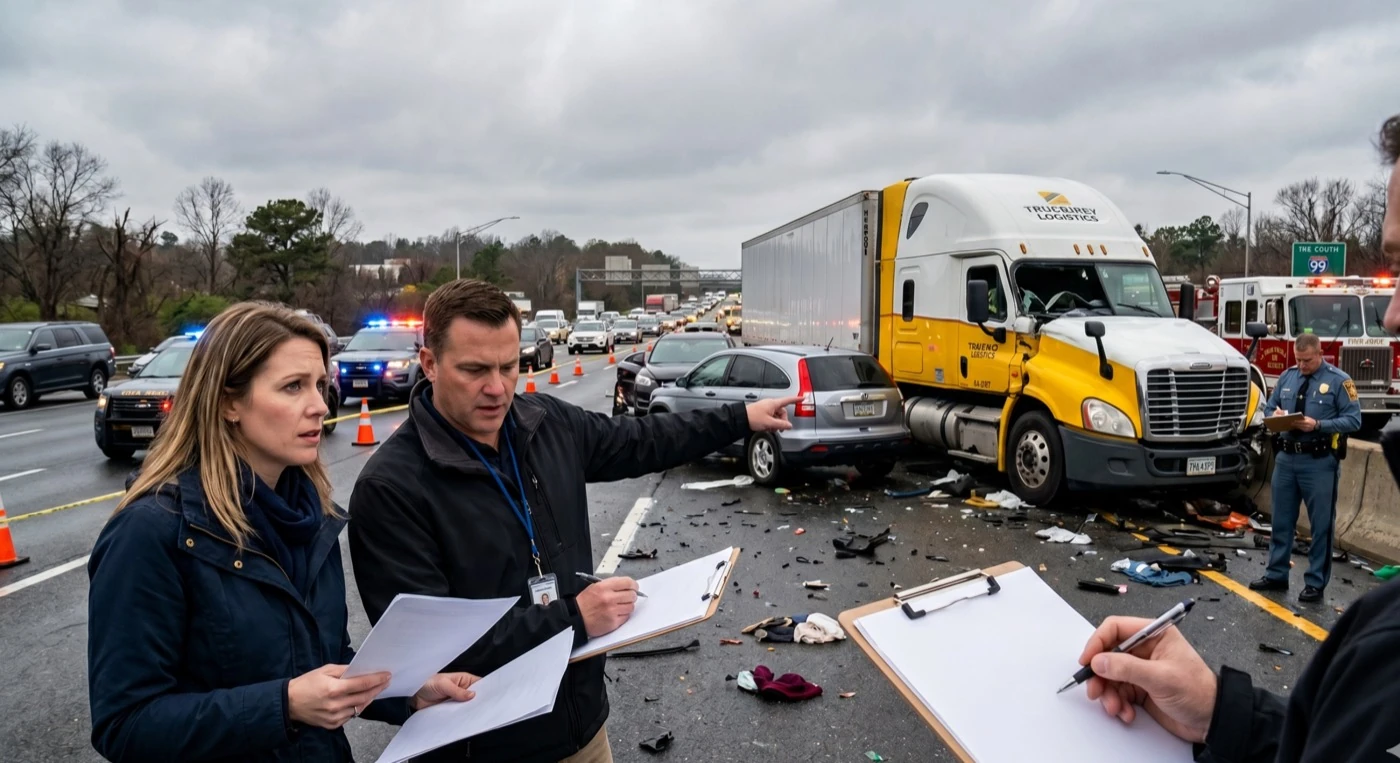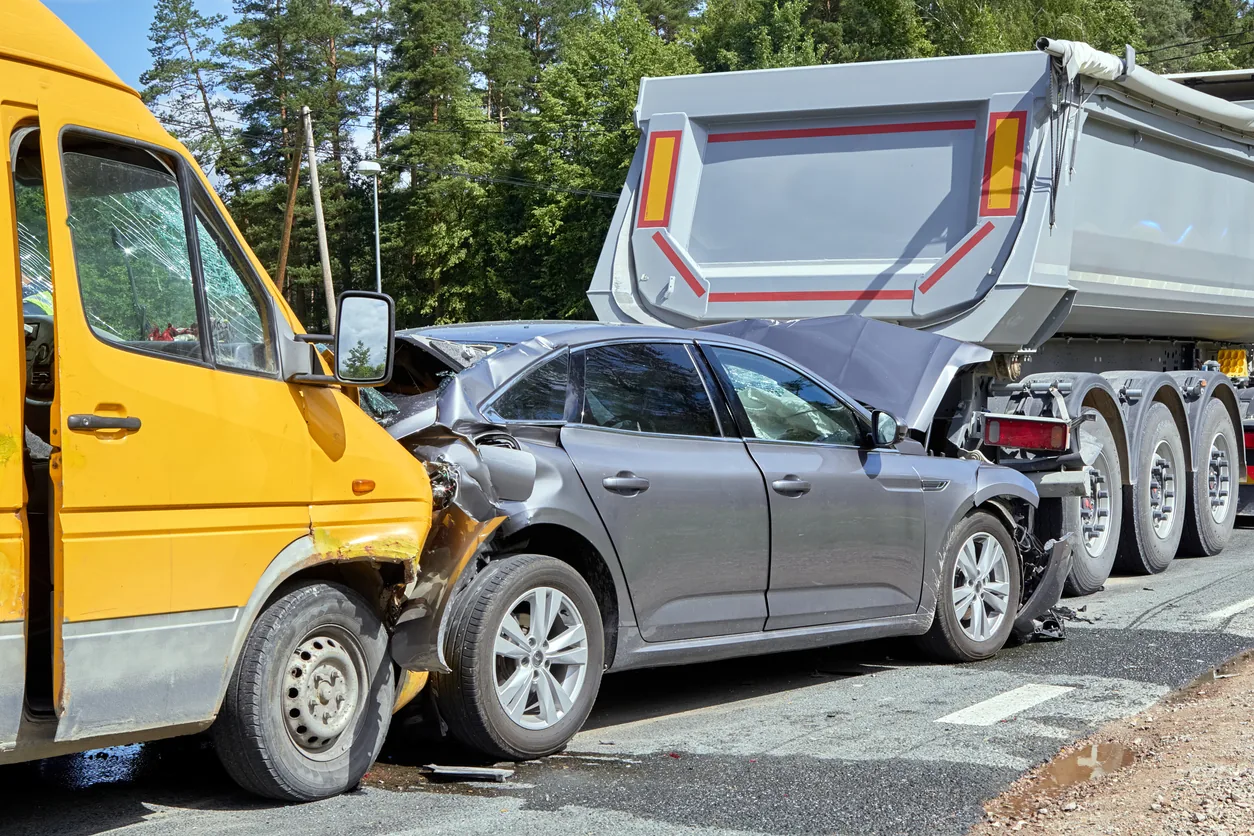
A standard two-car collision is complicated enough. But when an 80,000-pound commercial truck is involved in a multi-vehicle pile-up, the situation becomes exponentially more complex — a scene of chaos, multiple impacts, conflicting stories, and a dozen different parties, all trying to blame someone else.
Determining who is legally at fault in a multi-vehicle commercial truck accident is one of the most challenging tasks in personal injury law. It is not as simple as blaming the first or last car in the chain. And the longer you wait to build your case, the more critical evidence disappears.
If you or someone you love was caught in a pile-up involving a commercial truck, contact Bennett Legal for a free case evaluation — we move fast on evidence preservation from day one.
Free consultation
Hurt in a truck accident?
Commercial truck cases are complex. Let an experienced attorney handle yours. Free consultation.
The Central Problem: The Chain Reaction
Unlike a simple passenger vehicle collision, a multi-vehicle truck accident is a chain reaction. Consider this common scenario:
- A semi-truck is following too closely and fails to stop for slowing traffic.
- The truck rear-ends Car A, pushing it into Car B.
- Car B is forced into the adjacent lane, where it is struck by Car C.
In this one event, there are at least three separate impacts. The driver of Car C might blame the driver of Car B, who in turn blames the driver of Car A. But the entire chain of events was initiated by the negligence of one party: the commercial truck driver. Proving that chain of causation is the central challenge — and it requires far more than a police report.
How Liability Is Determined: The Forensic Investigation
To untangle who is truly at fault, your legal team must conduct a deep, multi-layered investigation.
1. Accident Reconstruction Experts
This is the most critical step. Expert accident reconstruction engineers visit the scene, analyze vehicle damage, scrutinize skid marks, and use physics-based software to create a second-by-second digital recreation of the crash. Their report can definitively show how the initial truck impact caused the entire chain reaction — and who bears the most fault.
2. The Truck's Black Box (ECU) Data
Every modern commercial truck has an Electronic Control Unit (ECU) — the equivalent of an airplane's black box. It records the truck's speed, braking patterns, RPMs, and other critical data in the seconds before impact. This data is a gold mine for your case.
We immediately send a spoliation letter demanding the trucking company preserve this data before it can be overwritten or conveniently "lost." Some ECUs overwrite data within 30 days. Waiting is not an option. For a full breakdown of the evidence that matters most and how quickly it disappears, see 6 Types of Evidence Every Truck Wreck Case Needs — and How to Preserve It.
3. Driver Logs and Company Records
Driver logs reveal whether the trucker was violating federal Hours of Service rules — meaning they were legally too fatigued to be behind the wheel. Company records expose whether the trucking company has a pattern of putting unsafe drivers or poorly maintained equipment on the road. For more on how carriers game the system, see Dangerous Trucking Companies Are Gaming the System — And Texas Drivers Are Paying the Price.
4. Witness Statements and Video Evidence
Every possible witness is tracked down and interviewed. The entire surrounding area is canvassed for dashcam footage from other drivers and surveillance video from nearby businesses that may have captured the initial impact.
🚨 Don't wait. Dashcam footage overwrites itself. Surveillance videos get deleted on routine cycles. Witnesses' memories fade. The moment you suspect a trucking company's negligence caused a pile-up, call Bennett Legal — we deploy preservation demands immediately.
Comparative Fault: The Texas Standard
Texas is a modified comparative fault state, which means a jury can assign a percentage of blame to each driver involved in the pile-up — including you.
Why it matters: You can only recover damages if you are found to be 50% or less at fault. If you are found 10% at fault, your final recovery is reduced by 10%. If you are found 51% at fault, you recover nothing. For a full breakdown of how this plays out in practice — including how adjusters use partial fault against you — see Are You Partly at Fault? How Comparative Negligence Really Works in Car Wreck Cases.
Insurance companies for every other vehicle involved will aggressively try to push as much blame onto you as possible. Even shifting your fault percentage from 20% to 51% saves them from paying a single dollar. This is not an accident — it is their strategy. Having a legal team that understands Texas comparative fault from the inside is not optional in these cases; it is survival.
Vicarious Liability: Why the Trucking Company Pays
Even if the truck driver is personally 100% at fault, the trucking company is almost always held legally responsible for their employee's negligence under the doctrine of vicarious liability.
This is a critical step in securing a full recovery. The individual driver may carry minimal personal assets, but the commercial carrier holds a much larger insurance policy — often with coverage in the millions. Identifying and pursuing the company directly is what transforms a limited recovery into full compensation for your injuries, lost wages, and long-term damages. For a deeper look at how trucking companies structure their operations to evade liability — and how we pierce that structure — see Dangerous Trucking Companies Are Gaming the System — And Texas Drivers Are Paying the Price.
Joint and Several Liability
In cases where multiple parties share fault — for example, a negligent truck driver and a second negligent passenger vehicle driver who contributed to the pile-up — the doctrine of joint and several liability can allow you to recover the full amount of your damages from just one of those responsible parties. This is particularly powerful when one defendant has significantly deeper pockets than another.
The Insurance Nightmare: Multiple Adjusters, One Goal
After a multi-vehicle pile-up involving a commercial truck, you will be contacted by adjusters from every single insurance company involved. Each one has the same goal: protect their own company and shift blame to someone else.
They will try to take a recorded statement — hoping you say something that implicates yourself. They will offer a fast, lowball settlement to get you to sign away your rights before you understand the full extent of your injuries. They will delay and deflect, betting that frustration will cause you to drop the claim.
Do not navigate this alone. The moment multiple adjusters start calling, you need a legal team running interference. Contact Bennett Legal and we handle all communication with every insurer involved — shielding you from their tactics from day one.
In a Pile-Up, You Need a Team That Can Untangle the Wreckage.
When you are one of many victims in a catastrophic multi-vehicle accident, you cannot afford to be just another claim number lost in the chaos. You need a legal team with the resources, expertise, and toughness to lead the investigation and place the blame squarely where it belongs: on the negligent trucking company.
At Bennett Legal, we thrive on these complex cases. We know how to cut through the chaos and build an ironclad case.
We help families by:
- Immediately deploying accident reconstruction experts to preserve scene evidence before it is gone.
- Sending legal spoliation demands to lock down the truck's black box, driver logs, and company records before they can be destroyed.
- Handling all communication with every insurance adjuster involved — you don't take a single call.
- Identifying every liable party, from the driver to the carrier to the maintenance shop, to maximize your recovery.
- No upfront cost: We handle commercial truck accident cases on contingency. You pay nothing unless we win.
In a multi-vehicle pile-up, confusion is the trucking company's best weapon. Our job is to replace that confusion with clarity — and force.
Reach out when you're ready. We'll take it from here.
Contact Bennett Legal today for a free case evaluation.
Frequently Asked Questions
Who is usually at fault in a multi-car pile-up involving a commercial truck?
Liability typically rests with the driver who caused the initial impact that started the chain reaction. In accidents involving a commercial truck, this is frequently the truck driver due to factors like speeding, following too closely, or fatigued driving in violation of federal Hours of Service rules.
What if I was the first car that got hit?
If you were legally stopped or slowing for traffic and were rear-ended, you are almost never at fault. The driver who struck you from behind is typically considered negligent — and in a truck pile-up, proving that the truck caused the initial impact is exactly what accident reconstruction experts are brought in to establish.
How do insurance companies determine fault in a multi-vehicle accident?
Insurers rely on police reports, driver statements, and physical evidence from the vehicles. But their primary goal is to minimize their own payout — not to find the truth. A formal legal investigation with an accident reconstruction expert is almost always required to establish the true sequence of events and resist blame-shifting by the other parties.
Can I still recover damages if I'm partially at fault?
In Texas, yes — as long as you are found to be 50% or less at fault. Your total recovery is reduced by your percentage of fault. For example, if you are 10% at fault on a $500,000 case, you recover $450,000. If you are found 51% or more at fault, you recover nothing — which is exactly why the defense pushes so hard to inflate your fault percentage.
What if a rideshare vehicle like an Uber or Lyft was also involved in the pile-up?
A rideshare vehicle adds another layer of insurance complexity. Uber and Lyft each carry tiered coverage policies that depend entirely on the driver's app status at the moment of the crash — whether the app was off, the driver was waiting for a ride, or a passenger was in the vehicle. Each status triggers a different coverage level. For a full breakdown of how rideshare insurance works in multi-vehicle accidents, see 7 Reasons Why Truck, Rideshare, and Commercial Vehicle Wrecks Are Different.
What is a jackknife accident and does it change liability?
A jackknife occurs when the cab and trailer of a semi-truck fold inward at the coupling point, often sweeping across multiple lanes simultaneously. These accidents almost always involve driver error, equipment failure, or improper loading — all of which point back to the trucking company. Because a jackknife can trigger a wide-area pile-up in a fraction of a second, securing black box and pre-trip inspection data is especially urgent.
How long do I have to file a claim in Texas?
Texas's statute of limitations for personal injury claims is two years from the date of the accident. However, waiting that long is a serious mistake in a truck accident case — critical evidence like ECU data, dashcam footage, and driver logs can be permanently lost within days or weeks. The sooner you act, the stronger your case.
Related Reading
- Step-by-Step Guide to Filing a Claim After a Commercial Truck Accident — Once you understand who is liable, this is your roadmap for what to do next — from the scene through settlement.
- 7 Reasons Why Truck, Rideshare, and Commercial Vehicle Wrecks Are Different — Why a multi-vehicle pile-up with a commercial truck is legally nothing like a standard car accident, and what that means for your claim.
- 6 Types of Evidence Every Truck Wreck Case Needs — and How to Preserve It — Black box data, dashcam footage, and driver logs all disappear fast. This explains exactly what to demand and when.
- Dangerous Trucking Companies Are Gaming the System — And Texas Drivers Are Paying the Price — The corporate negligence behind many pile-ups starts long before the crash, in hiring, scheduling, and maintenance decisions.
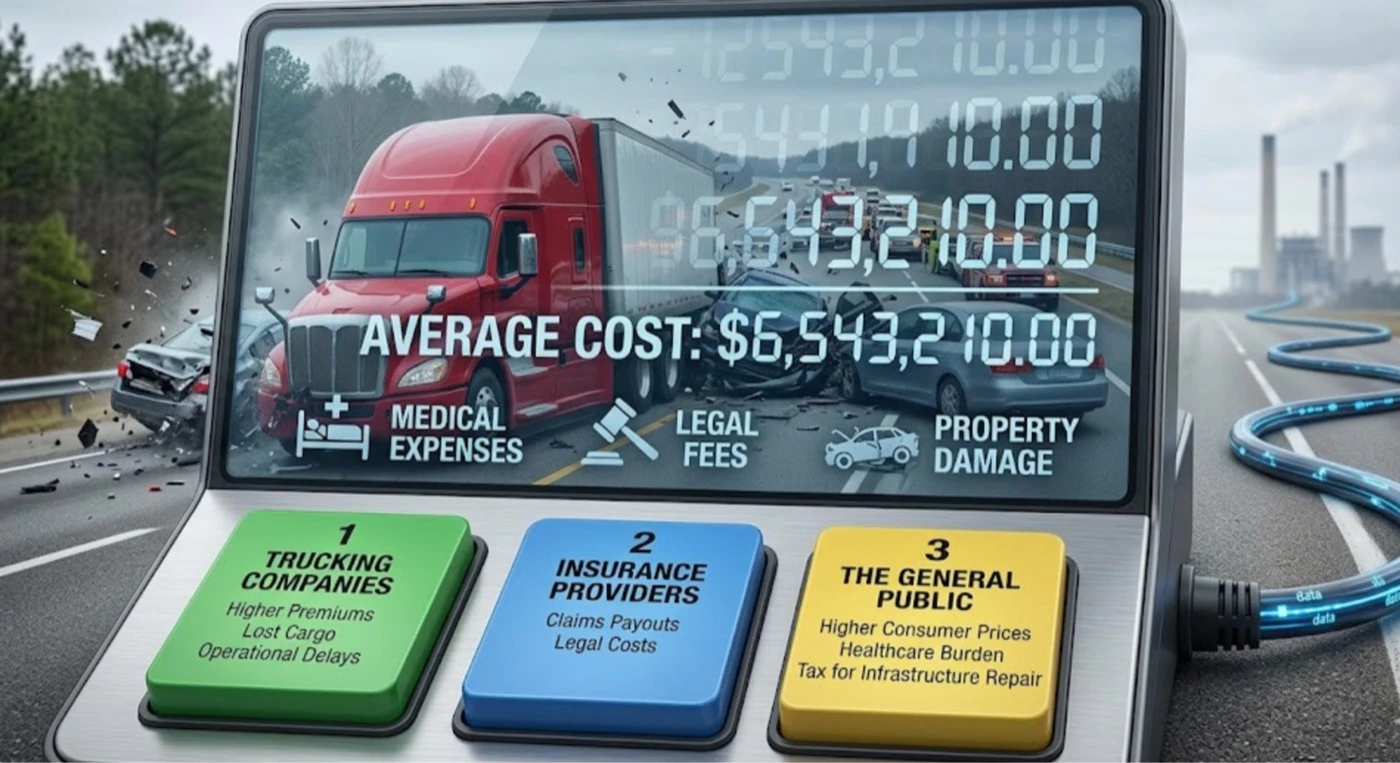
- The Average Cost of a Commercial Truck Accident and Who Really Pays — Medical bills, lost wages, and long-term care in a catastrophic pile-up can run into the millions. Here's the full picture of what your damages may actually be worth.
Free consultation
Hurt in a truck accident?
Commercial truck cases are complex. Let an experienced attorney handle yours. Free consultation.