Disclaimer: This article provides general information and is not legal advice. Laws vary by state. Please consult an attorney about your specific situation.
You didn't cause this crash. But in a few weeks, when you're sitting across from an insurance adjuster, the question won't be what you know happened — it'll be what you can prove.
That's the part most people don't think about in the hours after a wreck. They get checked out, exchange insurance cards, maybe take a few photos on their phone, and go home. Then weeks later, they learn that a security camera that might have caught the whole thing was overwritten. The other driver's cell phone records are now buried in a legal dispute. The skid marks on the road have been rained away.
Car wreck evidence has a shelf life. Some of it expires in days.
Free consultation
Been in a car accident?
Get the legal help you need. Free consultation with a Dallas car accident attorney.
This guide walks through every category of car wreck evidence that matters in a liability case — what it is, where it lives, how to get it, and how fast it disappears if no one acts.
Why Liability Evidence Is Different From Injury Evidence in a Car Wreck
Most people understand they need medical records to prove they were hurt. Fewer realize that there's an entirely separate body of evidence needed to prove who caused the crash and how.
Liability evidence answers three questions:
- What happened? The sequence of events, speed, position, and actions of each vehicle
- Who was at fault? Which driver (or other party) behaved negligently
- How bad was the impact? Force, angle, and damage that corroborates injury claims
Without strong liability evidence, even a seriously injured person can end up with a disputed claim — or a lowball settlement — because the defense has room to argue fault. Understanding the full roadmap of a car wreck case helps you see where evidence fits into every phase of the process.
Car Wreck Evidence Type 1: Scene Documentation — What Disappears Fastest
Photographs and video
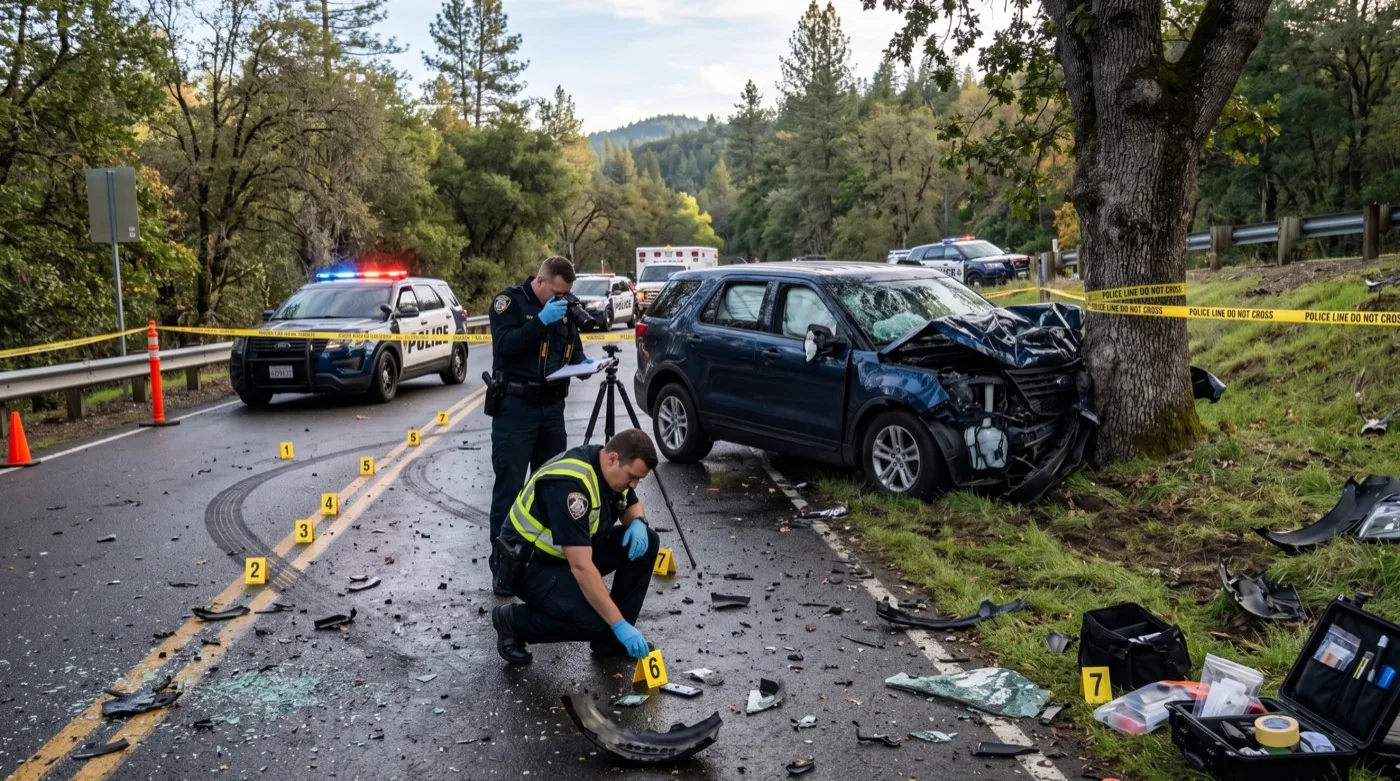
If you are physically able to take photos at the scene, do it before anything is moved.
| What | Why It Matters |
|---|---|
| Both vehicles from all four corners | Shows damage extent and point of impact |
| Final resting positions of vehicles | Helps reconstruct direction of travel and force |
| Skid marks, debris, fluid trails | Shows where braking began, point of impact, direction |
| Road conditions (wet, cracked, faded lines) | Relevant if road defect contributed to the crash |
| Traffic signs, signals, signal timing | Establishes what rules applied at that intersection |
| The other driver's license, insurance, plates | Factual documentation you'll definitely need later |
| Any visible injuries on yourself | Time-stamped documentation of immediate injury |
| Weather and lighting conditions | Context for visibility and road grip |
| The surrounding area (businesses, cameras) | Flags where surveillance footage might exist |
Skid marks and debris typically wash away or get swept within days. Get photos before you leave the scene if at all possible. Not sure what else you should be doing right after a crash? Our guide on your first call after a car wreck walks through the critical early decisions.
Surveillance and traffic camera footage
When you're photographing the scene, look around. Gas stations, banks, parking lots, fast food restaurants, ATMs, and traffic signals often have cameras pointed at or near intersections. Some private business cameras overwrite footage on a 24–72 hour loop.
An attorney can send a spoliation letter — a formal legal notice demanding that evidence be preserved — to a business within hours of a crash. Without it, the footage is routinely deleted as part of normal operations.
Traffic camera footage from municipal systems is typically held longer (often 30 days), but it still requires a formal records request.
911 call recordings
The first call to 911 after a crash is often the most unfiltered account of what happened, made before anyone had time to think about liability or craft a narrative.
911 recordings are public records, but they're not kept forever. Most jurisdictions purge them within 30–180 days. Request them early, in writing, from the relevant dispatch center.
Car Wreck Evidence Type 2: The Police Report — Useful But Not the Final Word
The responding officer's crash report is usually the first thing insurers look at. It documents the scene, identifies the parties, notes any citations issued, and sometimes includes the officer's opinion about fault.
What the report typically includes:
- Names, addresses, license numbers, and insurance information for all parties
- Vehicle identification and damage descriptions
- A diagram of the crash scene
- Witness names and contact information
- Any citations issued
- The officer's narrative and sometimes a fault assessment
Here's what most people don't realize: the police report is not necessarily accurate, and it is not automatically admissible in court. Officers often arrive after the fact, rely on statements from the parties involved, and make judgments without full information. Reports contain errors more often than you'd expect.
Insurance companies treat the police report as near-gospel. If the report has errors that disadvantage you, those need to be challenged early. Get a copy of the report as soon as it's available and review it carefully.
Car Wreck Evidence Type 3: Black Box Data — Critical Evidence From the Vehicle Itself
What is a vehicle's Event Data Recorder (EDR)?
Most vehicles manufactured after 2014 are equipped with an Event Data Recorder, commonly called a "black box." The EDR captures a snapshot of vehicle data in the seconds before and during a crash.
| Data Point | What It Shows |
|---|---|
| Vehicle speed | How fast the car was traveling pre-impact |
| Brake application | Whether and when brakes were applied |
| Throttle position | Whether the driver was accelerating |
| Steering angle | The direction the wheel was turned |
| Seatbelt status | Whether occupants were buckled |
| Airbag deployment timing | Confirmation of crash force and sequence |
| Engine RPM | Additional confirmation of speed and throttle |
This data is extraordinarily powerful in litigation. A driver who claims they were going 35 mph when the EDR shows 67 mph has a serious credibility problem.
The problem: EDR data can be overwritten or lost
EDR data is stored on the vehicle itself. Once the vehicle is repaired, scrapped, or sold, that data can be overwritten or lost.
- If the vehicle is totaled: The insurance company will want to sell it for salvage quickly. Once it leaves the salvage yard, the EDR data is gone.
- What to do: Your attorney can send a preservation letter and, if needed, seek a court order to preserve and inspect the vehicle. This needs to happen fast — within days of the crash in serious cases.
Accessing the other driver's EDR data
You cannot just walk up to another driver's car and download their EDR data. Accessing it requires either the owner's consent, a court order, or law enforcement authority. This is a primary reason why retaining an attorney early in a serious crash matters. If you've been in a wreck involving a commercial truck, these stakes are even higher — federal regulations create additional data retention requirements that make truck wrecks a completely different legal situation.
Car Wreck Evidence Type 4: Cell Phone Records — Proving Distracted Driving
What the records can show
Cell phone carriers maintain logs of:
- Calls made and received (with timestamps)
- Text messages sent and received (timestamps, not content)
- Data usage (which can show app activity, including navigation, social media, or streaming)
With the right records and the right expert, it's often possible to establish that a driver was actively using their phone within seconds of the crash.
How to get them
Cell phone records from another party require either a subpoena (available once litigation has begun) or a court-ordered preservation letter. Carriers typically retain call and text logs for 12–18 months, and data logs for varying periods depending on the carrier.
Important: Courts in most states will not grant broad access to a phone's actual content without a significant showing of need. But call and data activity logs are generally obtainable through discovery.
If the other driver was intoxicated as well as distracted, cell phone evidence becomes even more powerful. Learn more about how drunk and drugged driving cases unlock punitive damages beyond standard compensation.
Car Wreck Evidence Type 5: Witness Evidence — The Most Underutilized
Eyewitnesses are gold. An independent third party who saw the crash happen, and has no stake in the outcome, is often more persuasive to a jury than any other single piece of evidence. The problem is that witnesses disappear.
At the scene
- If bystanders stop, exchange contact information immediately — full name, phone number, and email
- Note the license plate of anyone who witnessed the crash and drove on
- Ask any witness whether they'd be willing to give a brief statement, even a voice memo recorded on your phone
After the scene
Witness memories are not stable. Studies consistently show that eyewitness recollection changes over time. If you have witnesses, they need to give formal statements as early as possible.
Car Wreck Evidence Type 6: Crash Reconstruction — Putting the Evidence Back Together
What they do
A crash reconstruction specialist is typically an engineer or former law enforcement officer with specialized training in accident physics. They can reconstruct:
- Pre-crash speed of each vehicle
- Point of impact (exact location on the roadway)
- Direction of travel and angles at impact
- Force and energy transfer
- Whether either vehicle took evasive action
- Where each vehicle ended up relative to where physics says it should have
When you need one
Consider crash reconstruction when:
- Fault is genuinely disputed and both sides have conflicting accounts
- Speed is a central issue
- The crash was at an intersection with a disputed signal or stop sign
- A commercial vehicle, large truck, or multiple vehicles were involved
- Serious injuries or death occurred
- The police report's account doesn't match the physical evidence
A Timeline: How Quickly Car Wreck Evidence Disappears
| Evidence Type | Typical Preservation Window | Action Required |
|---|---|---|
| Scene photographs | Hours (weather, cleanup) | Take them at the scene |
| Skid marks and debris | 24–72 hours | Photograph immediately |
| Private security camera footage | 24–72 hours | Spoliation letter same day |
| Traffic camera footage | Up to 30 days | Formal records request ASAP |
| 911 recordings | 30–180 days by jurisdiction | Written records request early |
| EDR/black box data | Days to weeks if vehicle is totaled | Preservation letter immediately |
| Cell phone activity records | 12–18 months | Subpoena once in litigation |
| Witness memories | Degrade continuously | Statements as soon as possible |
| Police report | Usually available within days | Request and review carefully |
What a Lawyer Actually Does With All of This
- Issues spoliation letters within hours or days of being retained
- Subpoenas records through the litigation process — phone records, employment records, prior driving records
- Retains experts — crash reconstruction specialists, biomechanical engineers, accident scene investigators
- Takes witness statements early, formally, and in a way that can be used in court
- Challenges the police report when it contains errors
- Coordinates with law enforcement when criminal charges may be involved
None of this is available to a person acting on their own. A car accident lawyer can begin issuing preservation letters within hours of being retained — often before you've even had time to recover from the initial shock. The window to act on the most time-sensitive evidence is often narrower than the window to decide whether to hire an attorney. If you're worried that evidence in your case may already be disappearing, contact Bennett Legal for a free case evaluation — we can start sending preservation letters within hours.
How Bennett Legal Builds Liability Cases
At Bennett Legal, we don't wait for evidence to come to us. From the moment we take a car wreck case, we move on preservation, because we've seen too many strong cases weakened by footage that was overwritten, data that was lost with a totaled vehicle, or witnesses whose memories shifted.
If a commercial truck was involved, our approach goes even deeper — federal regulations impose additional data retention requirements on trucking companies, and our team knows exactly what to demand and when.
When crashes result in catastrophic injuries or death, the stakes of getting the evidence right are even higher — see our guide on the 9 steps in a catastrophic injury claim for a full walkthrough of how those cases unfold.
We work on contingency — you pay nothing unless we recover for you. Contact Bennett Legal today for a free case evaluation and let us start protecting your evidence before it's gone.
You Matter, Your Claim Matters
Building a liability case after a car wreck isn't about luck or who tells a more convincing story. It's about evidence, collected early, preserved properly, and presented in a way that leaves no room for doubt.
If you've been seriously hurt in a wreck that wasn't your fault, the most important thing you can do right now — besides getting medical care — is to make sure someone is protecting that evidence before it's gone. Avoiding the costly mistakes most people make after a car wreck starts with acting fast on evidence preservation.
Frequently Asked Questions
Can I get the other driver's black box data on my own? No. EDR data stored on another person's vehicle requires either their consent or a court order obtained through litigation. An attorney can issue preservation letters immediately and seek a court order before the vehicle is repaired or scrapped.
What if the police report says I was at fault but I wasn't? Police reports are not final legal determinations of fault, and they contain errors regularly. You can formally request an amendment, and your attorney can build a parallel record of evidence that directly contradicts an incorrect report.
How do I find out if a nearby business has surveillance footage of the crash? Walk or drive the immediate area and look for cameras on buildings, parking lots, ATMs, and fuel stations. Contact businesses directly on the same day if possible, and have an attorney issue a formal spoliation letter. Do not wait more than 24–48 hours.
Is texting and driving hard to prove legally? Harder than it should be, but far from impossible. Call and data activity logs from cell carriers can show the phone was in active use within seconds of impact. These records require a subpoena, which means litigation needs to be underway.
Does every car wreck case need a crash reconstruction expert? No. But when fault is genuinely disputed, when speed is a central issue, when a commercial vehicle is involved, or when serious injuries occurred, a reconstruction expert's analysis can be the most decisive element of the liability case. For a deeper look at what evidence matters most for proving your injuries specifically, see our guide on 11 key types of evidence that make or break your case.
What happens if key evidence is lost before I could preserve it? The loss of evidence by another party, if destroyed after a preservation obligation arose, can result in an "adverse inference" instruction to the jury — meaning the jury can be told to assume the lost evidence would have been bad for the party who lost it. This is called "spoliation."
Related Articles from Bennett Legal:
- From Crash Scene to Courtroom: A Car Wreck Lawyer's 6-Phase Roadmap
- Proving Injuries After a Car Wreck: 11 Key Types of Evidence That Make or Break Your Case
- 11 Costly Mistakes People Make in Car Wreck Lawsuits (and How to Avoid Them)
- Your First Call After a Car Wreck: Insurance Company or Lawyer?
- 7 Reasons Why Truck, Rideshare, and Commercial Vehicle Wrecks Are Different
- Drunk and Drugged Drivers: How a Car Wreck Becomes a Punitive-Damages Case
- The 9 Steps in a Catastrophic Injury Claim (And What Really Happens Behind the Scenes)
Free consultation
Been in a car accident?
Get the legal help you need. Free consultation with a Dallas car accident attorney.