If you need help, learn more about our Solar Panel Financing Fraud.
$170,000+ recovery
Against Sunlight Financial · Solar fraud arbitration
- $113,000 loan cancelled
- UCC lien removed
- Credit repaired
- $58,000 cash to client
Past results do not guarantee a similar outcome. Every case is different.

You stood at the window, coffee in hand, watching the crew finish up on your roof.
Today was supposed to be the day - the day your home officially became powered by the exact, high‑efficiency solar panels you were sold on weeks (or months) ago.
But as you step outside to take a closer look, something catches your eye. The logo on the panels isn’t the sleek brand name you remember from the glossy brochure. In fact… you’ve never even heard of this company before.
Your stomach drops.
“Wait - are these even the panels I paid for? Why would they switch them? And if they changed the brand, what else did they change?”
The installer smiles and shrugs: “Same specs, just a different manufacturer - trust me, these are just as good.”
But you didn’t drop tens of thousands of dollars on “just as good.” You chose a brand for a reason - maybe it had a stronger warranty, higher efficiency, better aesthetics, or a rock‑solid reputation. Now you feel blindsided, wondering if you’ve just been hit with a bait‑and‑switch.
Here’s the thing: solar companies can make changes under certain circumstances - but only in very specific, legal ways. When they swap your panels without clear, informed consent in writing, it can be a breach of contract, a deceptive trade practice, and a direct hit to the return on your investment.
In this guide, we’ll break down:
- When a substitution is legitimate vs. when it’s fraud
- Common excuses installers use - and how to see through them
- Your legal rights if a panel swap costs you performance or warranty value
- The steps to take the moment you suspect a bait‑and‑switch
Can a Solar Installer Legally Switch the Brand of Panels I Ordered?
Short answer? Yes. But.
Only if you agreed to it - and that agreement has to be in writing.
Here’s the deal: In most states, your solar installation contract is legally binding down to the brand and model of the equipment listed.
If it says you’re getting “SunPower Model XYZ” panels, that’s what should end up on your roof. Full stop.
The only legal wiggle room installers have is if your contract includes phrases like:
- “or equivalent”
- “subject to availability”
- “manufacturer substitution allowed with comparable product”
When that’s the case, they may swap the brand if the replacement matches or exceeds the original in all key specs - wattage output, efficiency rating, degradation rate, and warranty terms.
Where it crosses the line into trouble:
- They never told you about the change beforehand.
- The new panels are of lower quality or have a shorter warranty.
- You paid more for a premium brand but got a value‑tier substitute.
Even if they claim “these are just as good,” you have the right to verify. A panel’s brand affects not just energy production, but long‑term reliability, aesthetics, and resale value. In solar - as in roofing or flooring - materials matter. Your money also buys the manufacturer’s reputation and warranty support, not just a list of specs.
 Homeowner reviewing a solar installation contract, proposal, and manufacturer information before verifying the installed solar panels.
Pro Tip: Check your contract now. If the brand and model are listed - without “or equivalent” language - any substitution without your written okay could be a breach of contract.
Free consultation
Solar panel contract problems?
We help homeowners fight back against solar fraud. Free consultation.
7 Common Excuses Installers Give for Swapping Brands
Guess what? Solar panel companies who engage in such scams have creative answers lined up in case you get suspicious and question the swap. What are they?
1. Supply chain issues: One of the most common fallbacks. The installer blames back‑orders, shipping delays, or “unavailability” of your chosen brand. While legitimate shortages do happen, they should come with documented proof and your consent for any substitution - not a surprise reveal on installation day.
2. These are actually better: They’ll say the new panels are higher‑wattage, newer‑generation, or more efficient. Sometimes true, but often those “better” panels have trade‑offs like shorter warranties, a higher degradation rate, or a lesser‑known manufacturer. Always check the full spec sheets yourself.
3. Same specs, different brand: On paper, two panels might look similar in wattage and efficiency. But specs don’t tell the whole story - build quality, warranty service, and long‑term reliability can vary drastically between brands.
4. The rep who sold you that brand is no longer here: A way to distance the company from promises made in the sales phase. Your contract, not their staffing changes, controls what you’re entitled to receive.
5. We already installed them - trust us: This is the high‑pressure, too‑late‑to‑change tactic. They count on you not wanting to delay your project or deal with uninstalling panels. Accepting them without pushback can weaken your leverage, so raise the issue immediately.
6. The old model was discontinued: Sometimes true, especially if there was a long delay between signing and installation. If that’s the case, you should still be offered an equal or better replacement and the chance to approve it in writing.
7. We got a deal and passed the savings on to you: Sounds generous, but swapping in cheaper panels without your consent is profit padding, not a discount, especially if you paid for premium equipment.
And, Why do They do This? (The Part They Don’t Say Out Loud)
1. Bigger Profit Margins – Swapping in cheaper panels costs them less but they charged you for the pricier ones. Every dollar saved on hardware goes straight to their bottom line.
2. Clearing Out Overstock – If they have a warehouse full of last year’s panels, it’s easier to unload them on unsuspecting customers than find buyers who’ll accept them knowingly.
3. Sales vs. Operations Disconnect – The salesperson might promise your dream panel to close the deal, while the installation team just uses whatever’s on the truck.
4. Supplier Rebates and Kickbacks – Some manufacturers give bonuses or incentives to installers for meeting sales quotas. Those reward programs can influence what shows up on your roof more than your actual contract.
5. Betting You Won’t Notice – Sadly, many installers bank on homeowners not climbing the roof or checking panel labels. If you can’t see it from the ground, they think you’ll never know.
6. Faster Installation – Sometimes it’s about speed - using whatever’s easy to get means they don’t have to delay your project for back‑ordered panels.
When a Change Might Be Legitimate - and How to Tell
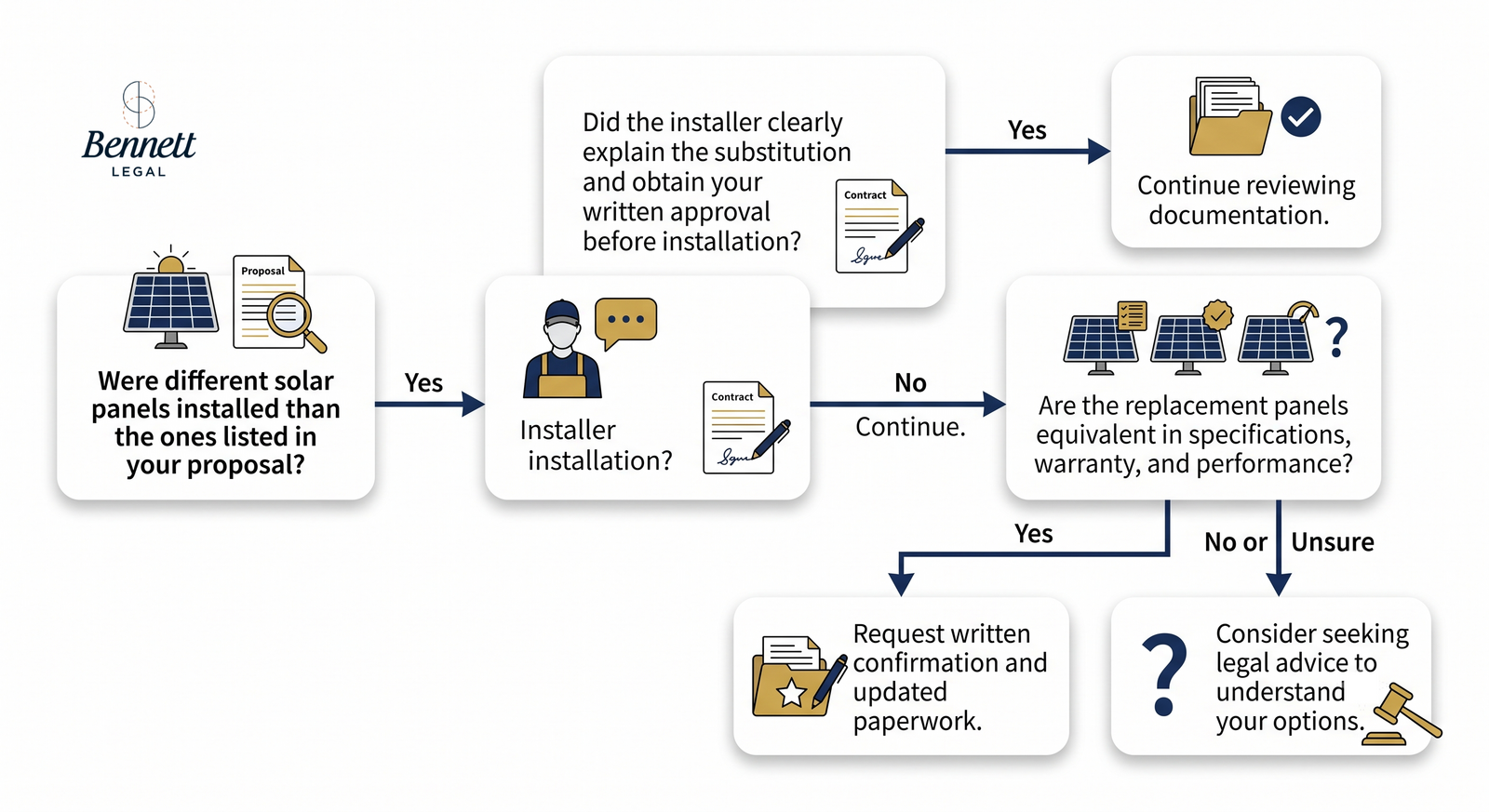 Decision tree showing how homeowners can evaluate whether a different solar panel installation may indicate an unauthorized substitution.
Not every brand change is a scam.
There are a few situations where a substitution is reasonable - even beneficial - as long as you’re told in advance and the replacement matches or improves on what you ordered.
Here are signs the change might be legitimate:
- The original panel model was discontinued or no longer manufactured.
- There’s a documented supply shortage, and the installer has proof from the supplier or manufacturer.
- The replacement has equal or better specs (wattage, efficiency, degradation rate, and warranty length).
- You were given the choice to approve the substitution in writing before installation.
- The upgrade came at no extra charge - and you’re not paying for specs you didn’t get.
If none of these are true, you may be dealing with a bait‑and‑switch designed to boost the installer’s profit margin or clear out their warehouse.
Legitimate Swap vs. Bait‑and‑Switch
| Factor | Legitimate Swap | Bait‑and‑Switch |
| Reason Given | Manufacturer discontinued model or proven supply shortage | Vague excuses like “same thing” or “just as good” without proof |
| Performance Specs | Equal or higher wattage, efficiency, and warranty | Lower output, shorter warranty, higher degradation rate |
| Consent | Homeowner approves in writing before install | No notification until after installation is complete |
| Documentation | Spec sheets and warranty info provided for new panels | No paperwork for the substituted product |
| Impact on Price | No increase - sometimes a genuine free upgrade | You paid for premium, received lower‑cost equipment |
| Transparency | Honest discussion of changes and options | Changes hidden until the job is done |
Red Flags That Point to a Bait‑and‑Switch (and How to Avoid Them)
1. Your Contract Doesn’t Name a Brand or Model
- Why it’s a red flag: Vague terms like “Tier 1 panels” or “high‑efficiency solar modules” give the installer room to swap brands without technically breaking the contract. Learn more about the difference between solar leases and loans.
- How to avoid it: Insist the contract list the exact manufacturer name and model number, and make sure there are no “or equivalent” clauses unless you’re comfortable with substitutions.
2. No Pre‑Installation Equipment Confirmation
- Why it’s a red flag: Legit installers will send you a final equipment list or packing slip before the crew arrives. If you get no confirmation, they may be keeping it vague until installation day.
- How to avoid it: Ask for a written list of the panel brand, model, and specs at least a week before your installation date.
3. Equipment Arrives Without Labels or in Generic Packaging
- Why it’s a red flag: Manufacturers ship branded panels with clear model markings. If your panels are unlabeled or in plain packaging, ask why before they go on the roof.
- How to avoid it: Be present on installation day, inspect the panels yourself, and photograph the manufacturer label on each panel before it’s mounted.
4. Installer Hurries You Away from the Work Area
- Why it’s a red flag: They may want to avoid having you see the panel brand or model before they’re bolted down.
- How to avoid it: Let the crew know you’ll be checking the panels before installation begins; respectful pros won’t mind.
5. “We Already Installed Them” Without Prior Approval
- Why it’s a red flag: The “too late to change” tactic is common in bait‑and‑switch scenarios.
- How to avoid it: Put in writing that no brand substitutions are authorized without your signed consent - and keep a copy.
6. New Panels Don’t Match Sales Materials or Performance Estimate
- Why it’s a red flag: If the brand, look, or spec sheet differs from what was in your proposal, you may not be getting what you paid for.
- How to avoid it: Keep your original sales brochure, proposal, and energy output estimates to compare against the installed equipment.
7. Refusal to Provide Spec Sheets or Warranty Info for Installed Panels
- Why it’s a red flag: Reputable installers want you to have all the documentation; hiding it may mean they don’t want you to see the differences.
- How to avoid it: Request all manufacturer warranties and datasheets during your contract review - before installation starts.
Different Logo, Different Warranty, Different Risk: Your Legal Rights & Protections
If your installer swapped out your panels without consent and gave you something of lesser quality, you’re not stuck living with it. There are legal tools - both state and federal - designed to hold them accountable.
Contract Law – Your installation agreement is legally binding. If it specifies a brand/model and you didn’t approve a change, it’s a potential breach of contract. The remedy can include requiring them to replace the panels, refunding part of what you paid, or compensating you for lost performance and diminished value.
Consumer Protection Laws –
- Texas: The Deceptive Trade Practices Act (DTPA) covers false, misleading, or deceptive acts - including delivering goods different from what was promised. Seniors (65+) may be entitled to triple damages.
- California: The Contractors State License Board (CSLB) requires accurate representation of goods to be installed; equipment substitutions without approval can trigger fines or license action.
- Florida: The Florida Deceptive and Unfair Trade Practices Act (FDUPTA) lets you recover damages for misrepresentation in home improvement contracts.
Federal Protections: The FTC Act makes bait‑and‑switch sales illegal as an “unfair and deceptive act or practice.” You can also file complaints with the FTC, which can investigate patterns of wrongdoing. Learn more about identity theft through solar panel scams.
Warranty Rights: If the substitute brand has worse warranty terms, that’s not just an inconvenience - it can be a loss of real, calculable value, which strengthens your case. Learn more about tax incentive and rebate scams.
Exceptions & Procedural Barriers
Even strong complaints can hit hurdles, and knowing them upfront helps you prepare:
Broad Contract Language – If your contract says “or equivalent,” you’ll need to prove the swap isn’t actually equivalent in performance, warranty, or value.
Verbal Promises Without Written Proof – It’s hard to enforce something the sales rep “said” if it isn’t in your signed paperwork, so written specs are vital.
Proving Damages – You may have to get an independent solar expert to document how the installed panels are inferior in measurable ways.
Arbitration Clauses – Common in solar contracts, these force disputes into private arbitration rather than public court. Fraud or misrepresentation can sometimes void them, but that’s a legal fight in itself.
Timing – Some state laws give you just 1–4 years to bring a contract or consumer protection claim, and waiting weakens leverage.
Immediate Action Steps if You Suspect a Bait‑and‑Switch
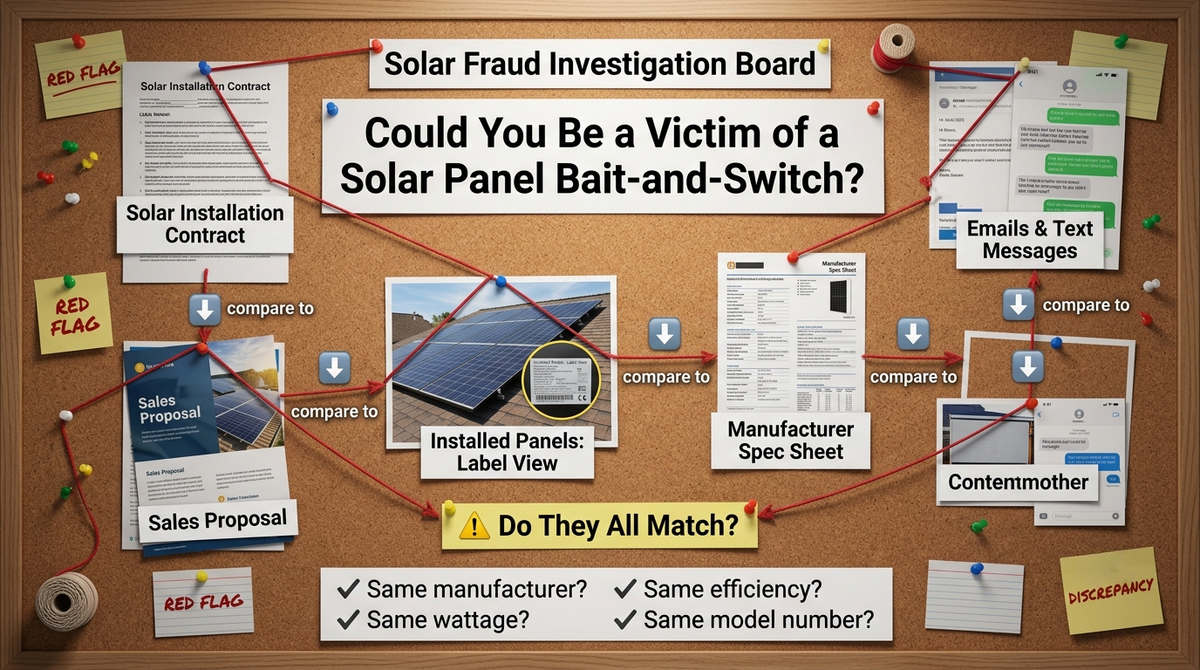 Illustration of a solar fraud investigation board showing a homeowner comparing a solar contract, sales proposal, panel labels, manufacturer specifications, and communications to identify a potential solar panel bait-and-switch.
- Check Your Contract – Highlight the brand/model and note any “or equivalent” clause.
- Identify the Panels – Write down model numbers directly from the manufacturer labels on your panels.
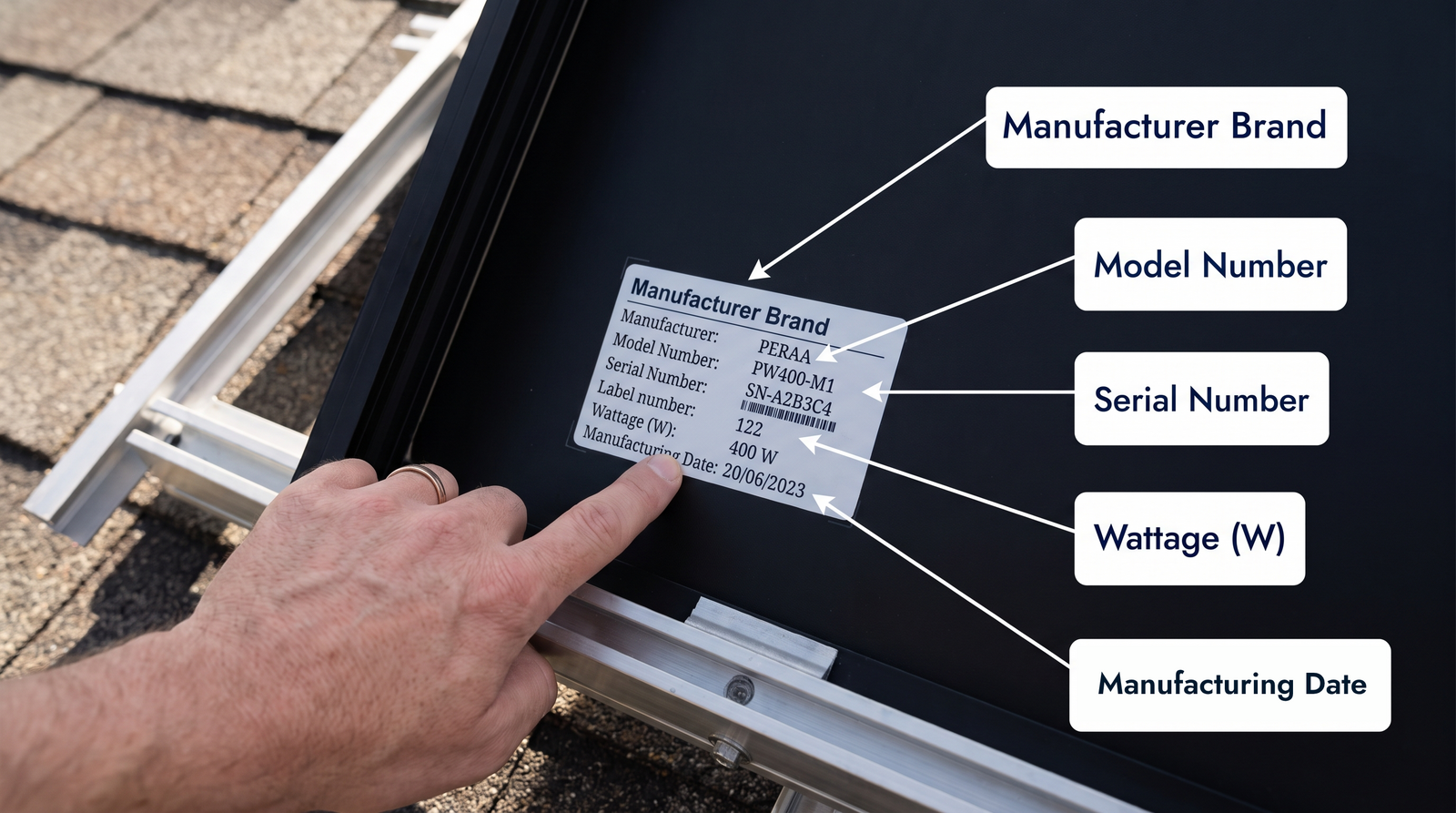 Close-up of the manufacturer label on the back of a solar panel with callouts identifying the brand, model number, serial number, wattage, and manufacturing date.
- Compare Specs – Look up efficiency, wattage, degradation, and warranty for both the promised and installed panels.
- Document Everything – Take photos, save brochures, keep all emails and texts with the installer.
- Ask for an Explanation in Writing – Verbal excuses are easy to deny later.
- Don’t Accept “It’s the Same” Without Proof – Request spec sheets and warranty documents right from the manufacturer.
- Contact a Consumer Protection Attorney – A law firm like Bennett Legal can push for replacement, restitution, or damages.
- File Complaints – With your state licensing board, Attorney General’s office, and the FTC.
State‑by‑State Equipment Disclosure Rules Quick Chart
| State | Sales/Install Disclosure Requirements | Consumer Protections | Cooling‑Off Period |
| TX | Contract must match installed goods or equivalent | DTPA covers misrepresentation; treble damages for seniors | 5 business days for residential solar (Occ. Code § 1806.156, since 9/1/2025); 3 business days for other in-home sales (Bus. & Com. Code Ch. 601) |
| CA | CSLB requires accurate equipment disclosure | Civil penalties for false/misleading advertising | 3 business days |
| FL | Agreement must list brand/model; deviation = breach | FDUPTA for deceptive trade practices | 3 business days |
| NY | Contract must clearly identify products | Attorney General enforcement of consumer fraud laws | 3 business days |
| IL | Written contract must include brand/model details | Consumer Fraud and Deceptive Business Practices Act | 3 business days |
Bait-and-Switch Panels Aren’t Just Dishonest - They’re Illegal
Your roof isn’t a testing ground for a solar company’s shortcuts. You chose a brand for its warranty, its efficiency, and its value - not for a contractor to swap it out with something cheaper once you weren’t looking. That isn’t a mix-up. It’s a breach of trust and, in many cases, a breach of contract.
At Bennett Legal, we see this pattern every day: homeowners promised one system and delivered another. The result? Lower-quality equipment, weaker warranties, and thousands in lost value. We don’t let those excuses stand.
Our team steps in to:
- Compare your contract to the panels installed and document every mismatch with manufacturer specs and warranties.
- Challenge bait-and-switch substitutions under state consumer protection laws, for instance, the Texas DTPA and California CSLB rules.
- Force replacement, refunds, or damages when installers try to pocket the difference between what you ordered and what you received.
- Protect your resale and warranty rights so your home value isn’t dragged down by panels you never agreed to.
This isn’t just about equipment - it’s about your right to get exactly what you paid for. If a solar company switched panels without your consent, you don’t have to accept it.
Bennett Legal knows how to fight back and restore both your investment and your peace of mind. Call us, now!
FAQs
Q: Can I refuse to accept different panels?
Yes, if your contract specifies brand/model and has no “or equivalent” clause - and you catch the change before or during installation.
Q: What if the replacement is better than what I ordered?
That’s a win - but you should still be told ahead of time in writing so you can verify specs and warranty.
Q: Can I get money back if they used cheaper panels?
Yes. Damages can be calculated as the difference in value between the panels paid for and those installed - plus installation costs if replacement is required.
Q: How do I prove they swapped my panels?
Model and serial numbers on the panels are the primary proof. Independent inspection reports help too.
Q: What if I only have the salesperson’s promise, not in writing?
It’s still worth pursuing under consumer protection laws, but written contracts are far stronger.
Related Reading
Free consultation
Solar panel contract problems?
We help homeowners fight back against solar fraud. Free consultation.