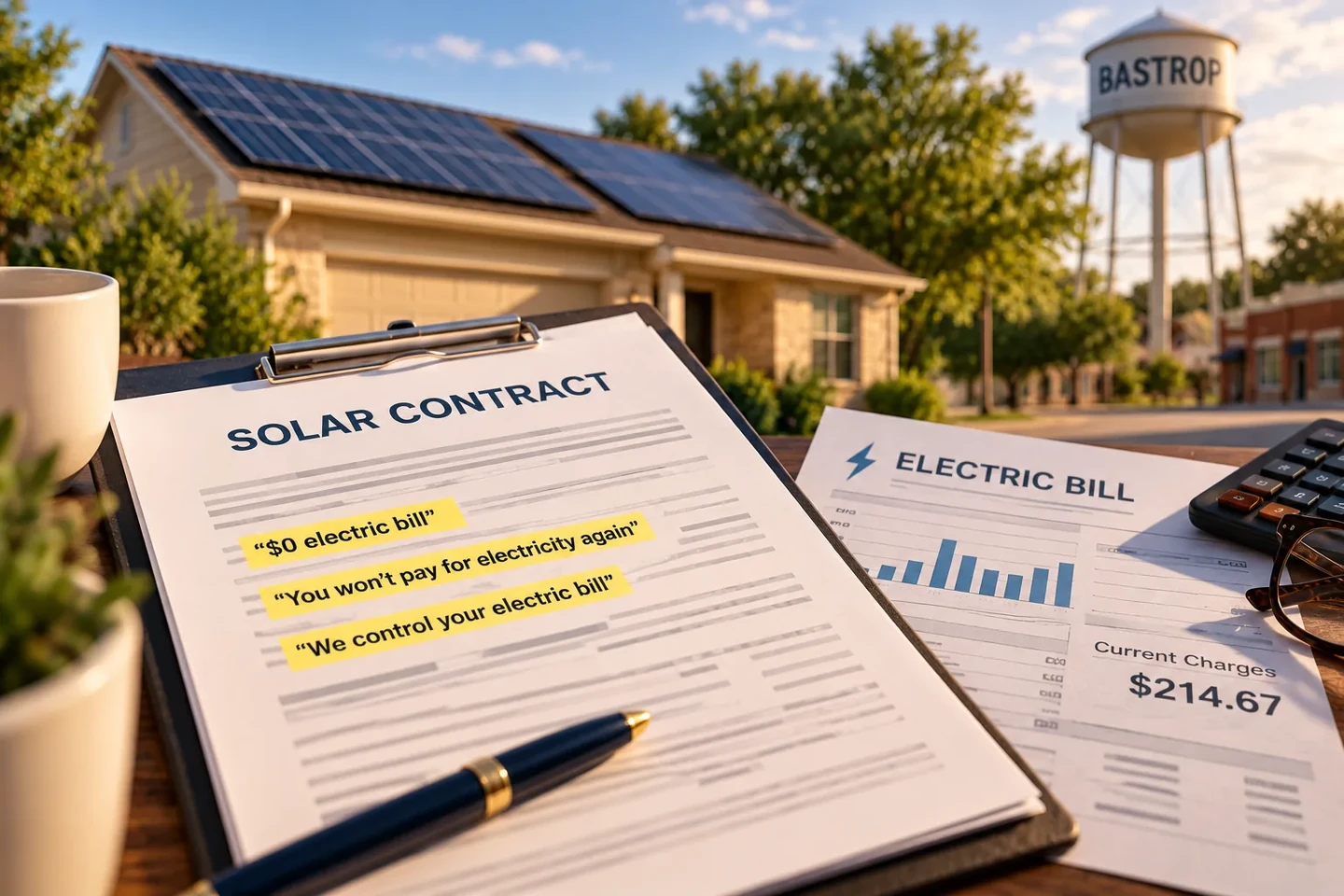
Bastrop is changing how some rooftop-solar customers get credited for the electricity they send back to the grid, and adding a new monthly charge tied to system size. The city council approved the changes on September 8, 2026, with the new rules taking effect October 1.
$170,000+ recovery
Against Sunlight Financial · Solar fraud arbitration
- $113,000 loan cancelled
- UCC lien removed
- Credit repaired
- $58,000 cash to client
Past results do not guarantee a similar outcome. Every case is different.
If you don't live in Bastrop, the story still matters to you. It's a reminder of something that's easy to miss during a solar sales pitch: a solar savings estimate depends on variables your salesperson doesn't control.
Most solar proposals include a projected electric bill or a solar savings estimate spanning 20 or 25 years. The real question isn't just "how much will I save?" It's what assumptions produced that number -- and which of those assumptions can change.
Free consultation
Were you promised solar savings that never showed up?
We review solar sales representations against what you actually signed and what you're actually paying. Free case evaluation.
What Changed for Solar Customers in Bastrop
Here's what's changing, briefly:
- Bastrop customers who export excess electricity to the grid will be credited based on the utility's avoided cost of generation -- what it saves by not buying that power elsewhere -- rather than a fixed rate.
- A new monthly charge tied to system size is being added, though the exact amount hadn't been finalized as of publication.
- New installations still need to go through the city's inspection and interconnection process before connecting to the grid.
The details matter less than the pattern: a city changed the economics behind solar exports and fees after homeowners had already signed contracts and financing agreements based on the old numbers.
What Actually Determines How Much Solar Saves You
A savings projection isn't one number -- it's the output of several variables stacked on top of each other:
- Solar production -- how much electricity your system actually generates
- Household energy use -- how much electricity you actually consume, and when
- Utility electricity rates -- what you pay per kilowatt-hour today
- Export or buyback credit -- what you're paid or credited for electricity you send to the grid
- Fixed utility fees and solar-specific charges -- flat fees that don't move with usage
- Financing cost -- your solar loan or lease payment, on top of whatever electricity you still buy
- Future rate changes -- whether the projection assumes utility rates rise, and by how much
- System performance over time -- panels degrade gradually as they age
Change any one of those, and the "savings" number on your original proposal moves with it.
What Is a Solar Export Credit?
When your system produces more electricity than your household is using, the excess flows back to the grid. Depending on your utility or electricity plan, you may be paid or credited for it -- but electricity you send to the grid doesn't necessarily have the same value as electricity you buy from it. Export/buyback rates vary by utility and by plan, and as Bastrop shows, they can also change over time. Don't assume a rate you were quoted at signing is permanent.
Any savings estimate you were shown almost certainly baked in an assumption about this rate. If your utility or plan changes how it compensates exported electricity -- or if you switch retail electricity providers -- the math behind that original number no longer holds, even though nothing about your system itself has changed.
Why a Solar Savings Estimate Is Not the Same as a Guarantee
Every solar proposal is a calculation built on assumptions -- about your usage, the system's output, current utility rates, future rate increases, export credits, fees, and financing costs. A projection is only as reliable as the assumptions behind it, and few homeowners are ever shown that math.
Before you rely on a solar savings estimate, ask the person who gave it to you:
- What electricity rate did you use?
- What future rate increases did you assume, and at what percentage?
- What solar production did you assume?
- What export or buyback credit did you assume?
- Did the estimate include utility and interconnection fees?
- Did it include the full loan or lease payment, or only the electricity side?
- Is this an estimate, or a contractual guarantee?
- Where is this documented in writing?
If a salesperson can't answer these, the number they showed you is a guess dressed up as a forecast.
Can a Solar Salesperson Guarantee Your Electric Bill Will Disappear?
It's worth knowing the difference between four things that often get blurred in a sales conversation:
- Estimate: a calculation based on assumptions
- Projection: an estimate of future performance or savings
- Representation: something a salesperson told you or showed you
- Contractual guarantee: a promise actually written into your signed agreement, subject to its terms
Whether a specific statement made during a sale carries legal weight depends on exactly what was said, what documentation exists, the terms of the contract, and the circumstances of the sale. That's a case-by-case question, not a blanket rule -- and it's a different question from whether your solar bill is higher than you expected or whether you were told your savings would look different than they turned out. The federal solar tax credit is often folded into the same pitch -- treat any tax-credit figure the same way you'd treat a savings number: as an assumption to verify, not a guarantee.
If the Savings You Were Promised Never Happened
If your actual results don't match what you were shown during the sale, preserve what you have before it's harder to find:
Preserve before it's harder to find:
- The original sales proposal and savings analysis
- Texts, emails, and any recorded communications
- Your solar contract and financing agreement, including disclosures
- Utility bills from before and after installation, plus your export-credit statements
- System production reports or monitoring-app data
- Any marketing materials that referenced specific savings
What was promised, what you signed, and what actually happened are three different things -- and the gap between them is usually where a case starts.
Texas Now Regulates Residential Solar Sales
Texas has started phasing in a new regulatory framework for residential solar sales. As of September 1, 2026, residential solar retailers and salespeople generally must be registered with the Texas Department of Licensing and Regulation to conduct covered transactions. Certain contract terms and a five-business-day cancellation right already applied to covered agreements signed on or after September 1, 2025. TDLR has delayed enforcement of two rules covering certain contract disclosures and educational materials until November 1, 2026 -- that delay applies to those two rules, not to the registration requirement itself.
Before You Rely on a Solar Savings Projection
Whether you're considering solar or already signed: get the savings calculation in writing, ask which assumptions it used, understand your specific export-credit arrangement, and separate your utility bill from your solar financing payment when you compare the pitch to reality. Don't treat a projected number as guaranteed just because it looked precise.
Some homeowners only realize after installation that the numbers look nothing like what they remember being shown. If that's you, the question isn't only whether the system produces electricity -- it's what was represented during the sale, what you actually agreed to, and what documentation shows the difference. Bennett Legal reviews solar agreements, financing documents, and sales representations -- and, where the facts support it, contract cancellation options -- to help homeowners answer that question. Learn more on our solar panel financing fraud page.
Talk to Bennett Legal about your solar savings projection ->
Frequently Asked Questions
Are solar savings estimates guaranteed?
Not necessarily. Savings projections typically rely on assumptions about electricity consumption, solar production, utility prices, export-credit rates, and other variables. Review your proposal and contract to determine whether a stated result is an estimate, a projection, or an actual contractual guarantee.
Can my utility change what it pays for excess solar electricity?
Yes, depending on your provider and the applicable rules -- Bastrop's 2026 policy change is a current example. Understand your current export-credit arrangement and whether a sales projection assumed that arrangement would stay the same indefinitely.
Why might my actual solar savings be different from the sales estimate?
Differences usually come from some combination of household energy use, system production, utility rates, export compensation, fees, financing costs, and the assumptions built into the original projection.
What should I save if a solar salesperson promised a specific amount of savings?
Keep the sales proposal, contract, financing agreement, emails, texts, advertisements, utility bills, and system-production data. These help establish what was represented and what actually happened.
Free consultation
Were you promised solar savings that never showed up?
We review solar sales representations against what you actually signed and what you're actually paying. Free case evaluation.