If you need help, learn more about our Solar Panel Financing Fraud.
$170,000+ recovery
Against Sunlight Financial · Solar fraud arbitration
- $113,000 loan cancelled
- UCC lien removed
- Credit repaired
- $58,000 cash to client
Past results do not guarantee a similar outcome. Every case is different.
Disclaimer: This article is for informational purposes only and is not a substitute for professional tax or legal advice. It reflects federal law as of July 2026. The rules surrounding the federal solar tax credit are complex and depend on your individual financial situation. You should consult with a qualified tax professional to determine your specific eligibility.
“I thought I was getting thousands back… what happened?”
You made the leap into solar energy and planned your budget around the federal solar tax credit. Your installer highlighted it during the sales pitch — maybe more than once. Then your tax preparer delivered the bad news:
- “You can’t claim the credit for this system.”
- “Your system doesn’t qualify under IRS rules.”
- “The paperwork from your installer is incomplete.”
At Bennett Legal, we speak with homeowners every tax season who are blindsided by these denials. Sometimes the cause is timing or a misunderstanding of IRS rules. Sometimes it’s paperwork the installer never produced. And increasingly, it’s because a salesperson promised a credit the homeowner was never legally able to receive.
There is also a much bigger reason now, and it changes the answer for anyone who went solar recently: the federal residential solar credit no longer exists for new installations.
Free consultation
Solar panel contract problems?
We help homeowners fight back against solar fraud. Free consultation.
The Change That Reframes Everything: The Residential Credit Ended After 2025
The 30% Residential Clean Energy Credit — the homeowner credit under Internal Revenue Code Section 25D — was repealed for expenditures made after December 31, 2025. Public Law 119-21, signed July 4, 2025, provides that the credit “shall not apply with respect to any expenditures made after December 31, 2025.”
The IRS says the same thing on the form itself. The 2025 Instructions for Form 5695 open with: “You can’t claim residential clean energy credits for expenditures made after December 31, 2025.”
So if you bought a system with cash or a solar loan and the installation was finished in 2026, there is no federal residential solar credit to claim. Not a reduced credit. Not one deferred to a later year. None.
That single fact rewrites how homeowners should read almost every solar sales pitch made this year.
The controlling date is when installation was completed — not when you paid
This is where a lot of homeowners get hurt, and it is worth being precise about.
Section 25D(e)(8)(A) provides that an expenditure “shall be treated as made when the original installation of the item is completed.” The IRS addressed the point directly in Fact Sheet 2025-05 (August 21, 2025), answering whether a homeowner who paid in 2025 can claim the credit for property installed later:
“No. Section 25D(e)(8)(A) provides that an expenditure with respect to an item is treated as made when the original installation of the item is completed. If installation is completed after December 31, 2025, the expenditure will be treated as made after December 31, 2025, which will prevent the taxpayer from claiming the section 25D credit.”
Read that again if you signed in 2025 and were told your deposit “locked in” the credit. It did not.
- It’s not about when you signed the contract.
- It’s not about when you made your first payment or deposit.
- It’s not about when the panels were delivered to your house.
There is a separate rule for new construction: under Section 25D(e)(8)(B), costs connected with constructing or reconstructing a home are treated as made when your original use of that home begins.
One nuance worth raising with your tax professional: the statute keys on completion of the original installation, which is not the same thing as your utility granting Permission to Operate. If your system was fully installed in December 2025 but the utility didn’t issue PTO until 2026, don’t assume the credit is gone — ask your preparer to look specifically at Section 25D(e)(8)(A) and the IRS fact sheet above before giving it up.
Good News If You Already Earned the Credit: The Carryforward Survived
Congress ended the credit for new installations. It did not touch the carryforward rules.
The credit is nonrefundable, meaning it can reduce your federal income tax to zero but cannot generate a refund beyond your tax liability. If your credit is larger than your tax bill, the unused portion carries forward — and it can be carried forward indefinitely until it is used up. The Congressional Research Service confirmed this in a September 2025 analysis of the new expiration rules, noting that the law “did not change” the carryforward provisions and that carryforwards “may be utilized indefinitely until a taxpayer has used the entire credit amount.”
The 2025 Form 5695 instructions say it plainly too: use the form “to take any residential clean energy credit carryforward from 2024 or to carry the unused portion of the residential clean energy credit to 2026.”
This matters to a lot of people. IRS data for tax year 2023 show that of roughly 1.4 million taxpayers who qualified for the credit, about 43% carried forward part of it and another 10% carried forward all of it. Half of all recipients had an unused balance.
Think of your tax liability as a $1,000 bill at a restaurant. The solar tax credit is a $5,000 gift card. It covers the entire bill and leaves a $4,000 balance on the card for your next visit — but the restaurant won’t hand you $4,000 in cash. The card doesn’t expire. The kitchen just stopped issuing new ones.
Practical takeaway: if you completed a qualifying installation in 2025 or earlier and couldn’t use the whole credit, that balance is still yours. Don’t let anyone — including a salesperson trying to sell you a replacement system — tell you it evaporated.
The 2026 Sales Pitch to Watch: “You Still Get the 30% Credit” on a Lease or PPA
Here is the part that should make every homeowner slow down.
The homeowner credit is gone. The business-side clean electricity investment credit is not. A company that owns a rooftop solar system — a leasing company or a power purchase agreement (PPA) provider — can still claim a federal credit on that system under Section 48E, subject to its own deadlines and requirements.
That has produced a predictable pivot across the residential solar industry: away from selling systems homeowners own, and toward leases and PPAs, where a third party owns the panels and the homeowner buys the power or rents the equipment.
Which means the pitch has quietly changed shape. Some version of this is being said at kitchen tables right now:
- “The 30% credit is still available — we just handle it for you.”
- “You still get the tax credit, it comes off your rate.”
- “Sign this year and the credit is yours.”
Here is the reality, and it is not complicated: the credit belongs to whoever owns the system. If you don’t own the panels, you cannot claim a federal credit on your tax return. Nothing appears on your Form 1040. There is no IRS form for you to file.
A leasing company may choose to price its tax benefit into your monthly payment or your per-kilowatt-hour rate. That can be a real economic benefit. But it is a pricing promise from a private company, not a tax credit — and the two are not interchangeable. A pricing promise should appear in your written agreement, with numbers you can check. If the only place it exists is a salesperson’s explanation, you don’t have it.
This is precisely the product line we litigate. The industry’s shift toward third-party ownership means more homeowners signing 20- and 25-year agreements they believe are purchases, on the strength of a tax benefit they will never see. Read our related coverage on the “free solar panels” zero-down pitch and whether you can cancel a solar contract.
Before you sign anything in 2026, ask two questions and get the answers in writing:
- Who holds title to this equipment? If the answer is anyone other than you, you are not getting a tax credit.
- Show me where the tax benefit appears in this contract. If it isn’t in the document, it isn’t part of the deal.
Eligibility Basics (For Installations Completed Through 2025)
If you completed an installation in 2025 or earlier, these are the rules that determine whether you can claim the credit — or carry forward what you already earned. They aren’t hidden in fine print. They’re in the federal tax code. Homeowners still miss them.
1. You Must Own the Solar System
Owning the system doesn’t mean you paid cash — financed purchases qualify — but leases and PPAs do not.
- Qualifies: You purchased the system with cash or through a loan where you hold title to the equipment.
- Does not qualify: You signed a lease or power purchase agreement in which a third party owns the panels and sells you electricity. In that case the system owner claims the credit, not you.
Example: A homeowner in Texas financed a system with a solar loan. Even though they’re making monthly payments, they hold title to the panels — so they were eligible. Their neighbor signed a $0-down lease; the installer owns the system and takes the credit.
2. Installation Must Have Been Completed in the Claim Year
The credit applies to the tax year in which the original installation of the property was completed. In practice, that generally means:
- The system is fully built out, with all related components (including inverters) installed.
- Required building and electrical inspections are addressed.
- The installer’s completion documentation reflects a date in the claim year.
A partially installed system — even one that is 95% done — does not produce a qualifying expenditure until the original installation is complete.
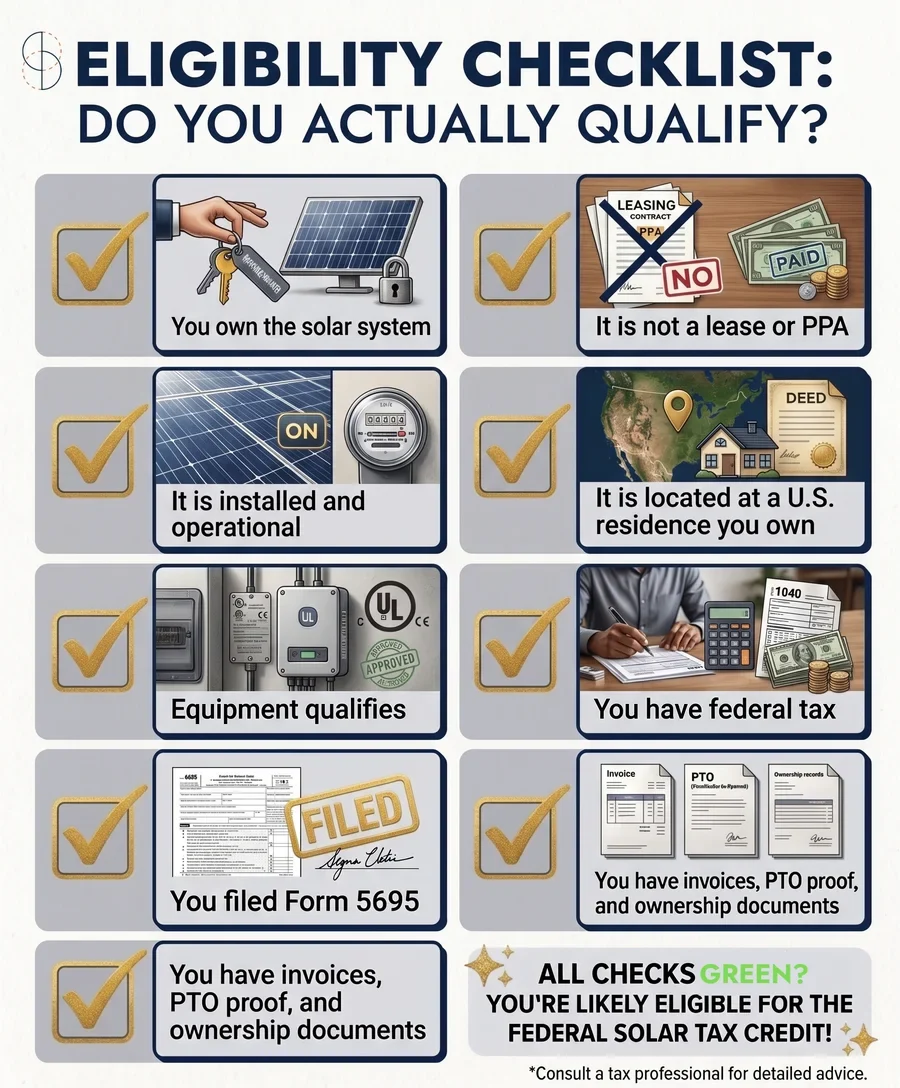
3. The System Must Be at a U.S. Residence You Use
The credit applies to primary residences and second homes. It does not apply to rental property you don’t personally use for part of the year. Different rules may allow separate credits for business or rental use — a tax professional should evaluate that.
4. Qualifying Equipment
Eligible solar property includes:
- Solar photovoltaic panels or cells.
- Inverters.
- Mounting equipment and racking.
- Wiring and electrical connections.
- Energy storage (batteries).
- Labor properly allocable to onsite preparation, assembly, and original installation.
Cosmetic home upgrades and unrelated electrical repairs are not eligible. Replacing your roof isn’t covered — unless you’re installing a solar shingle roof designed as part of the system. See also: skylight leaks caused by solar installation.
5. You Must Have Tax Liability
The credit is non-refundable. It reduces what you owe to zero but cannot pay you beyond your liability. If you had no federal tax liability at all, there was nothing for the credit to offset that year — though an unused balance carries forward indefinitely, as described above.
6. You Must Meet IRS Filing Requirements
- File IRS Form 5695 for the tax year the installation was completed.
- Keep your documentation — itemized invoices, manufacturer certifications, completion records — in case the IRS asks.
Missing or incorrect filing can sink an otherwise valid claim.
7 Common Reasons You Can’t Claim the Solar Tax Credit

- Your Installation Was Completed After December 31, 2025
This used to push your claim into the following tax year. It no longer does. For installations completed after December 31, 2025, the residential credit is unavailable — permanently.
What you can do:
- Pull your completion documentation and confirm the actual date the original installation was finished.
- If your installer promised completion in 2025, controlled the schedule, and missed it, the lost credit is a specific, calculable dollar figure — not a vague disappointment. Document what you were told, when, and by whom.
- Have a professional assess whether that promise and that failure give you a claim.
- You Have a Leased System or PPA
If you don’t own the system, you can’t claim the credit. Leases and PPAs assign ownership — and the tax benefit — to the solar company.
What you can do:
- Read your agreement and confirm who holds title. The word “own” in a brochure is not the same as title in a contract.
- If you were told you would own the system and the contract says otherwise, that gap is the whole case. A legal review can tell you what you actually signed.
- You Filed Your Taxes Incorrectly
A missing Form 5695, the wrong tax year, or omitted eligible costs will produce a denial.
What you can do:
- File an amended return if the error was on your end and the year is still open.
- Use a preparer who has handled solar credits before — including carryforward tracking, which now matters more than ever.
- The Installation Was Never Actually Completed
Systems left unfinished, waiting on components, or abandoned mid-project never produced a qualifying expenditure.
What you can do:
- Get a written, dated statement of what remains outstanding.
- If the installer has walked away, stopped responding, or gone out of business, stop waiting and get advice. Abandoned installations are one of the most common fact patterns we see.
- Ownership Paperwork Was Incomplete
If the system title or purchase agreement wasn’t finalized, the IRS won’t process the credit. This is common in home purchases with existing solar and in builder-installed systems.
What you can do:
- Finalize transfer-of-ownership documents as soon as possible.
- If a seller or installer is withholding documentation, legal assistance can cut through stalling.
- You Don’t Have Enough Tax Liability
The credit only offsets what you owe. You cannot receive the unused balance as cash.
What you can do:
- Claim what you can and carry the remainder forward — indefinitely, until it’s used.
- Make sure your preparer is actually tracking the carryforward year to year. This is the single most commonly dropped piece of a solar credit.
- Your Installer Made Paperwork Errors
The credit depends on accurate documentation, and most of it comes from the company that sold and installed your system.
The key documents include:
- Itemized invoice showing eligible equipment and installation costs.
- Proof of ownership (sales receipt, signed loan agreement, or system title).
- A completion date consistent with inspection and utility records.
- Manufacturer certification statements.
- Utility Permission to Operate documentation.
If any of it is wrong, missing, or internally inconsistent, your claim can be denied even though your system qualified.
What you can do:
- Request corrected or missing documents from your installer in writing, and keep the request.
- If they refuse or stall, you may need help compelling compliance — especially with filing deadlines in play.
What Actually Proves Your Claim Year
Because everything now turns on a single date, documentation is the whole ballgame. Here’s what each record does and doesn’t establish.
| Document | What It Establishes | Why It Matters |
|---|---|---|
| Installer completion certificate / final invoice | The date the original installation was completed | This is the date Section 25D turns on. Get it in writing, with a date, before you need it. |
| Signed contract and deposit receipt | When you committed and paid | Useful evidence of what you were promised — but it does not establish your claim year. |
| Final electrical / building inspection record | Independent third-party date the work was finished | Often the strongest corroboration when an installer’s paperwork is vague or backdated. |
| Utility Permission to Operate (PTO) letter | When the utility authorized interconnection | Frequently later than completion. Don’t assume a 2026 PTO defeats a 2025 completion — ask your tax professional. |
| Loan agreement or system title | Who owns the equipment | Ownership is a threshold requirement. No title, no credit — regardless of dates. |
| Sales materials, texts, and recordings | What the salesperson actually represented | Establishes nothing with the IRS. Can establish a great deal in a fraud claim. |
See also: HOA issues with solar panel installation.
What to Do If You Can’t Claim the Credit
- Confirm the exact date your original installation was completed, in writing.
- Check whether you have an unused carryforward balance from a prior year — it doesn’t expire.
- Amend a still-open return if a filing error caused the denial.
- Get missing or corrected documentation from your installer, in writing.
- Consult a tax professional to protect your carryforward.
- If an installer or salesperson misrepresented eligibility, ownership, or timing, seek a legal review of what you were sold.
When Tax Credit Denials Cross From Confusion to Misrepresentation
Most homeowners who lose out on the solar tax credit didn’t do anything wrong. They were misled, rushed, or misinformed by the companies that sold them the dream of “free solar.”
At Bennett Legal, we see the same patterns across case after case: installers promising guaranteed credits, misstating IRS timing, failing to produce basic documentation, and — now — selling third-party-owned systems while implying the homeowner gets a tax benefit that legally belongs to the company.
The end of the residential credit did not end that behavior. It gave it a new script.
Our legal team helps homeowners:
- Investigate whether an installer or salesperson misrepresented eligibility, ownership, or timing under Texas and federal consumer protection law.
- Review contracts and sales materials to determine what was actually promised about ownership, “guaranteed” credits, and savings.
- Demand accountability and recovery — including damages tied to incentives you were promised and never received.
- Work alongside tax professionals to correct filings, restore documentation, and preserve any credit still available to you.
Many of these start out looking like misunderstandings. But if a company assured you of a benefit you were never legally able to receive, that isn’t a clerical error. Under Texas and federal law, it may be misrepresentation.
At Bennett Legal, we hold solar companies to the standard they sell: transparency, accountability, and truth about savings. Because when tax season exposes what the contract hid, you deserve more than an apology.
A qualified tax professional is the right person to help you file for and claim a credit you are owed. Bennett Legal steps in when a solar company’s false promises or failures are the reason you lost it.
If a solar company told you something about the tax credit that turned out not to be true, contact Bennett Legal for a free case evaluation.
Primary Sources
- 26 U.S.C. § 25D — Residential clean energy credit
- IRS Fact Sheet 2025-05 — FAQs on OBBB energy provision terminations (Aug. 21, 2025)
- IRS 2025 Instructions for Form 5695
- Congressional Research Service, Expiration and Carryforward Rules for the Residential Clean Energy Credit (IN12611)
Related Reading
Free consultation
Solar panel contract problems?
We help homeowners fight back against solar fraud. Free consultation.