Why Fraudulent Solar Liens Are Becoming a Hidden Threat in Probate
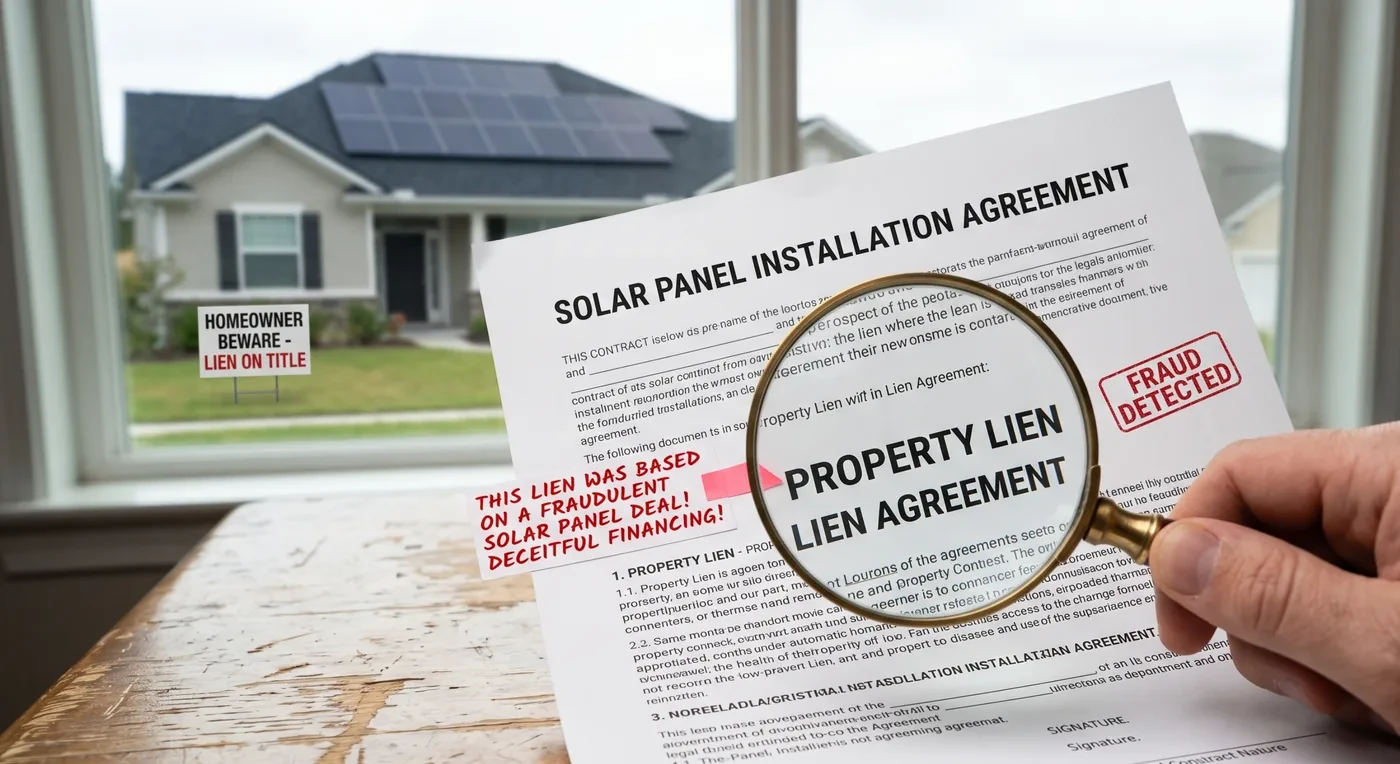
In recent years, fraudulent solar liens have become one of the most unexpected obstacles families face during probate. Predatory solar contracts — often pushed through aggressive door-to-door sales targeting seniors — are surging across the country. Families often discover the problem only after the homeowner dies, when a title search suddenly reveals an unexpected UCC-1 lien filed by a solar company.
$170,000+ recovery
Against Sunlight Financial · Solar fraud arbitration
- $113,000 loan cancelled
- UCC lien removed
- Credit repaired
- $58,000 cash to client
Past results do not guarantee a similar outcome. Every case is different.
Key takeaway: If you inherited a home and a title search revealed a solar UCC-1 lien, do not contact the solar company or make any payments. Speak with an attorney first.
For a document-based assessment, request an attorney review of the solar filing, inherited-property records, and underlying contract.
These fraudulent solar liens in probate can block the transfer of an inherited home, freeze refinancing, delay the estate settlement, and even derail a pending sale. Because UCC-1 liens attach to personal property rather than real estate, many heirs are shocked to learn that a solar company's filing — sometimes legitimate, sometimes entirely fraudulent — can still cloud title and stop a transaction cold.
Free consultation
Solar panel contract problems?
We help homeowners fight back against solar fraud. Free consultation.
As more estates encounter unauthorized or fraudulent solar liens, probate attorneys are seeing a growing wave of families unable to transfer inherited homes without first unraveling a complex web of consumer fraud, lien law, and estate-administration rules.
If you're dealing with a solar contract dispute right now — whether for yourself or for a deceased family member's estate — start with our most comprehensive guide: How Do I Get Out of My Solar Panel Contract?
What a Solar UCC-1 Lien Is and Why It Impacts Inherited Homes
Solar companies frequently use UCC-1 filings to secure financing of solar panels or equipment leases. In a valid transaction, the homeowner signs a contract, receives equipment, and the company perfects its security interest by filing a UCC-1 statement.
But in fraudulent or unauthorized situations — common in predatory solar sales — the homeowner never consented, never saw a contract, or never received the equipment. Yet the company still files a UCC-1. For a deeper look at how this happens and what it means, see our article on why solar companies file UCC liens without telling you.
While a UCC lien does not create a lien on the real property itself, title companies treat any UCC filing that references solar equipment as a cloud on title. This means:
- Lenders may refuse financing
- Buyers may refuse to close
- Title companies may not insure the transfer
- Escrow cannot proceed until the lien is released or terminated
Even in probate, the personal representative may be unable to transfer the home until the lien is resolved. And unlike most creditor claims that follow a predictable probate timeline, a fraudulent UCC filing introduces legal disputes that can take months to untangle.
How Fraudulent Solar Liens Are Commonly Created
Predatory solar sales tactics have exploded, especially in communities with large elderly populations. If you suspect the original homeowner was subjected to high-pressure tactics, our guide to the solar panel sales playbook and the fraud signals to watch for covers the most common patterns in detail.
Common fraud patterns include:
- High-pressure door-to-door sales
- Forged e-signatures
- Bait-and-switch contracts
- Unauthorized credit applications
- Contracts that are never delivered
- UCC-1 filings despite no installation, equipment delivery, or financing
Because UCC-1 filings require no verification, a solar company can file one with minimal information. Elderly homeowners are especially vulnerable — and their families are often left sorting through the damage during an already difficult time.
How Solar Liens Disrupt Probate Administration
When a homeowner dies with a solar lien on record, the estate must address it before distributing the home. This is true whether the lien is legitimate or fraudulent — the personal representative cannot simply ignore it.
Fraudulent liens complicate probate in several specific ways. First, they create a cloud on title that can delay the court's approval of property transfers, even when the rest of the estate is ready to close. Second, the solar company may file a creditor claim against the estate, forcing the personal representative to evaluate — and potentially challenge — the validity of the underlying contract. Third, if the estate needs to sell the home to pay debts or distribute assets, a solar lien can halt the sale entirely until it is resolved.
For families already navigating the emotional and legal burden of losing a loved one, a fraudulent solar lien adds an unexpected layer of complexity. For more on how these contracts affect estates generally, see Can a Solar Panel Contract Outlive You? What It Means for Your Heirs.
Solar liens can:
- Delay Letters Testamentary or Administration
- Create disputed creditor claims
- Block estate property sales
- Impose duties on the personal representative to challenge improper filings
Selling or Transferring an Inherited Home with a Solar Lien
Title companies universally treat solar UCC liens as encumbrances that must be cleared before any transfer. Even when the lien is clearly fraudulent, title companies are not in a position to adjudicate the dispute — they simply refuse to insure the transaction until the lien is released or terminated by the filing party.
This creates a particularly frustrating situation for heirs. The solar company may have no legitimate claim, but the lien's mere existence on the public record is enough to freeze the transaction. In some cases, solar companies have demanded large payments to release even fraudulent liens — essentially holding the property hostage.
For a detailed look at how these liens affect property sales and refinancing beyond the probate context, read The Hidden Solar Panel Lien That Could Kill Your Home Sale or Refinance.
Common problems include:
- Buyers unwilling to proceed with a clouded title
- Lenders refusing to finance a purchase with an open UCC filing
- No title insurance issued until the lien is cleared
- Solar companies demanding payoff amounts to release fraudulent liens
Need help right now? If a fraudulent solar lien is blocking the sale or transfer of an inherited home, contact Bennett Legal for a free consultation. We help families clear title so the estate can move forward.
State-by-State Variations (5-State Summary)
Solar lien protections vary significantly by state. The table below summarizes key differences, but every situation is unique — the right approach depends on where the property is located and the specific facts of the case.
| State | Key Protections | Notes |
|---|---|---|
| CA | Clear UCC dispute procedures | Strong consumer solar protections |
| TX | Simplified UCC termination options | Active AG enforcement for solar fraud |
| FL | Detailed home-solicitation rules | High volume of solar-fraud complaints |
| NY | Strong elder-protection statutes | Fast-track UCC challenge options |
| AZ | Solar-specific contract regulations | Installation verification requirements |
Texas in particular has seen aggressive enforcement by the Attorney General's office against solar companies that file unauthorized UCC liens. Families in Texas dealing with this issue should be aware that the state's streamlined UCC termination process may offer a faster path to resolution.
How to Challenge and Remove a Fraudulent Solar Lien After Death
A fraudulent solar lien can be removed, but the process is technical and should not be attempted without legal counsel. The steps vary depending on the state, the type of lien, and how cooperative (or uncooperative) the solar company is.
Steps may include:
- Filing a UCC-3 termination statement
- Demanding the solar company produce the original signed contract
- Sending formal dispute notices under UCC and consumer-protection statutes
- Invoking elder-fraud statutes to void the underlying contract
- Filing complaints with the state Attorney General or the FTC
- Litigation if the solar company refuses to release the lien
Important: These contracts are extremely complicated. Do not negotiate or sign anything with the solar company before speaking with a lawyer. If you're looking for a starting point on your options, our guide How Do I Get Out of My Solar Panel Contract? covers the general landscape — but probate cases involve additional legal layers that require specialized help.
Evidence checklist — gather these before your first attorney consultation:
- Photos or inspection confirming no solar equipment was installed
- Medical records showing diminished capacity at the time of signing
- Witness statements about the circumstances of the sale
- Device logs disproving electronic signatures (e.g., signed from a device the homeowner didn't own)
- Any correspondence documenting misrepresentations by the solar company
- The homeowner's mail, email, and any solar company paperwork found in the home
How Elder Fraud Laws Help Heirs Remove Invalid Solar Liens
Most states have enacted statutes specifically designed to protect vulnerable adults from predatory business practices. These laws are a powerful tool for heirs dealing with fraudulent solar liens, because they can void the underlying contract entirely — and a void contract cannot support a UCC lien.
State elder-fraud and consumer-protection statutes typically address exploitation of vulnerable adults, deceptive trade practices, undue influence over elderly or disabled individuals, lack of meaningful consent due to cognitive impairment, and home-solicitation violations such as missing cancellation notices or cooling-off period failures - in Texas, that includes the five-business-day residential solar cancellation right under Occupations Code § 1806.156 (covered contracts signed on or after September 1, 2025).
When an elder-fraud claim succeeds, it does more than just remove the lien — it can eliminate the solar company's basis for any claim against the estate. In some states, it also opens the door to statutory damages, attorney's fees, and penalties that can be recovered on behalf of the estate.
For more on the deceptive tactics that give rise to these claims, see What to Do If a Solar Panel Company Lied About Your Savings.
Can Solar Companies Claim Against the Estate?
This is one of the most common questions families ask when they discover a solar lien during probate. The short answer: a solar company can only assert a valid creditor claim if there was a valid, enforceable contract.
Fraudulent agreements — contracts that were never signed, were signed under duress or misrepresentation, or were executed without the homeowner's capacity to consent — do not create enforceable obligations. A solar company cannot convert a fraudulent filing into a legitimate debt simply by asserting it during probate.
Key principles heirs should understand:
- The solar company can file a creditor claim, but the personal representative has the right — and the duty — to challenge it if the underlying contract is invalid
- Heirs do not personally inherit the debt, even if the lien is legitimate — it is an obligation of the estate, not the individuals
- UCC liens do not create the right to force a home sale or foreclose on real property
- Most states impose strict deadlines for creditors to file claims during probate, and solar companies that miss those deadlines may lose their right to collect entirely
How to Protect Yourself if You Suspect a Solar Lien Is Fraudulent
If you've inherited a home and suspect the solar lien on the property may be fraudulent, time matters — but so does caution. Taking the wrong steps early can weaken your legal position.
Heirs should immediately:
- Review the deceased homeowner's mail, email, and digital records for any solar company correspondence
- Check the state's UCC database for filings against the homeowner's name
- Run a full title search on the property
- Physically confirm whether solar equipment was actually installed
- Preserve all evidence — photos, contracts, emails, medical records
- Do not pay the solar company — making a payment can be interpreted as acknowledging the validity of the lien
- Consult a probate or consumer-fraud attorney before taking any action
These cases are legally complex — never attempt to cancel or negotiate solar contracts without legal representation. For an overview of your options, start with How Do I Get Out of My Solar Panel Contract?
Options for Heirs Who Cannot Sell or Transfer the Property
When a fraudulent solar lien is blocking a property transfer, heirs have several legal paths available. The right option depends on the strength of the evidence, the solar company's responsiveness, and how quickly the estate needs to close.
Available remedies include:
- Emergency UCC-3 termination — filing a termination statement when the lien is clearly unauthorized
- Negotiated release — working with the solar company to release the lien without admitting liability or making payment
- Probate petition — asking the court to declare the lien invalid as part of the estate administration
- Court-ordered termination — seeking a judicial order to remove the lien when the solar company refuses to cooperate
- Civil damages — pursuing a lawsuit for damages caused by the fraudulent filing, including costs incurred from delayed property sales
- Litigation to clear title — a quiet title action or declaratory judgment to resolve the dispute permanently
Related reading: If the solar company that filed the lien has gone bankrupt, the situation becomes even more complicated. See Solar Company Bankruptcy: What Happens to Your Panels and Warranty for guidance on that scenario.
How Bennett Legal Helps Families Resolve Solar UCC Liens
Bennett Legal has developed a focused process for handling fraudulent or disputed solar liens during probate. Our team understands both the probate administration side and the solar panel financing fraud side — which is critical, because these cases sit at the intersection of both.
The firm:
- Reviews the lien, contract, and any electronic-signature data
- Demands contract proof from the solar company
- Challenges invalid signatures or predatory sales activity
- Files UCC-3 terminations when appropriate
- Raises elder-fraud arguments to void unauthorized contracts
- Negotiates lien releases without heirs paying fraudulent claims
- Works directly with title companies to clear title so the property can transfer or sell
Because solar agreements are unusually dense, technical, and hostile to consumers, Bennett Legal strongly advises heirs not to sign releases, admission forms, payment agreements, or contract amendments without legal counsel.
Take the Next Step with Fraudulent Solar Liens in Probate
Bottom line: Heirs do not have to accept fraudulent solar liens. The law provides tools to challenge them — but acting without legal guidance can make things worse.
If your family discovered a solar lien during probate, do not take any action with the solar company until you speak with an attorney. These contracts are complex, highly technical, and often predatory. Making the wrong move — even something that seems harmless like calling the solar company to ask questions — can undermine your legal position.
Contact Bennett Legal for a free consultation. We help families clear fraudulent liens and protect their ability to transfer or sell the inherited home.
Related Reading
- How Do I Get Out of My Solar Panel Contract? — Our most comprehensive guide to solar contract disputes
- Why Did a Solar Company File a UCC Lien Without Telling Me? — Understanding unauthorized UCC filings
- Can a Solar Panel Contract Outlive You? — What solar contracts mean for your estate
- The Hidden Solar Panel Lien That Could Kill Your Home Sale — How liens block property transactions
- The Solar Panel Sales Playbook: High-Pressure Tactics That Signal Fraud — Recognizing predatory sales patterns
Conclusion
Fraudulent solar liens have become an unexpected but common roadblock in probate. Seniors targeted by aggressive sales tactics leave behind estates burdened by unauthorized UCC filings, clouded titles, and fraudulent creditor claims.
Heirs do not have to accept these liens. With the right combination of probate action, UCC procedures, elder-fraud protections, and legal advocacy, families can clear title and move forward. Bennett Legal assists families through every step of this process.
Free consultation
Solar panel contract problems?
We help homeowners fight back against solar fraud. Free consultation.