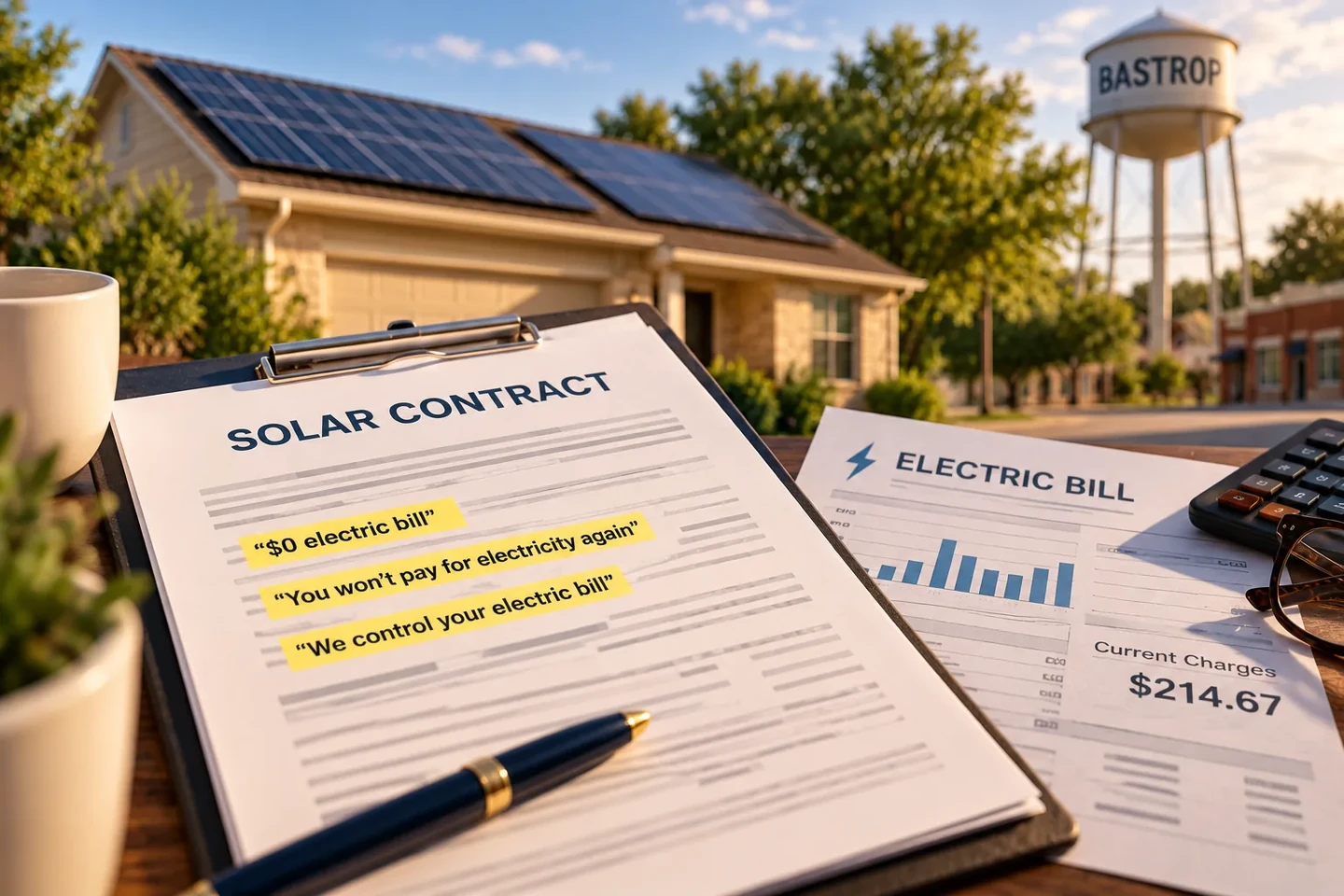
Most homeowners looking for solar scam warning signs are thinking about the sales pitch — the high-pressure tactics, the promises that were too good to be true. But some of the most damaging red flags don't show up until after the contract is signed and the crew has left your roof.
$170,000+ recovery
Against Sunlight Financial · Solar fraud arbitration
- $113,000 loan cancelled
- UCC lien removed
- Credit repaired
- $58,000 cash to client
Past results do not guarantee a similar outcome. Every case is different.
Tall Chuck here. I've sat across the table from a lot of homeowners who had no idea anything was wrong until months — sometimes years — later. The panels were up. The loan was running. And then: an unknown crew shows up for "repairs." Or the inverter fails for the third time in a year. Or the system produces less power each month than the contract promised.
These aren't maintenance issues. They are patterns. And at Bennett Legal, we've learned to read them.
Here are the 5 post-installation red flags that tell us a homeowner may have been defrauded — and why the lender who financed the deal may be just as liable as the installer who disappeared.
Free consultation
Solar panel contract problems?
We help homeowners fight back against solar fraud. Free consultation.
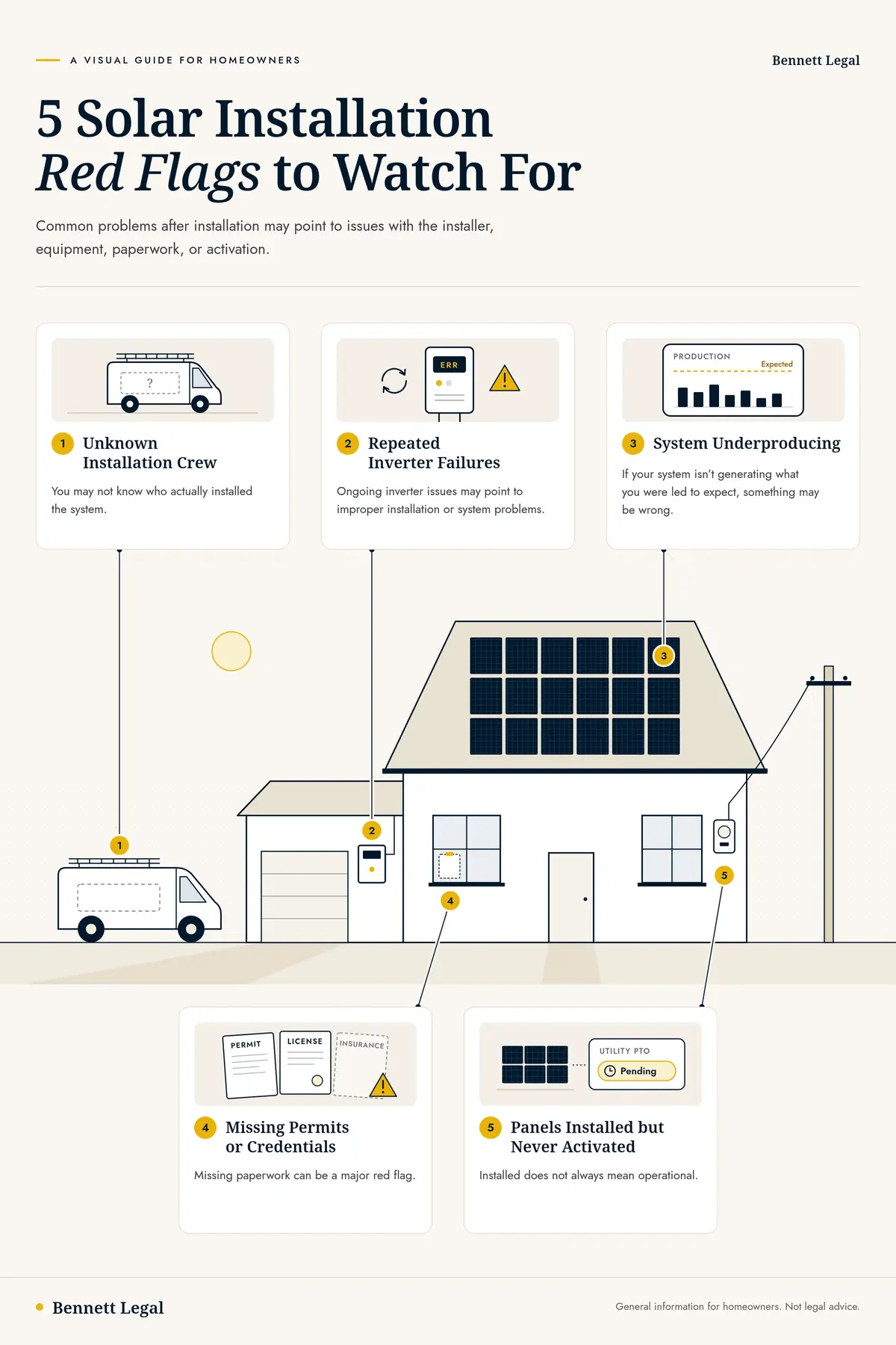 Infographic: 5 solar installation red flags to watch for
Red Flag #1: An Unknown Crew Showed Up on Installation Day
 Unknown crew showed up on solar installation day
You spent weeks vetting the solar company. You read their reviews, checked their license, signed a contract with their name on it. You feel good about it.
Then, on installation day, there's no branded company truck. Instead: an unmarked van and a crew in plain t-shirts you've never seen before. They say they're here to install your solar — but they work for "ABC Electrical," not the "SunPower Pros" you hired.
From up here on the ladder, I can see a five-alarm fire of red flags.
When a solar company sends a subcontractor you never agreed to, they are not making a simple substitution. They are gambling with your home, your money, and your safety. Before you let a single one of those strangers onto your roof, you need to understand the legal trap you are about to walk into.
What This Means Legally
When you signed a contract with a solar company, you hired that specific company — their license, their insurance, their reputation. Sending an unknown crew without your written consent is called an unauthorized delegation of duties. In plain talk: they pawned your project off on someone else to cut costs, and they're betting you'll be too polite to ask questions.
The Liability Shell Game
Say the subcontractor drops a panel on your car, or a crew member falls off your roof. You call the solar company you hired. Their answer: "Not our problem — that was an independent contractor. File a claim with their insurance." You go to the subcontractor. No insurance, or their policy has lapsed. Now you're caught in the middle, both companies pointing fingers, with property damage and no clear party willing to pay.
In every state, the law is consistent: the company you signed with is responsible for everything their subcontractors do on your property. They cannot insulate themselves by outsourcing the job.
Your 25-Year Warranty May Already Be Void
This is the long-term financial trap. Manufacturers like Enphase, SolarEdge, and REC require certified technicians for installation — and their 25-year warranties are only valid if a certified installer did the work. Most cheap subcontractors are not certified.
The moment an uncertified crew installs your panels, your manufacturer's warranty is legally void. When an inverter dies in year five, the manufacturer denies your claim. The subcontractor is gone. The original company washes their hands of it. You pay for repairs that should have been free.
Tall Chuck's Move When That Unknown Truck Pulls Up:
Walk straight out there, stand tall, and say: "I have a contract with [Original Company]. I do not have a contract with you. I need written authorization that you are their legal agent, a copy of your license, and your insurance certificate before you take a single ladder off that truck."
If they can't produce all three — tell them to leave your property immediately.
Unknown crew already came and went? Voided warranties, roof leaks, failed inspections — the damage may still be recoverable. Tell us what happened. Get a Free Case Evaluation →
Red Flag #2: Your Inverter Keeps Failing — And They Just Keep "Resetting" It
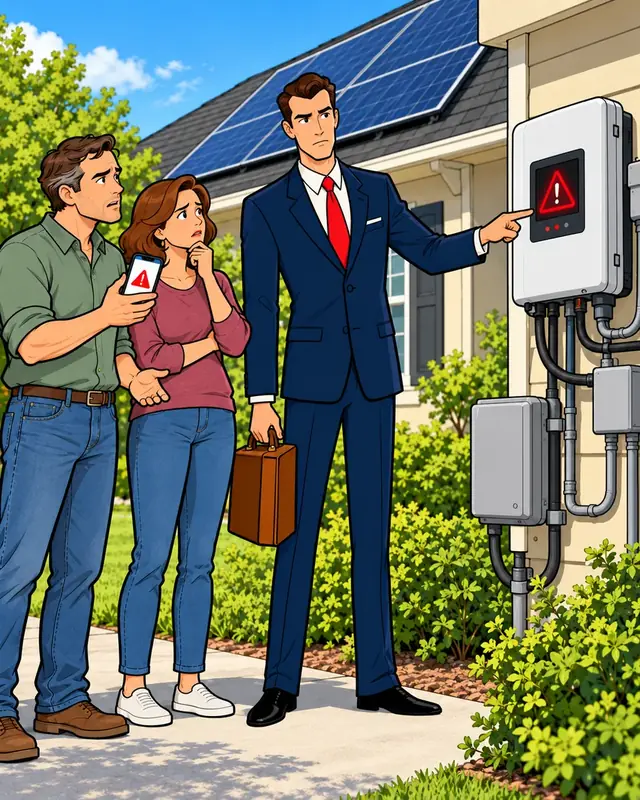 Your solar inverter keeps failing
You hear that beeping from the garage again. Third time in eight months.
You check the monitoring app: "Inverter Error." A technician comes out, spends an hour on the phone with the manufacturer, "resets" something, and leaves. Two months later, it starts again.
Here's what the solar company isn't telling you: when an inverter fails repeatedly, it is rarely bad luck. In the vast majority of cases we handle at Bennett Legal, chronic inverter failure is a direct consequence of how the system was installed — and often designed — in the first place.
Was Your Inverter Set Up to Fail?
The most common scenario: the installer paired a large solar array with a small, cheap inverter to fatten their profit margin. On any sunny day, the inverter gets overwhelmed, overheats, and degrades from the inside out. The failures start months later. The salesperson is long gone.
Other ways a bad installation engineers inverter failure:
- No ventilation: Inverters are heat-sensitive electronics. Placing one in direct afternoon sun or a sealed closet isn't an accident — it's incompetence or fraud.
- Mismatched components: Incompatible wiring or breakers put constant strain on the inverter from day one. Technicians patch symptoms. No one fixes the root cause.
- Uncertified installation: If the subcontractor who installed your system wasn't certified (see Red Flag #1), your inverter manufacturer's warranty is already void before the first failure.
The Repair Stall: How to Recognize a Bad-Faith Cover-Up
A legitimate company replaces a defective inverter after the second failure — without a fight. Here's what fraud looks like instead:
- The Endless Reset: The technician never replaces parts. They restart the system, clear the error code, and tell you to "keep an eye on it."
- Warranty Erosion: Every repair takes weeks to schedule, eating into your warranty period while the system sits broken. They're deliberately running out the clock.
- Refurbished Parts: They replace a failing component with a used part, leading to another failure months later.
- Truck Roll Fees: They charge a diagnostic fee for each visit — even though the problem is clearly their defective equipment or installation.
When the Law Says Enough Is Enough
The law recognizes that a warranty is not a license for endless repair attempts. Three to four documented failures for the same issue is generally the threshold in consumer protection law for establishing a chronic defect. At that point, under the Magnuson-Moss Warranty Act and your state's consumer protection statutes, the company is obligated to provide a replacement — not another reset.
If your inverter has failed three or more times, document everything: date, error code, when you called, when the technician arrived, what they did, what parts were replaced. That repair log is the foundation of your case.
Three inverter failures and counting? That repair log may be enough to demand a full replacement — or build a fraud case. Let's look at what you have. Get a Free Case Evaluation →
Red Flag #3: The System Never Produced What the Contract Promised
Your solar contract includes a production estimate — a number in kilowatt-hours the company promised your system would generate each year. If your monitoring app is consistently showing numbers far below that estimate, you are not just dealing with a bad weather year.
Chronic underproduction is almost always the downstream effect of a fraudulent installation: an undersized inverter clipping your production, panels facing the wrong direction, mismatched components, or a system that was installed but never properly activated. The same shortcuts that cause inverter failures (Red Flag #2) are usually the same ones killing your output numbers.
If your system is consistently underproducing, read our full guide on solar underproduction and your legal rights →
Red Flag #4: They Can't Produce Permits, Certifications, or Insurance
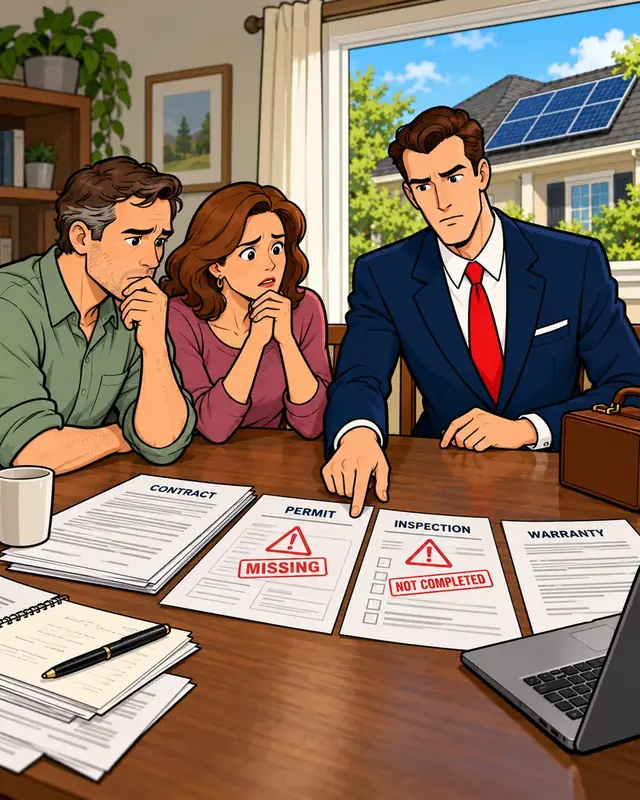 Missing paperwork can be a solar installation red flag
After installation, ask the company for three documents: (1) the permit and inspection sign-off from your city or county, (2) the installer's license number and state certification, and (3) a certificate of general liability and workers' compensation insurance.
A legitimate company produces all three without hesitation.
A company that stalls, deflects, or can't produce documentation has a serious problem — and it's now your problem too:
- Unpermitted systems can result in fines, forced removal, and a home that cannot be insured or sold. They often can't be legally turned on.
- Unlicensed installers void manufacturer warranties and expose you to full personal liability if a worker is injured on your property.
- No insurance means you — not the company — absorb all risk from installation damage, roof leaks, or worker injuries.
These failures almost always travel together with the subcontractor problem (Red Flag #1). A company that outsourced your job to a cheap crew is usually the same company that didn't pull permits. If you had an unknown crew on your roof, this is the first document you should be asking for.
Red Flag #5: The System Was Installed but Never Activated
If GoodLeap or Sunlight Financial has been billing you since installation — but your system has never been turned on — you are living the clearest form of solar fraud we handle at Bennett Legal.
The solar company collected the installer payment from the lender. They put equipment on your roof. Then they walked away without obtaining Permission to Operate (PTO) — the utility approval required before a solar system can legally generate electricity.
You are paying a solar loan for a system that has never produced a single dollar of electricity. That is not a scheduling delay. That is fraud. And both the installer and the lender who funded them may be responsible.
Tall Chuck puts it plainly: paying for panels that were never turned on is like paying rent on an apartment you were never given the keys to. Nobody should accept that.
Read more about what to do when your solar panels were installed but never turned on →
The Lender Connection: Why GoodLeap and Sunlight Financial May Be Just as Liable
Here's what solar lenders don't advertise: under the FTC Holder Rule (16 C.F.R. Part 433), when you finance a solar installation through a lender like GoodLeap or Sunlight Financial, that lender takes on legal responsibility for the installer's fraud.
The Holder Rule exists precisely for arrangements like this: a company sells you something using a third-party loan, then disappears. Under the Rule, any claim or defense you have against the installer — fraud, breach of contract, failure to deliver a working system — can also be raised against the lender.
This matters because:
- Your installer may be gone. The lender is not.
- The lender collected payments while the fraud was happening.
- The lender has the resources to make you whole — up to the full amount of the loan.
GoodLeap and Sunlight Financial have faced complaints across Minnesota, New York, Virginia, and Texas tied directly to installers in their financing networks. State attorneys general in those states have opened enforcement initiatives. The regulatory pressure is growing — and homeowners who act now have the most leverage.
Learn more about lender liability when your solar installer disappears →
🏆 We Went After the Lender — and Won $170,000
Our client's installer left her with panels on her roof that were never turned on. Sunlight Financial kept billing her $268/month anyway.
We fought back. Total recovery: $170,000. $113,000 loan cancelled · Lien removed · Credit repaired · $58,000 in her pocket.
Your Action Plan If You're Seeing These Red Flags
- Document everything immediately. Repair logs, installation photos, error codes, service call records, all written communication with the company. Start a dedicated folder today — every document you create now is evidence.
- Request permits and certifications in writing. If they can't or won't provide them within a reasonable time, you have your first piece of formal evidence of fraud.
- Do not let unknown crews do additional work until you've verified their credentials and obtained written authorization from the original company.
- Send a formal dispute letter to both the installer and the lender. Put your complaints on the record in writing — this starts the legal clock and creates a paper trail.
- File complaints. CFPB (for lender issues), your state's contractor licensing board, and the Attorney General's consumer protection office.
- Get a solar fraud attorney before your warranty window closes. Every failed repair is eating into your warranty period. Every month you wait on a never-activated system is another payment on a loan that may be entirely fraudulent. The companies doing this are betting you'll give up. Talk to us before the clock runs out →
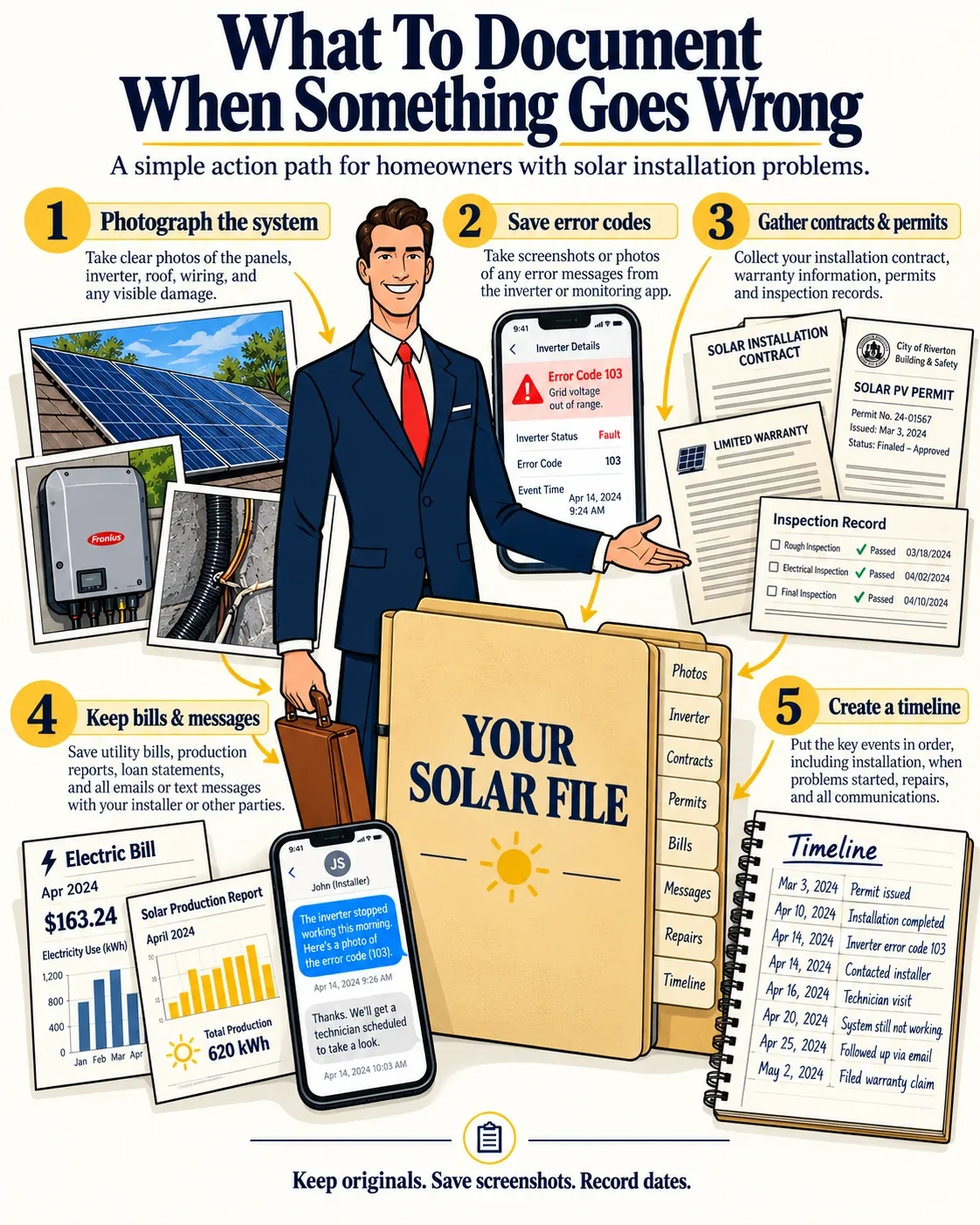 Start building your solar fraud case file
When the Red Flags Are Real, We Act on Them
At Bennett Legal, these aren't theoretical scenarios. The unknown crew on install day. The inverter that's failed four times without a real fix. The system that's been billed for two years and never turned on. We've handled all of it.
We know how to build fraud cases from repair logs and permit records. We know how to go after lenders under the FTC Holder Rule. And we know that the companies who commit this fraud are betting you'll give up before you figure out what they actually sold you.
At Bennett Legal, we:
- Investigate installation fraud using your documentation, repair history, and permit records
- Hold subcontractors and prime contractors jointly liable for property damage and voided warranties
- Pursue lender liability under the FTC Holder Rule against GoodLeap and Sunlight Financial
- Demand full loan cancellation, lien removal, credit repair, and compensation for damages
Seeing red flags in your installation? The sooner you document and act, the stronger your case. Talk to us today — it's free. Get Your Free Case Evaluation →
Frequently Asked Questions
Can a solar company use a subcontractor without my permission?
It depends on your contract — some include subcontracting clauses, others do not. But regardless of what the contract says, the original company you signed with is legally responsible for everything the subcontractor does on your property. You cannot be left legally exposed because they outsourced the job.
What should I do if an unknown solar crew shows up?
Do not let them begin work. Ask for written authorization from the company you hired, a copy of their business license, and a certificate of general liability and workers' compensation insurance. Call the original contractor's main office to verify before anyone touches your roof. If they cannot produce all three, tell them to leave.
How many inverter failures before I have a legal case?
Three to four documented failures of the same issue is generally the threshold in consumer protection law for establishing a chronic defect. At that point, repeated repair attempts have demonstrably failed and the company is legally obligated to provide a full replacement — not another service call. Document every failure from the very first one.
Does an uncertified installer void my solar warranty?
Yes. If the manufacturer requires a certified installer and the subcontractor lacked that certification, your 25-year equipment warranty is void. The company that sent the uncertified crew then becomes financially responsible for any future warranty claims the manufacturer denies.
What is the FTC Holder Rule and how does it apply to my solar loan?
The FTC Holder Rule (16 C.F.R. Part 433) requires that any claim or defense you have against a seller can also be raised against the lender who financed the sale. In solar fraud cases, this means that if your GoodLeap or Sunlight Financial loan funded an installation where fraud occurred, the lender is also legally responsible — even if the installer has since disappeared.
Can I sue GoodLeap or Sunlight Financial if my installer committed fraud?
Potentially, yes. Under the FTC Holder Rule, your claims against the installer can be asserted directly against the lender. We have done this successfully — including achieving a $170,000 recovery against Sunlight Financial in the Tellez case. Every situation is different, which is exactly why a free case evaluation is the right first step. Tell us what happened →
What if my system was installed but never activated?
This is one of the clearest forms of solar fraud we handle. You are making monthly loan payments on a system that has never generated a single dollar of electricity. Both the installer and the lender may be liable. Read our full guide on solar panels installed but never turned on →
Free consultation
Solar panel contract problems?
We help homeowners fight back against solar fraud. Free consultation.