If you've seen the news today about Texas's new solar law and immediately thought, "wait — does this apply to me?", you're asking exactly the right question. Maybe your solar payment ended up way higher than you were promised. Maybe the "savings" never materialized. Maybe you recently learned there's a lien on your home tied to your solar loan and nobody explained what that meant. Whatever brought you here, you deserve a straight answer — not just a headline.
$170,000+ recovery
Against Sunlight Financial · Solar fraud arbitration
- $113,000 loan cancelled
- UCC lien removed
- Credit repaired
- $58,000 cash to client
Past results do not guarantee a similar outcome. Every case is different.
So here it is: Texas's new solar law doesn't rewrite the contract you already signed. But that's not the end of the story, and it's not bad news for you. It just means your path forward looks a little different than "wait for the state to fix it" — and it's actually a path you can start on today.
Free consultation
Solar panel contract problems?
We help homeowners fight back against solar fraud. Free case evaluation.
What Texas's New Solar Law Actually Does
Starting September 1, 2026, new rules from the Texas Department of Licensing and Regulation (TDLR) require solar salespeople and companies to register with the state, disclose who they really are, and follow stronger rules against misleading sales tactics. It's a meaningful step — Texas lawmakers and regulators looked at how solar has been sold and financed in this state and decided homeowners needed real protection going forward.
Like most new consumer protection laws, though, it applies to contracts signed from today onward. It doesn't reach back and change the terms of a contract you already signed — and it doesn't erase what's already happened to homeowners who financed through companies like GoodLeap or Sunlight Financial before these rules existed.
💡 Good to know: Registration and stronger disclosure rules took effect today, but TDLR has temporarily suspended enforcement of two of the new administrative rules until November 1, 2026 — giving solar companies a short runway to get their paperwork in order. That delay doesn't touch your legal options at all; it's purely about the state's own enforcement calendar.
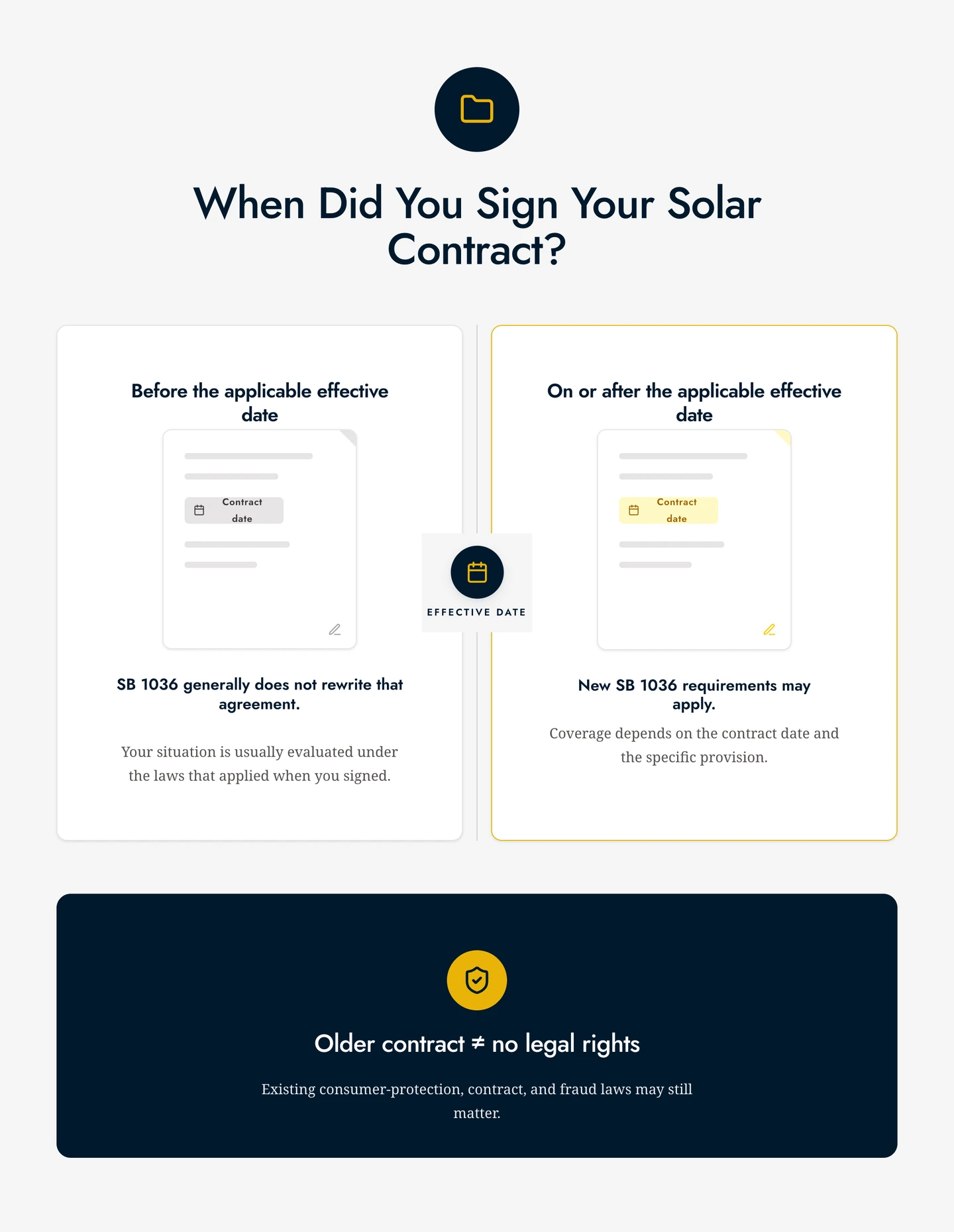 Infographic showing the timing of Texas's new solar law and how it applies to contracts
So How Does the New Solar Law Affect Your Existing Contract?
Here's the honest, practical answer: it doesn't change your contract's terms, but it doesn't change your rights, either.
The laws that protected you when you signed — Texas consumer protection law, contract law, and fraud law — were already in place, and they still apply to your situation today. This new law is additional protection for future buyers. It's not a replacement for the legal options you've always had. If anything, it's public confirmation that regulators recognize exactly the kind of problems many homeowners have already experienced.
A few things worth knowing about the rollout, so you have the full picture:
- TDLR is phasing in enforcement. Two of the new administrative rules won't be actively enforced until November 1, 2026. It just means the state's own timeline is slower than yours needs to be.
- You don't need to wait on TDLR. Your case doesn't depend on the state's enforcement schedule. It depends on what happened when you signed your contract.
- Companies whose practices prompted this law are still around. GoodLeap and Sunlight Financial are two of the most common lenders behind the complaints that helped drive this legislation — and homeowners financed through both are still dealing with the fallout.
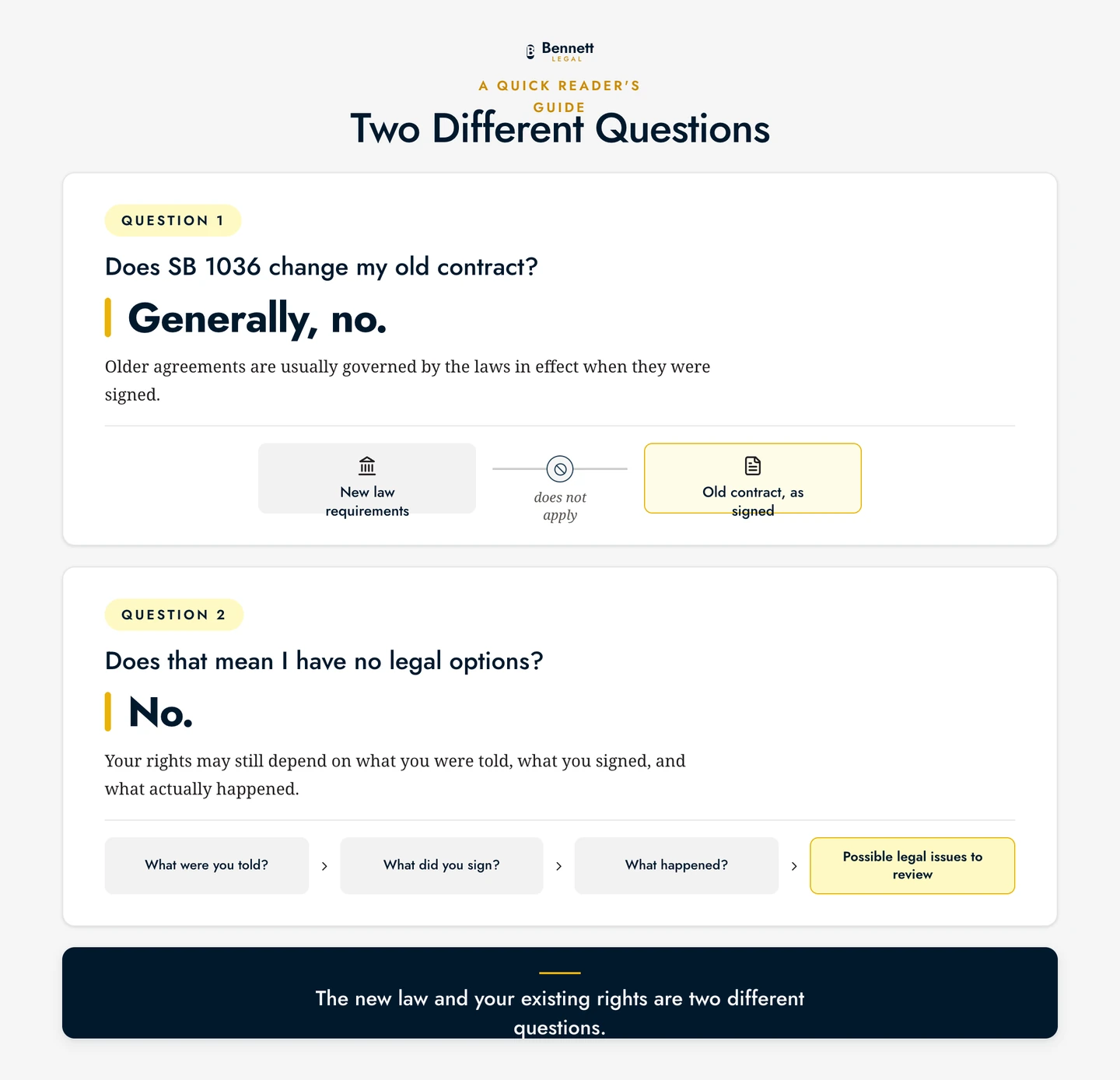 Infographic contrasting the two different legal questions homeowners have about their existing solar contract
If Something Felt Off About Your Solar Deal, Trust That Instinct
You don't have to have a legal background to know when something doesn't add up. If your contract involved any of the following, it's worth having it reviewed — today's law or not:
- Savings or system performance that were misrepresented to you
- Hidden fees or financing terms that shifted after you signed
- A UCC-1 lien on your property that was never clearly explained
- High-pressure sales tactics, incomplete disclosures, or terms that didn't match what you were told out loud
These are exactly the practices Texas's consumer protection and fraud laws already address. You don't need a new statute to have a valid claim — you need someone to look closely at what actually happened in your case.
"But a piece of paper does not get the final say. The law does."
That's a line we come back to often at Bennett Legal, because it's easy to feel like a signature at the bottom of a 40-page contract settles everything. It doesn't — not when that contract was built on misrepresentation.
📋 Not sure if your contract qualifies? Get a free review of your solar contract — we'll tell you plainly whether we see a case.
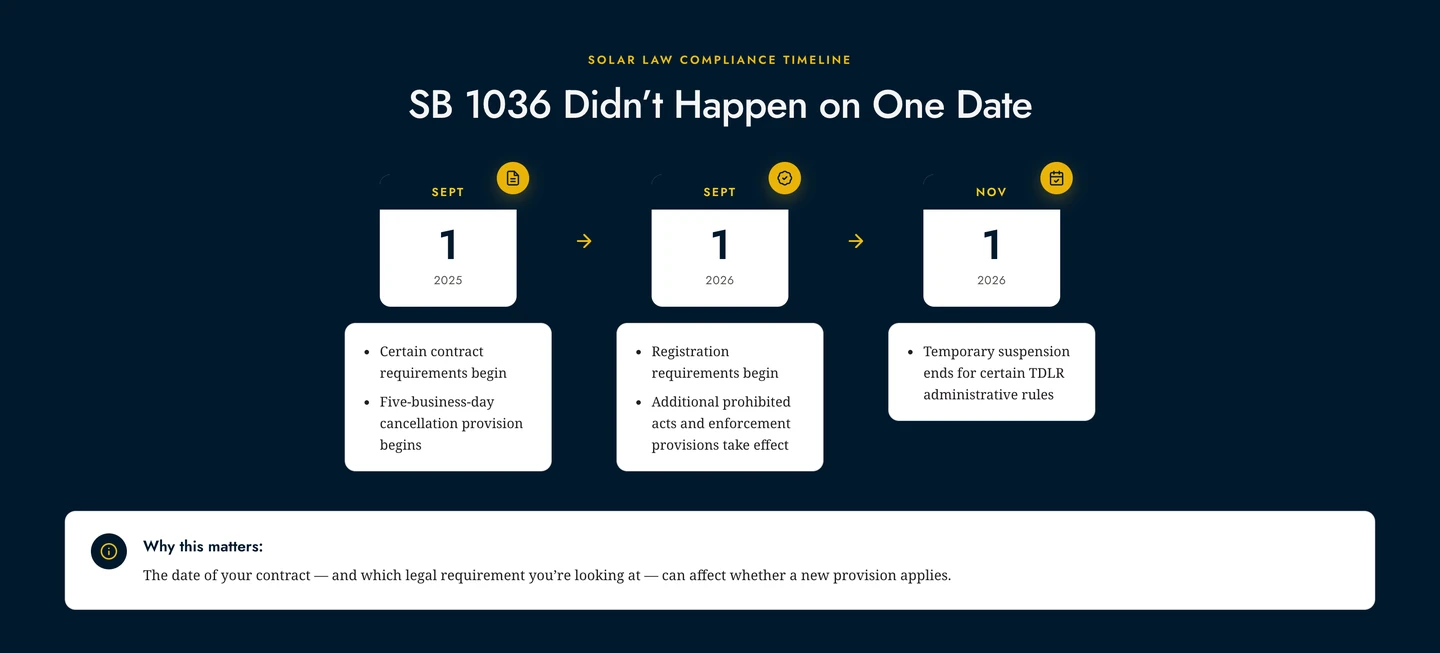 Timeline infographic showing key SB 1036 and TDLR enforcement dates for Texas's new solar law
About That Lien on Your Property
If part of what's worrying you is a lien connected to your solar financing, that concern is well-founded. A UCC-1 filing tied to a solar loan typically covers the panels and equipment — it's not a mortgage on your whole home. But in practice, title companies and mortgage lenders often require that filing to be paid off, released, or subordinated before you can sell or refinance. That gives your solar lender real leverage over a major decision in your life, even if the lien itself is narrower than it feels.
We've written in more detail about how this works and why it catches so many homeowners off guard:
- Can a Solar Company Put a UCC Lien on Your House Without Your Consent?
- The Hidden Solar Panel Lien That Could Kill Your Home Sale or Refinance
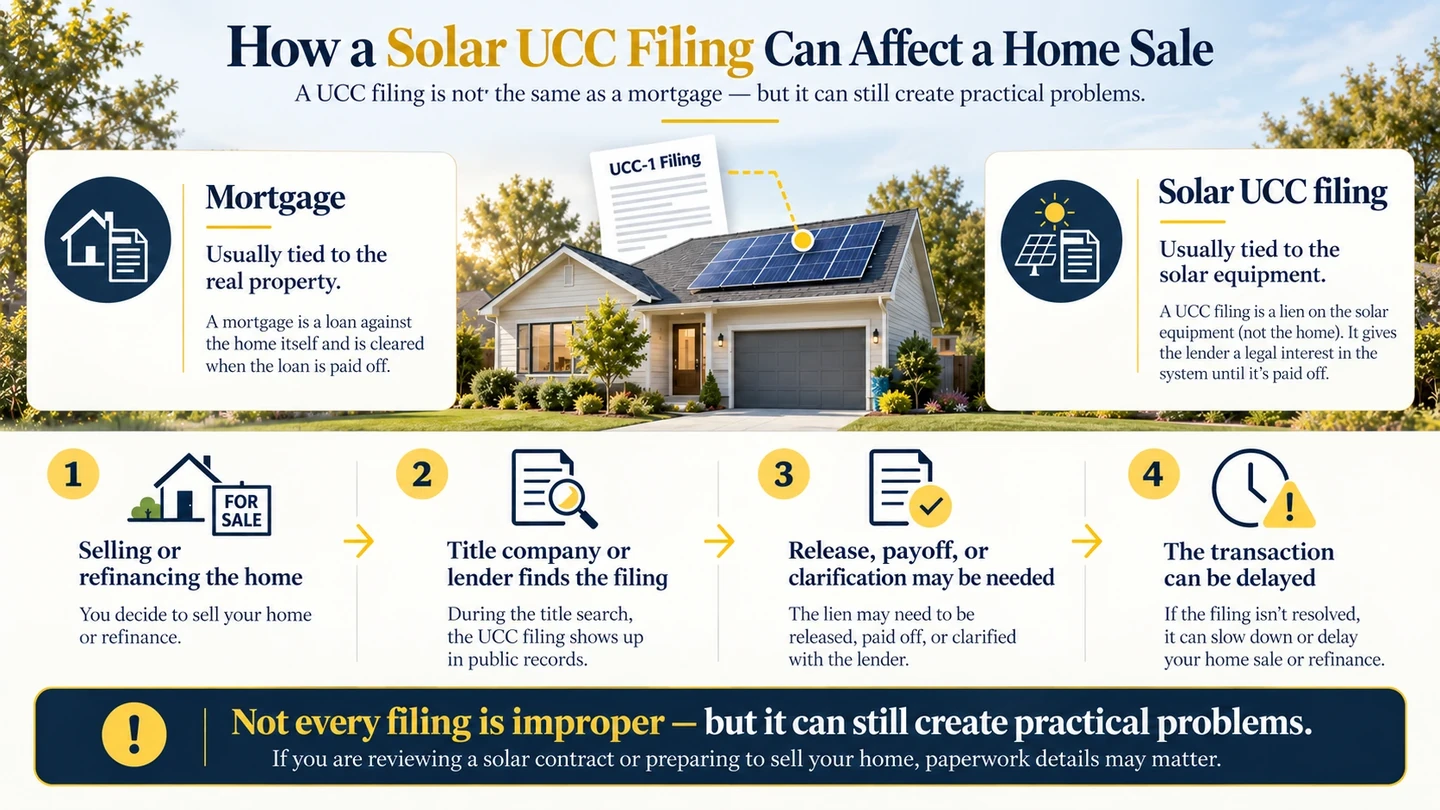 Infographic explaining how a UCC filing on a solar loan can affect your home resale or refinance
If you're not sure how your lien was placed or what it would take to clear it, that's a very reasonable thing to have someone examine.
What You Can Do Right Now
The good news in all of this: you don't have to wait for the state's enforcement date, and you're not without options just because your contract predates today's law. At Bennett Legal, we help homeowners in exactly this position — using the consumer protection, contract, and fraud laws that already exist to:
- Recover damages for misrepresented savings or performance
- Challenge unfair or deceptive financing terms
- Address UCC-1 liens filed against your property
- Pursue contract cancellation or financial recovery where the facts support it
Our solar panel financing fraud practice exists specifically for homeowners in this situation — people who signed a deal that looked reasonable on the surface and turned out to be anything but.
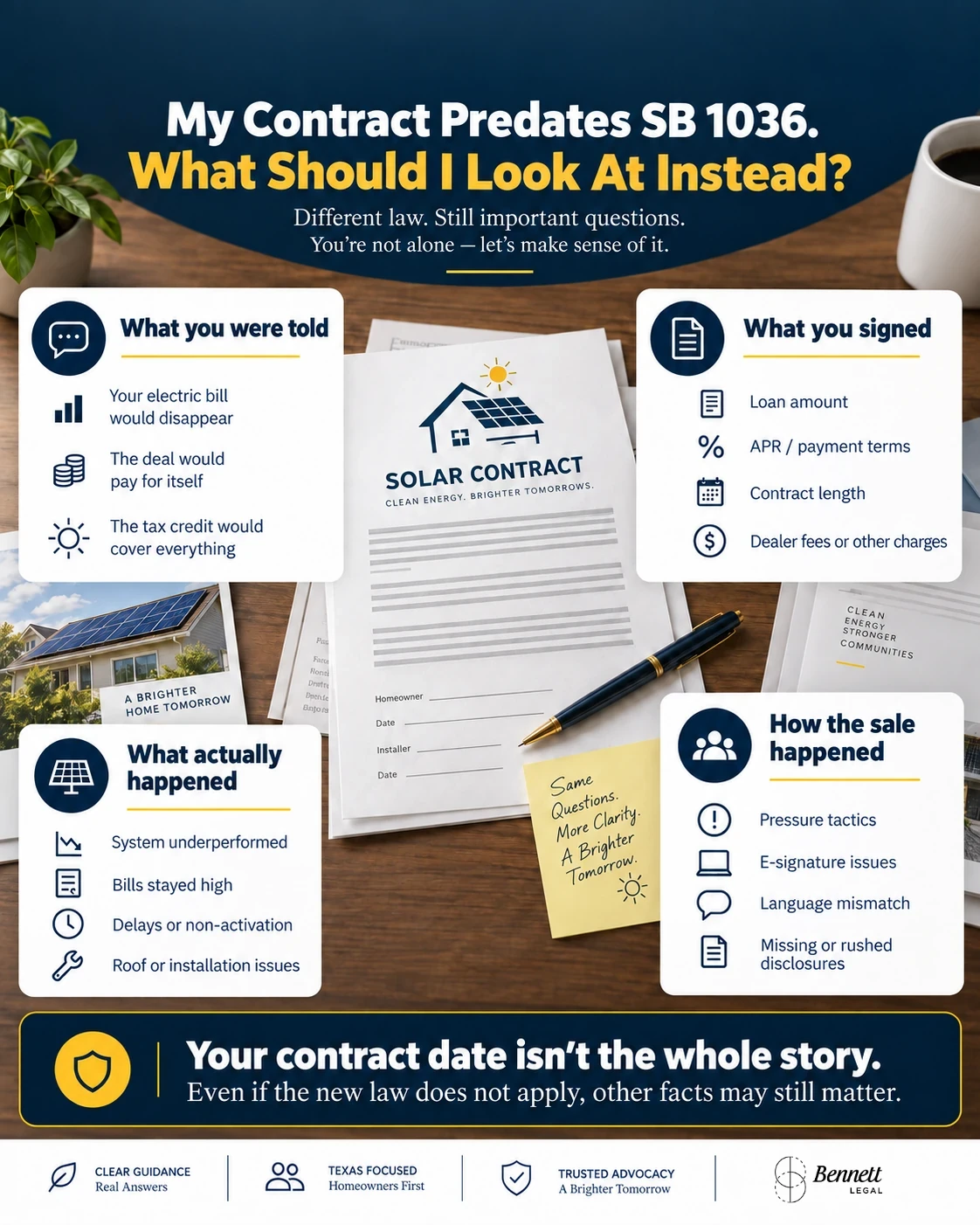 Checklist infographic: what to look for in your solar contract
Frequently Asked Questions
Does the new Texas solar law apply to my contract if I signed before September 1, 2026? No. The new registration and disclosure requirements apply to contracts and sales conducted from September 1, 2026 forward. Contracts signed before that date are governed by the law in place when you signed — but that law may still give you a claim if your contract involved fraud or misrepresentation.
Why did TDLR delay enforcement of some of the new rules? TDLR temporarily suspended enforcement of two administrative rules until November 1, 2026, giving solar retailers additional time to come into compliance with the new registration and disclosure requirements. This delay is a state enforcement decision — it doesn't affect a homeowner's ability to bring a private legal claim.
Do I need to wait until TDLR starts enforcing the new rules before I can do anything about my contract? No. Existing Texas consumer protection, contract, and fraud laws already apply to your contract, regardless of TDLR's enforcement timeline for the new rules.
If any of this sounds like your situation, the most useful next step isn't watching for more news out of Austin — it's having your contract reviewed by someone who can tell you exactly where you stand.
Schedule a free case evaluation with Bennett Legal. We'll walk through your contract with you and tell you honestly what your options look like.
Resources
- TDLR: Update on Residential Solar Retailers Program — TDLR's official notice on the enforcement delay for two administrative rules, effective through November 1, 2026
- TDLR: What's in Effect When — Residential Solar Retailers — TDLR's official timeline of the Residential Solar Retailer Regulatory Act (Texas Occupations Code Chapter 1806)
- Bennett Legal: Solar Panel Financing Fraud — how we help homeowners challenge misrepresented solar deals and UCC-1 liens
Free consultation
Solar panel contract problems?
We help homeowners fight back against solar fraud. Free case evaluation.